Solving 'Integration Fragility': Keep Jira–ServiceNow Sync Alive Through Every Platform Release
Build a Jira–ServiceNow sync that survives platform updates.
Every IT organization that connects Jira and ServiceNow knows the anxiety that precedes a major platform release. Will the integration survive the upgrade? Will tickets stop syncing silently? Will the on-call team spend a weekend patching broken field mappings? These are not hypothetical fears — they are lived realities for thousands of IT operations teams worldwide. Jira ServiceNow integration stability is not a one-time achievement; it is an ongoing engineering and operational discipline.
This article examines the root causes of integration fragility between Jira and ServiceNow, explains why platform releases are the most dangerous moment for your sync pipeline, and shows you how a purpose-built, no-code integration platform like ZigiOps can eliminate the fragility cycle for good.
What Is Integration Fragility — and Why Does It Keep Happening?
Integration fragility describes the tendency of system-to-system connections to break silently or catastrophically whenever one of the connected platforms changes. In the context of Jira and ServiceNow, fragility manifests as failed ticket syncs, mismatched field values, duplicated records, or complete data flow interruptions — all triggered by something as routine as a quarterly platform upgrade.
The problem is structural. Most Jira–ServiceNow integrations are built on assumptions: that a specific API endpoint will remain available, that a field name will not change, that an authentication scheme will persist, and that a webhook payload will keep the same schema. Every one of those assumptions can be invalidated by a single vendor release. Integration fragility is therefore not a bug in your integration — it is a design characteristic of brittle, assumption-heavy architectures.
According to Atlassian's Jira documentation, Jira releases major and minor updates on a continuous delivery cadence, meaning that cloud customers can receive breaking changes with little advance notice. ServiceNow, similarly, ships two major "Now Platform" releases per year — each capable of deprecating REST API endpoints, modifying table schemas, or altering authentication flows. When both platforms are evolving simultaneously, the probability of at least one integration-breaking change per year approaches certainty.
The Hidden Cost of Integration Downtime
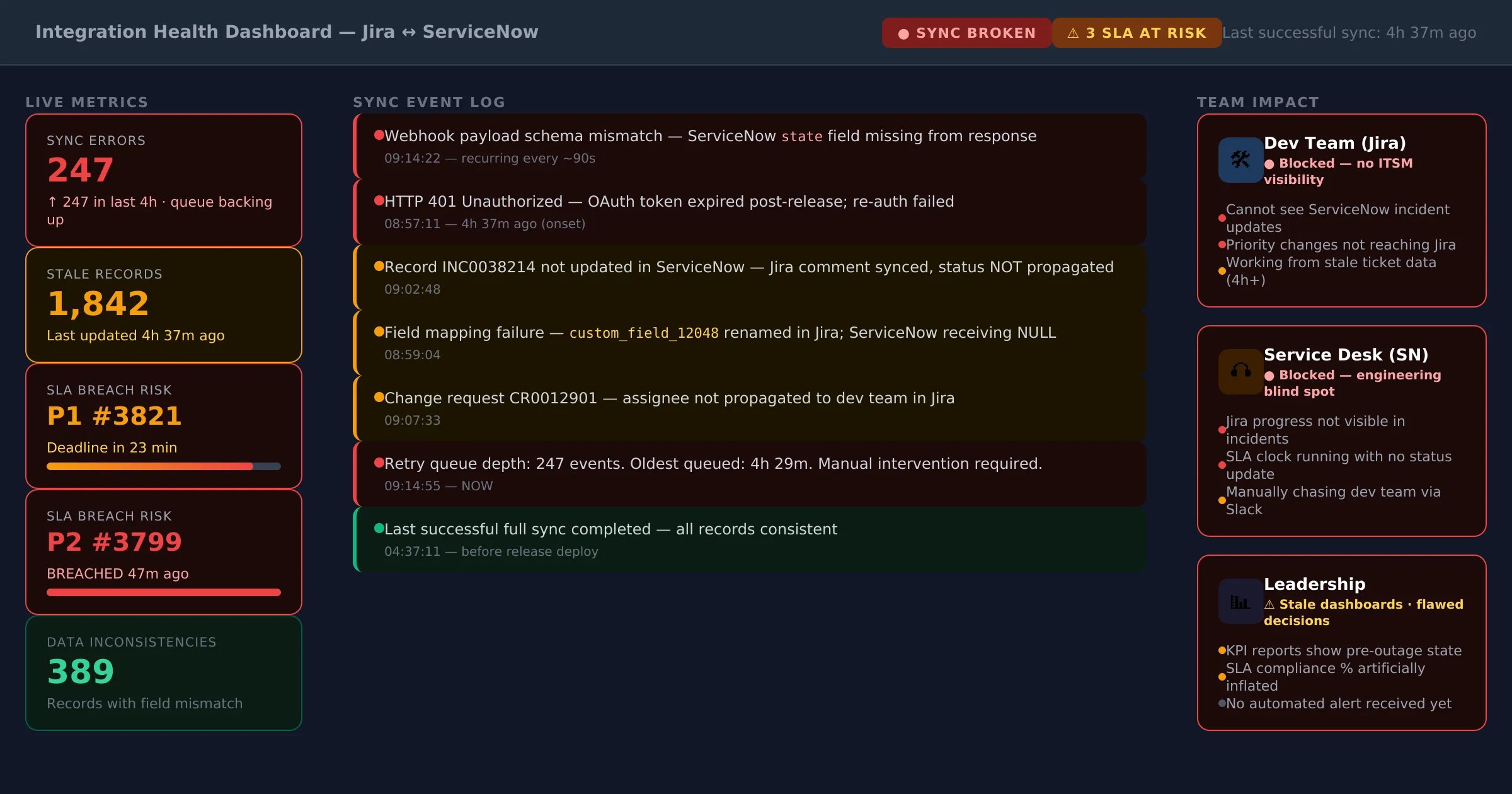
When a Jira–ServiceNow sync breaks, the damage is rarely contained to a single team. Development teams lose visibility into ITSM tickets. Service desk agents cannot track the engineering work tied to their incidents. SLA timers keep running while the data pipeline sits idle. Leadership dashboards show stale data that drives flawed decisions.
The financial and operational cost of integration fragility compounds quickly. Teams that rely on manual workarounds during outages introduce data inconsistencies that can persist for weeks. For a deeper look at how data inconsistency damages Jira–ServiceNow workflows, see ZigiWave's guide on data inconsistency in Jira–ServiceNow integrations.
The Anatomy of a Platform-Release Failure
Understanding exactly how platform releases break integrations is the first step toward building resilience. The failure modes are predictable, even if the specific trigger is not.
1. API Breaking Changes
API breaking changes are the most common cause of post-release integration failures. A breaking change occurs when a vendor modifies an API in a way that makes existing client code incompatible. This includes endpoint deprecation, parameter renaming, response schema changes, and authentication method updates.
ServiceNow's developer documentation acknowledges that REST API versioning is used to manage backward compatibility, but not all changes are versioned — and not all teams monitor the deprecation notices that accompany each Now Platform release. When an unmonitored API breaking change lands in production, integrations that were working perfectly the day before will fail silently or throw cryptic errors.
Atlassian's Jira Cloud platform similarly publishes REST API versioning guidelines, but the pace of cloud-native development means that even "non-breaking" changes — such as adding a required field or changing a default value — can disrupt downstream integrations that were not designed with forward compatibility in mind.
2. Field Schema and Workflow Changes
Beyond raw API endpoints, field-level changes are a persistent source of integration fragility. When a ServiceNow administrator renames a custom field, changes its data type, or modifies an associated workflow, every integration that references that field by name will immediately fail or produce incorrect data. The same applies to Jira: custom field IDs can change when projects are reconfigured, and workflow transition names can be modified without any system-level warning to downstream integrations.
Field mapping is one of the most delicate layers of any Jira–ServiceNow integration. Static, hardcoded mappings are especially vulnerable. For teams that need dynamic, conditional field mapping logic, ZigiWave's resource on conditional mapping for Jira and ServiceNow explains how to build mappings that adapt to field-level changes without requiring a full integration rebuild.
3. Authentication and Security Policy Changes
Both Atlassian and ServiceNow periodically update their authentication requirements. OAuth token expiry policies change. API key scopes are revised. IP allowlisting requirements are added. Each of these changes can invalidate an existing integration's credentials without triggering an obvious error — instead, the integration simply stops receiving data, and the failure is only discovered when a user notices that tickets are no longer syncing.
4. Webhook and Event Schema Drift
Many Jira–ServiceNow integrations rely on webhooks to trigger real-time data flows. When either platform changes the structure of its webhook payload — adding, removing, or renaming fields — the receiving system may fail to parse the event correctly. This type of API breaking change is particularly dangerous because it can cause partial data writes: some fields update correctly while others are silently dropped, creating data inconsistencies that are difficult to detect and expensive to remediate.
Why Traditional Integration Approaches Amplify Fragility
Custom-coded integrations and legacy middleware platforms are structurally ill-equipped to handle the pace of change that modern SaaS platforms like Jira and ServiceNow impose. Understanding why helps IT leaders make better architectural decisions.
Custom Scripts and Point-to-Point Code
Custom scripts written in Python, JavaScript, or Groovy are the most common form of Jira–ServiceNow integration in mid-market organizations. They are fast to build initially, but they accumulate technical debt with every platform release. Each API breaking change requires a developer to locate the affected code, understand the new API contract, rewrite the integration logic, test it in a staging environment, and redeploy — a process that routinely takes days or weeks.
The deeper problem is organizational: the developer who originally wrote the integration is often no longer available. Documentation is sparse. The integration becomes a black box that nobody wants to touch, which means that even minor fixes carry significant risk. This is integration fragility at its most dangerous.
Legacy iPaaS Platforms
Older integration platform-as-a-service (iPaaS) tools were designed for a world where APIs changed infrequently and enterprise software had multi-year release cycles. They often require low-level connector configuration, lack native support for ITSM-specific data models, and place the burden of API version management on the customer. When ServiceNow ships a new Now Platform release, these platforms frequently require manual connector updates that can take weeks to obtain from the vendor.
For enterprise-scale deployments, the limitations of legacy iPaaS become even more acute. ZigiWave's enterprise guide to Jira–ServiceNow integration outlines the specific requirements that large organizations must address — including multi-instance support, role-based access control, and audit logging — that legacy tools routinely fail to provide.
How ZigiOps Maintains Jira ServiceNow Integration Stability
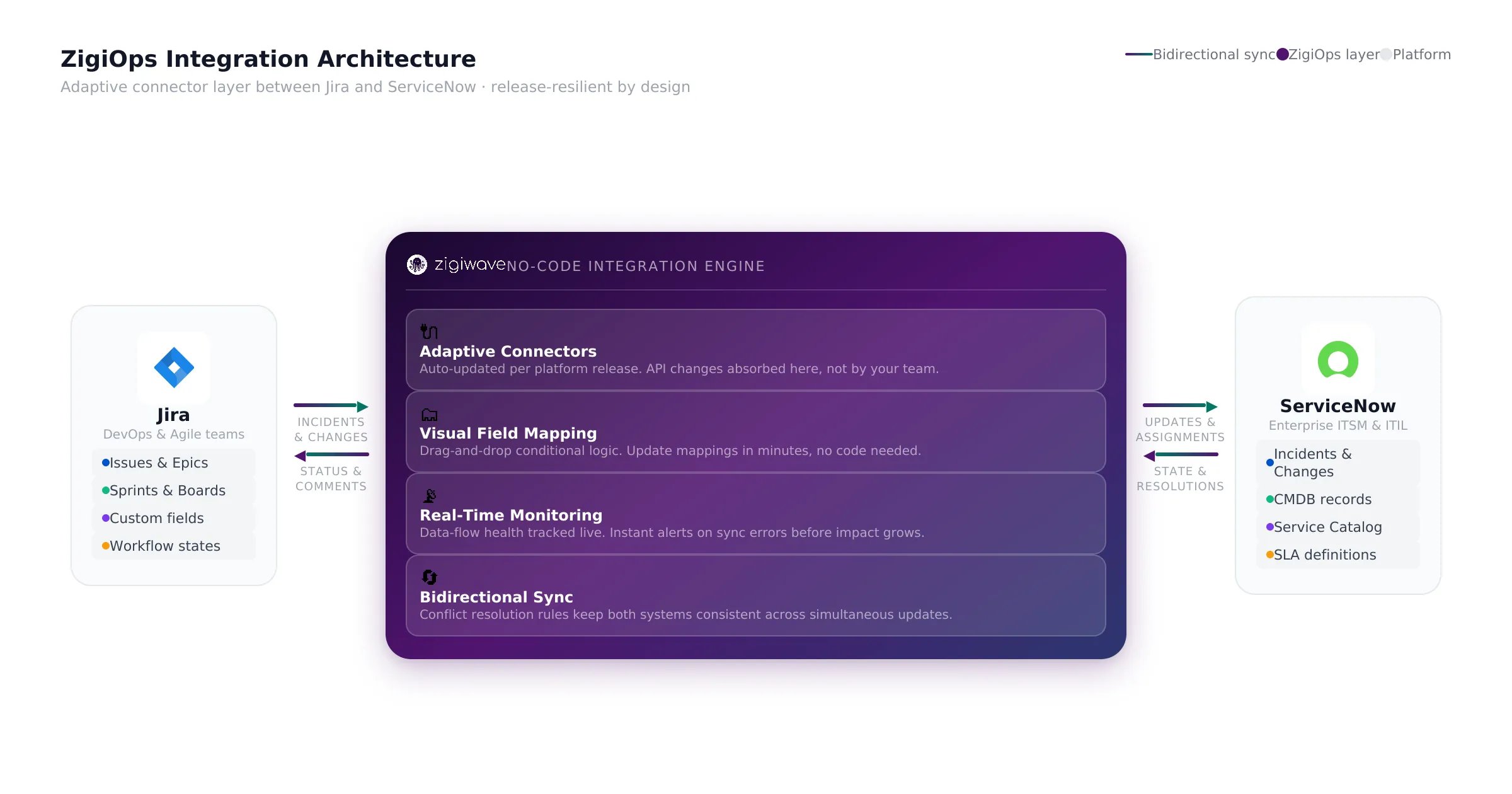
Jira ServiceNow integration stability requires an architecture that is designed from the ground up to absorb platform changes without breaking. ZigiOps, ZigiWave's no-code integration platform, is purpose-built for exactly this requirement. Its architecture addresses each of the failure modes described above through a combination of adaptive connectors, visual field mapping, and proactive monitoring.
Adaptive API Connectors That Handle Breaking Changes
ZigiOps maintains dedicated, actively managed connectors for both Jira and ServiceNow. When either platform ships a new release, ZigiWave's engineering team updates the connector to reflect the new API contract — before customers are affected. This means that API breaking changes are absorbed at the connector layer, not at the customer's integration configuration layer. IT teams do not need to rewrite mappings, update credentials, or redeploy scripts every time Atlassian or ServiceNow ships an update.
This approach is fundamentally different from custom-coded integrations, where every breaking change requires customer-side engineering effort. With ZigiOps, Jira ServiceNow integration stability is maintained by the platform vendor, not by the customer's internal team.
No-Code Visual Field Mapping with Conditional Logic
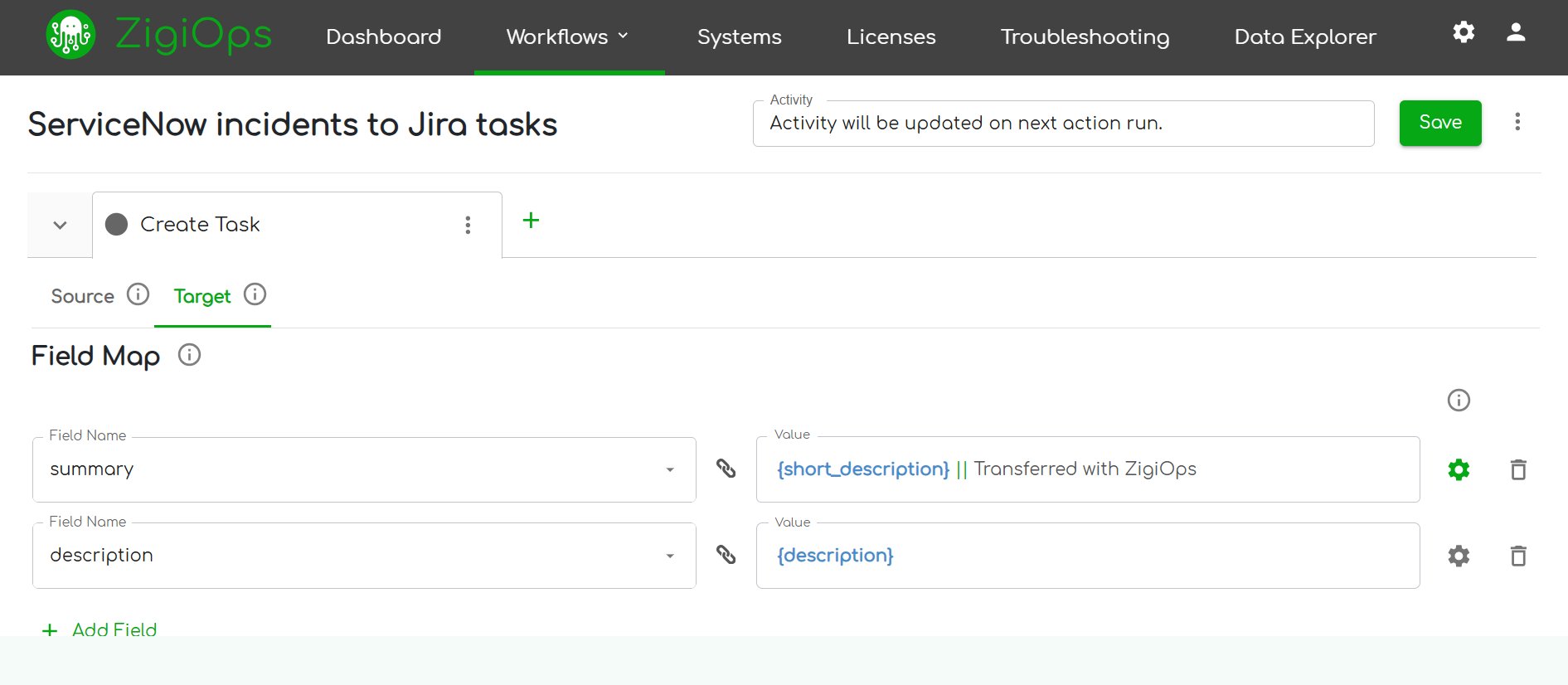
ZigiOps provides a visual, no-code interface for configuring field mappings between Jira and ServiceNow. Mappings can be updated in minutes through a drag-and-drop UI, without writing a single line of code. When a field is renamed or a new field is added in either platform, administrators can update the mapping immediately — no developer required, no deployment pipeline to manage.
Critically, ZigiOps supports conditional mapping logic, allowing teams to define rules such as "if the Jira issue type is 'Bug', map to ServiceNow incident; if the type is 'Story', map to ServiceNow change request." This flexibility ensures that Jira ServiceNow integration stability is maintained even as business processes evolve. Learn more about this capability in ZigiWave's conditional mapping resource.
Real-Time Monitoring and Alerting
Silent failures are the most insidious form of integration fragility. ZigiOps includes built-in monitoring that tracks data flow health in real time and alerts administrators when sync errors occur. Rather than discovering a broken integration days after the fact — when data inconsistencies have already propagated — teams receive immediate notification, enabling rapid remediation before business impact accumulates.
Bidirectional Sync with Conflict Resolution
True Jira ServiceNow integration stability requires more than one-way data push. ZigiOps supports fully bidirectional synchronization, with configurable conflict resolution rules that determine which system's data takes precedence when simultaneous updates occur. This eliminates the data inconsistency problems that plague simpler, unidirectional integrations — particularly after a platform release, when both systems may be processing a backlog of queued events.
Building a Release-Resilient Integration Architecture
Whether you are evaluating ZigiOps or hardening an existing integration, the following architectural principles will significantly improve your Jira ServiceNow integration stability over time.
Principle 1: Abstract the API Layer
Never let your integration logic depend directly on specific API endpoint URLs or raw field names. Use an abstraction layer — whether provided by a platform like ZigiOps or implemented as a custom adapter — that translates between your integration's internal data model and each platform's current API contract. When API breaking changes occur, only the abstraction layer needs to be updated, not the entire integration.
Principle 2: Use Schema-Driven Mapping
Store field mappings as configuration, not as code. Schema-driven mapping allows non-developers to update mappings when fields change, dramatically reducing the time-to-resolution for post-release integration issues. ZigiOps implements this principle natively through its visual mapping interface.
Principle 3: Monitor Data Flow, Not Just System Availability
Traditional monitoring checks whether a system is "up" — but an integration can be technically operational while producing incorrect or incomplete data. Implement data-flow monitoring that verifies not just that the integration is running, but that records are actually flowing and field values are correct. This is the difference between detecting an outage and detecting integration fragility before it becomes an outage.
Principle 4: Maintain a Pre-Release Testing Protocol
Both Atlassian and ServiceNow provide pre-release preview environments. Establish a protocol for testing your Jira–ServiceNow integration against preview releases before they reach production. This gives your team advance warning of API breaking changes and time to prepare remediation steps. For teams using ZigiOps, this testing is largely managed by ZigiWave's engineering team — but it remains a best practice for any integration architecture.
Principle 5: Document Your Integration Dependencies
Maintain a living document that lists every API endpoint, field name, webhook event, and authentication credential your integration depends on. Review this document against the release notes for every Jira and ServiceNow update. This simple discipline catches many breaking changes before they reach production and is the foundation of any serious Jira ServiceNow integration stability program.
Real-World Use Cases: When Stability Matters Most
The value of Jira ServiceNow integration stability is most visible in high-stakes operational scenarios. The following use cases illustrate why resilient integration architecture is not a luxury — it is a business requirement.
Incident Management and Escalation
When a P1 incident is raised in ServiceNow, the automatic creation of a linked Jira issue enables the engineering team to begin investigation immediately. If the integration breaks during a platform release — at any hour of the day — this escalation chain is severed. Engineering teams work blind, service desk agents cannot track progress, and SLA clocks run down without any coordinated response. Jira ServiceNow integration stability is, in this context, a direct contributor to incident resolution time.
Change Management and Release Coordination
Change Advisory Boards (CABs) rely on accurate, real-time data from both Jira (where development work is tracked) and ServiceNow (where change requests are managed). When the integration is fragile, CAB members are making decisions based on stale or incomplete data. A resilient, always-on integration ensures that change records reflect the actual state of development work at all times.
Cross-Team Visibility in Enterprise Environments
In large enterprises, Jira and ServiceNow are used by different organizational units — development and IT operations — that have historically operated in silos. The integration between these platforms is the primary mechanism for cross-team visibility. When it breaks, the silos re-emerge instantly. For enterprise-specific integration requirements and patterns, see ZigiWave's enterprise integration resource and the comprehensive Jira–ServiceNow integration use cases library.
Comparing Integration Approaches: Stability at Every Layer
The table below compares the most common Jira–ServiceNow integration approaches across the dimensions that matter most for long-term stability.
The contrast is stark. For organizations where Jira ServiceNow integration stability is a business-critical requirement, the no-code, actively maintained connector approach consistently outperforms alternatives across every stability dimension.
Jira ServiceNow Integration Stability: A Strategic Investment
IT leaders sometimes treat integration maintenance as a tactical, reactive activity — something to address when things break. This mindset is precisely what perpetuates integration fragility. The organizations that achieve lasting Jira ServiceNow integration stability treat it as a strategic capability, not a maintenance task.
This means selecting integration tools that are designed for longevity, not just initial deployment. It means investing in monitoring and observability so that issues are detected before they become incidents. And it means choosing vendors — like ZigiWave — who take responsibility for connector maintenance across platform releases, rather than pushing that burden back to the customer.
The ServiceNow ITSM platform and Jira are both mission-critical systems for the organizations that use them. The integration between them deserves the same level of engineering rigor and operational discipline as the platforms themselves. Treating it as a secondary concern is a risk that manifests, reliably and repeatedly, every time either vendor ships a release.
For a comprehensive overview of how ZigiOps connects Jira and ServiceNow — including setup, supported data flows, and enterprise capabilities — visit the ZigiOps Jira–ServiceNow integration page. You can also explore the full range of ZigiWave integrations to understand how the platform supports broader IT operations ecosystems.
Key Takeaways: Eliminating Integration Fragility Between Jira and ServiceNow
- Integration fragility is a structural problem, not a one-time bug — it recurs with every platform release unless the underlying architecture is changed.
- API breaking changes from Atlassian and ServiceNow are the most common trigger for post-release integration failures, but field schema changes, authentication updates, and webhook drift are equally dangerous.
- Custom scripts and legacy iPaaS tools amplify integration fragility by placing the burden of API version management on the customer's internal team.
- Jira ServiceNow integration stability requires an architecture built on adaptive connectors, schema-driven field mapping, real-time monitoring, and vendor-managed API updates.
- ZigiOps addresses all of these requirements through its no-code platform, purpose-built connectors, and proactive connector maintenance across every Jira and ServiceNow release.
- Treating Jira ServiceNow integration stability as a strategic investment — rather than a reactive maintenance task — is the defining difference between organizations that experience chronic integration outages and those that do not.
Conclusion
Integration fragility between Jira and ServiceNow is not inevitable. It is the predictable outcome of integration architectures that were not designed to absorb change. Every platform release from Atlassian or ServiceNow is a test of your integration's resilience — and the organizations that fail that test repeatedly are the ones that have not yet made the architectural shift from brittle, assumption-heavy integrations to adaptive, monitored, vendor-maintained platforms.
Jira ServiceNow integration stability is achievable. It requires the right tools, the right architecture, and the right operational discipline. ZigiOps provides the platform layer that makes this stability sustainable — across every release, every field change, and every authentication update that Atlassian and ServiceNow will inevitably ship.
Ready to eliminate integration fragility from your Jira–ServiceNow environment? Explore ZigiOps for Jira and ServiceNow and discover how no-code, always-on integration can transform your IT operations.