Jira and ServiceNow differences demand conditional mapping at scale

Enterprise Jira–ServiceNow integrations rarely fail because of API limitations or connectivity issues. They fail because Jira and ServiceNow represent work,ownership, and process control in fundamentally different ways. These differences are subtle during early testing but become critical once integrations are exposed to real workflows, governance rules, and scale.Atlassian’s Jira is optimized for execution speed and team autonomy. Teams adapt workflows frequently, rename statuses, and introduce new issue types as their work evolves.
ServiceNow is optimized for stability and control. It enforces standardized lifecycles,mandatory fields, numeric state models, and policy-driven automation across the organization.Conditional mapping is the mechanism that allows these two systems to exchange data safely. Instead of copying values directly, conditional mapping applies explicit rules that translate meaning based on context. This guide explains why conditional mapping is essential, where Jira and ServiceNow diverge, and how to design integrations that remain reliable over time.
Why Jira to ServiceNow Integrations Are Structurally Hard?
At a high level, integrating Jira and ServiceNow seems straightforward. Both platforms manage work items, support status changes, and expose modern APIs.This leads many teams to assume that integration is primarily a technical task.In reality, Jira–ServiceNow integrations sit at the intersection of DevOps andIT Service Management. These domains operate under different assumptions. Jiraencourages flexibility, experimentation, and local optimization. ServiceNowprioritizes predictability, governance, and enterprise-wide consistency.When integrations attempt to synchronize these systems without acknowledging this difference, problems inevitably emerge. Conditional mapping exists tobridge this structural gap.
The Hidden Hustles of Jira–ServiceNow Integrations
Many integrations appear successful during proof-of-concept phases. A limited set of issues synchronize correctly, and basic workflows appear intact. Oncethe integration reaches production, however, unanticipated complexity emerges.Multiple Jira projects introduce different workflows and meanings for the same statuses. ServiceNow enforces mandatory fields and automation that were notvisible during testing. Small changes—such as adding a required field orrenaming a status—suddenly cause synchronization failures.
“Data integration failures are more often caused bysemantic inconsistency than by data transport or connectivity issues.”— Gartner, IntegrationInsightsWithout conditional logic, integrations continue pushing updates even when they violate business rules. Manual intervention becomes routine, increasing costand reducing trust.
Jira and ServiceNow Do Not Share a Data Model
Although Jira and ServiceNow both manage work, they do not share a common conceptual or structural data model. Fields that appear similar in the userinterface often behave very differently internally.
| Aspect | Real-Time Integration | Batch Processing |
|---|---|---|
| Latency | Seconds or less | Minutes to hours |
| Operational Fit | ITSM, DevOps, Monitoring, Alerts | Migrations, Reporting, Backfills |
| Failure Scope | Isolated and visible quickly | Potentially large gaps if a job fails |
| Scalability | High — event-driven design scales well | Can overload systems during batch peaks |
| Team Impact | Fast collaboration and aligned updates | More manual checks, delayed visibility |
These differences are intentional design choices. Problems arise only when integrations treat Jira and ServiceNow as equivalent systems.
Fields and Entities That Do Not Match Cleanly
Several Jira entities frequently cause integration issues because they do not map cleanly to ServiceNow:
· Statuses vs States: Jira statuses are semantic labels designed for people. ServiceNow states are numeric values thatcontrol automation and SLAs.
· Priority vs Impact and Urgency: Jira priority is often subjective. ServiceNow priority is typically derived fromimpact and urgency and directly affects response commitments.
· Issue Types vs Record Types: A Jira Bug does not automatically correspond to a ServiceNow Incident.
· Assignee vs Assignment Group: Jira focuses on individuals, while ServiceNow routes work through teams and queues.
What Conditional Mapping Really Means
Conditional mapping applies explicit rules that determine if, when, and how data is synchronized. Instead of assuming one-to-one equivalence, theintegration evaluates context before acting.
| Approach | Strengths | Limitations |
|---|---|---|
| Static mapping | Simple | Breaks at scale |
| Lookup tables | Controlled translation | Context-blind |
| Scripts | Flexible | Hard to maintain |
| Conditional mapping | Context-aware | Requires proper platform |
“Workflow misalignment remains one of the leading causes of IT service management integration failure.”— Forrester Research
Status Mapping: The Highest-Risk Area
Status mapping causes more Jira–ServiceNow integration failures than any other field. In Jira, statuses communicate progress to humans. In ServiceNow, statescontrol system behavior. Treating these as equivalent leads to invalidtransitions and broken workflows.
Example Use Case: Jira “To Do” → ServiceNow State = 1
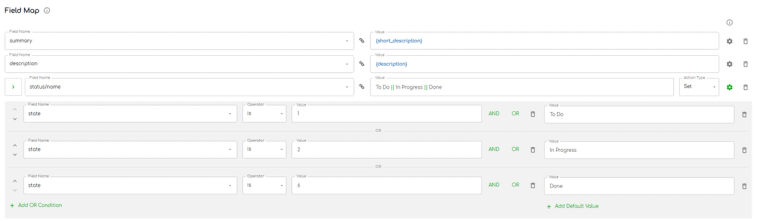
A common scenario illustrates the problem clearly. A Jira issue transitions to“To Do.” In ServiceNow, state value 1 represents a new or open record. While these values may appear equivalent, direct mapping is unsafe.A safe mapping applies conditions such as issue type, project, and record lifecycle before translating “To Do” into state 1.
Conditional Mapping Beyond Statuses
Status mapping is only the most visible challenge. Conditional mapping is equally important for priority alignment, assignment routing, mandatory fieldpopulation, filtering internal work, and preventing synchronization loops.
Why Generic iPaaS Tools Struggle
Generic iPaaS platforms optimize for breadth. They support many systems but lack deep understanding of workflow semantics. Without native conditionalmapping, teams rely on scripts that become brittle over time.
How ZigiOps Solves Conditional Mapping
ZigiOps treats conditional mapping as a first-class capability. Conditions are defined at field level, are visible and auditable, and can evolve as workflowschange. This allows a single integration to support multiple scenarios safely.
When Conditional Mapping Becomes Non-Negotiable
Conditional mapping is essential when integrations must scale, support two-way synchronization, or operate in governed environments. In thesecases, static mapping is not just insufficient—it is dangerous.
Final Takeaway
Jira–ServiceNow integrations succeed when they translate meaning instead of copying data. Conditional mapping is the layer that enablesthis translation. Without it, integrations remain fragile connectors. With it,they become durable enterprise infrastructure.
See the complete picture of this integration on our ServiceNow ↔ Jira integration page.
Frequently asked questions
What is conditional mapping in Jira–ServiceNow integrations?
Conditional mapping applies context-aware rules that determine when and how data is synchronized.
Why is status mapping so complex?
BecauseJira statuses guide people while ServiceNow states control automation.
What are the top ITIL best practices in 2025?
Incident management, change management, knowledge management, CMDB maintenance, and CSI.