Enterpise Architecture of a Jira ServiceNow Integration
Enterpise Architecture of a Jira ServiceNow Integration
In today's complex IT landscape, organizations struggle with fragmented toolchains that create data silos and operational inefficiencies. The disconnect between development teams using Jira and IT service management teams relying on ServiceNow has become a critical bottleneck for enterprise operations. A robust Jira ServiceNow integration architecture serves as the foundation for breaking down these barriers and establishing seamless workflow continuity.
Modern enterprises require more than basic point-to-point connections between their mission-critical platforms. They need architecturally sound integration frameworks that can scale, adapt, and maintain data integrity while supporting complex business processes. This comprehensive guide explores the proven architectural patterns and implementation strategies that leading organizations use to achieve successful Jira-ServiceNow integrations.
The stakes are high – poor integration architecture leads to duplicate work, missed SLAs, and decreased team productivity. However, when designed and implemented correctly, a well-architected integration becomes a strategic asset that transforms how development and IT operations teams collaborate and deliver value to the business.
Jira-ServiceNow Integration: The Strategic Imperative
Enterprise organizations face mounting pressure to accelerate digital transformation while maintaining operational excellence. The challenge lies in connecting disparate systems that were never designed to work together seamlessly. Jira excels at agile project management and issue tracking, while ServiceNow dominates IT service management and workflow automation.
The gap between these platforms creates operational friction that manifests in several ways. Development teams working in Jira often lack visibility into downstream operational impacts tracked in ServiceNow. IT service management teams struggle to correlate incidents with specific development activities or release cycles. This disconnect leads to prolonged resolution times, duplicated efforts, and poor customer experience.
"Organizations with integrated ITSM and development tools report 35% faster incident resolution times and 28% improvement in change success rates."— Gartner IT Service Management Research
A strategic Jira ServiceNow integration architecture addresses these challenges by establishing bidirectional data flow, automated workflow triggers, and unified reporting capabilities. This architectural approach enables organizations to maintain their preferred toolsets while achieving the operational cohesion necessary for modern IT delivery.
The business case for integration extends beyond operational efficiency. Organizations with mature integration architectures report improved compliance posture, better resource utilization, and enhanced ability to demonstrate business value from IT investments.
Explore how ZigiOps handles a Jira ServiceNow integration without any code.
Core Components of Enterprise Jira ServiceNow Integration
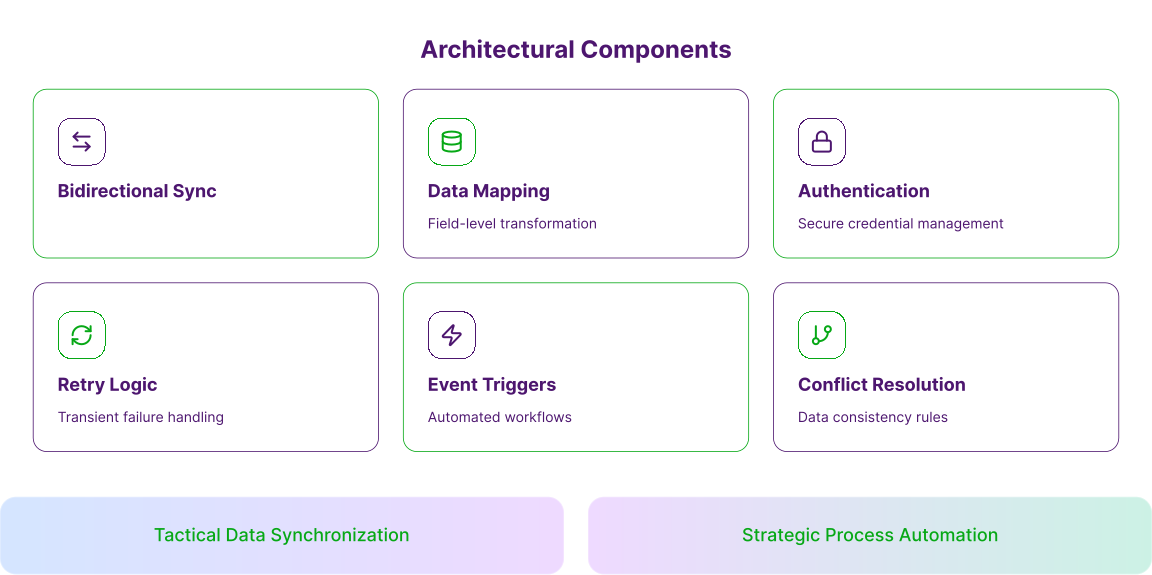
Building a robust enterprise Jira ServiceNow integration requires understanding the fundamental architectural components that enable reliable, scalable connectivity. These components work together to create a comprehensive integration framework that supports both tactical data synchronization and strategic business process automation.
Authentication and Security Layer
Security forms the foundation of any enterprise integration architecture. Both Jira and ServiceNow support multiple authentication methods, but enterprise implementations typically leverage OAuth 2.0 or API token-based authentication for service-to-service communication. This approach provides the necessary security controls while enabling automated data synchronization.
The authentication layer must account for credential rotation, access scope management, and audit trail requirements. Modern integration platforms implement credential vaulting and automated token refresh mechanisms to ensure continuous operation without manual intervention.
Network security considerations include firewall configurations, SSL certificate management, and potentially VPN or private network connectivity for organizations with strict data residency requirements. The architecture should support both cloud-to-cloud and hybrid deployment scenarios.
Data Mapping and Transformation Engine
Jira and ServiceNow utilize different data models, field structures, and workflow states. The transformation engine serves as the translation layer that maps data elements between platforms while preserving business context and maintaining referential integrity.
Effective data mapping addresses field-level transformations, value conversions, and conditional logic based on record types or business rules. For example, a Jira "Bug" issue type might map to a ServiceNow "Incident" record, while a Jira "Story" could trigger creation of a ServiceNow "Change Request" depending on organizational processes.
The transformation engine should handle complex scenarios such as multi-value field mapping, custom field synchronization, and hierarchical data relationships. This component often determines the success or failure of integration initiatives, making its design critical to overall architecture effectiveness.
Workflow Orchestration Layer
Beyond simple data synchronization, enterprise integrations require sophisticated workflow orchestration capabilities. This layer manages the business logic that determines when, how, and which data moves between platforms based on specific triggers and conditions.
Workflow orchestration handles scenarios such as incident escalation from Jira to ServiceNow when severity thresholds are met, automatic change request creation when development work impacts production systems, and bidirectional status updates that keep all stakeholders informed of progress.
Modern orchestration engines support complex routing logic, conditional processing, and error handling scenarios. They provide the flexibility to accommodate unique organizational processes while maintaining integration reliability and performance.
Architectural Patterns for Jira ServiceNow Integration Architecture
Successful enterprise integrations follow proven architectural patterns that address scalability, maintainability, and reliability requirements. Understanding these patterns helps organizations select the approach that best aligns with their technical constraints and business objectives.
Hub-and-Spoke Architecture
The hub-and-spoke pattern centralizes integration logic through a dedicated middleware platform that serves as the integration hub. Both Jira and ServiceNow connect to this central hub, which manages data transformation, routing, and workflow orchestration.
This approach offers several advantages for enterprise implementations. Changes to integration logic occur in a single location, reducing maintenance complexity. The hub can support additional integrations with minimal architectural changes, providing a foundation for broader digital transformation initiatives.
Hub-and-spoke architectures excel in environments with multiple system integrations, complex data transformation requirements, and centralized IT governance models. However, they introduce additional infrastructure complexity and potential single points of failure that must be addressed through proper design and redundancy planning.
Point-to-Point Integration
Point-to-point integration establishes direct connectivity between Jira and ServiceNow without intermediate middleware layers. This pattern utilizes native APIs and webhooks to achieve real-time data synchronization and event-driven workflow automation.
The simplicity of point-to-point integration makes it attractive for organizations with straightforward requirements and limited integration scope. Implementation timelines are typically shorter, and operational overhead is reduced compared to more complex architectural patterns.
However, point-to-point integrations can become difficult to maintain as requirements evolve. Each modification requires changes to multiple endpoints, and adding new systems to the integration landscape requires additional point-to-point connections, leading to exponential complexity growth.
Event-Driven Architecture
Event-driven patterns leverage message queues, event streams, or webhook mechanisms to enable loosely coupled integration between Jira and ServiceNow. This approach provides excellent scalability and resilience characteristics while supporting real-time data synchronization.
Event-driven architectures excel in high-volume environments where system availability and performance are critical. They provide natural decoupling between systems, allowing each platform to operate independently while maintaining data consistency through eventual consistency models.
The complexity of event-driven architectures requires significant technical expertise and operational maturity. Organizations must implement proper event ordering, duplicate detection, and error handling mechanisms to ensure reliable integration operation.
Implementation Strategies for Enterprise Jira ServiceNow Integration
Moving from architectural design to practical implementation requires careful planning, phased execution, and continuous optimization. Successful implementations balance technical requirements with business objectives while minimizing disruption to ongoing operations.
Assessment and Planning Phase
Every successful enterprise Jira ServiceNow integration begins with comprehensive assessment of existing processes, data structures, and technical infrastructure. This phase identifies integration touchpoints, data quality issues, and potential roadblocks that could impact implementation success.
Stakeholder alignment during the planning phase proves critical to long-term success. Development teams, IT operations staff, and business process owners must collaborate to define integration requirements, success criteria, and governance models that will guide the implementation process.
Technical assessment includes API capability analysis, data volume projections, and infrastructure capacity planning. Understanding the current state provides the foundation for designing an integration architecture that can meet both immediate needs and future growth requirements.
"Successful enterprise integrations require 3-6 months of planning and stakeholder alignment before technical implementation begins."— Forrester Application Integration Report
Proof of Concept Development
Before committing to full-scale implementation, organizations benefit from developing proof of concept integrations that validate architectural decisions and identify potential challenges. POC development focuses on core integration scenarios while providing stakeholders with tangible evidence of integration value.
Effective POCs demonstrate end-to-end data flow, basic transformation capabilities, and key workflow automations. They provide opportunities to test authentication mechanisms, validate data mapping logic, and assess performance characteristics under controlled conditions.
The POC phase also serves as a training opportunity for technical teams who will support the production integration. Hands-on experience with APIs, data structures, and integration tools builds the expertise necessary for successful deployment and ongoing maintenance.
Phased Production Rollout
Production implementation should follow a phased approach that gradually expands integration scope while maintaining system stability and user confidence. Initial phases typically focus on read-only data synchronization before progressing to bidirectional updates and complex workflow automation.
Phased rollouts enable organizations to validate integration performance, refine data mapping rules, and address unexpected edge cases without impacting critical business processes. Each phase provides learning opportunities that inform subsequent implementation stages.
Change management becomes crucial during production rollout as users adapt to new workflows and automated processes. Training programs, communication plans, and feedback mechanisms help ensure smooth adoption and identify areas for optimization.
Leveraging No-Code Platforms for Jira ServiceNow Integration
Traditional integration development requires extensive custom coding, lengthy development cycles, and specialized technical expertise. No-code Jira ServiceNow integration platforms offer an alternative approach that accelerates implementation while reducing technical complexity and ongoing maintenance requirements.
Advantages of No-Code Integration Platforms
No-code platforms democratize integration development by providing visual interfaces, pre-built connectors, and drag-and-drop workflow designers. This approach enables business analysts and citizen developers to participate directly in integration development, reducing reliance on scarce technical resources.
Implementation timelines compress significantly when using no-code platforms. Pre-built templates and connector libraries eliminate the need to develop custom API integrations from scratch. Organizations can achieve production-ready integrations in weeks rather than months.
Maintenance and modification of no-code integrations typically require less specialized expertise compared to custom-coded solutions. Visual workflow designers make integration logic transparent and accessible to non-technical stakeholders, improving long-term sustainability.
A comprehensive Jira integration with ServiceNow solution demonstrates how modern no-code platforms can achieve enterprise-grade integration capabilities without extensive custom development.
Enterprise-Grade No-Code Capabilities
Modern no-code Jira ServiceNow integration platforms provide sophisticated capabilities that rival custom-developed solutions. Advanced data transformation engines support complex mapping scenarios, conditional logic, and multi-step workflows that address enterprise requirements.
Security and compliance features include encrypted data transmission, audit logging, and role-based access controls that meet enterprise governance standards. Integration platforms designed for enterprise use provide the reliability, scalability, and security controls that IT organizations require.
Monitoring and observability capabilities offer real-time visibility into integration performance, error rates, and data flow metrics. These features enable proactive issue identification and resolution, maintaining integration reliability without extensive operational overhead.
"No-code integration platforms reduce development time by 70% while maintaining enterprise security and compliance requirements."
— ServiceNow Integration Hub Documentation
Data Synchronization Patterns and Best Practices
Effective data synchronization forms the backbone of any successful Jira ServiceNow integration architecture. The approach to data synchronization significantly impacts integration performance, reliability, and user experience. Understanding proven patterns and best practices helps organizations avoid common pitfalls while achieving optimal results.
Real-Time vs. Batch Synchronization
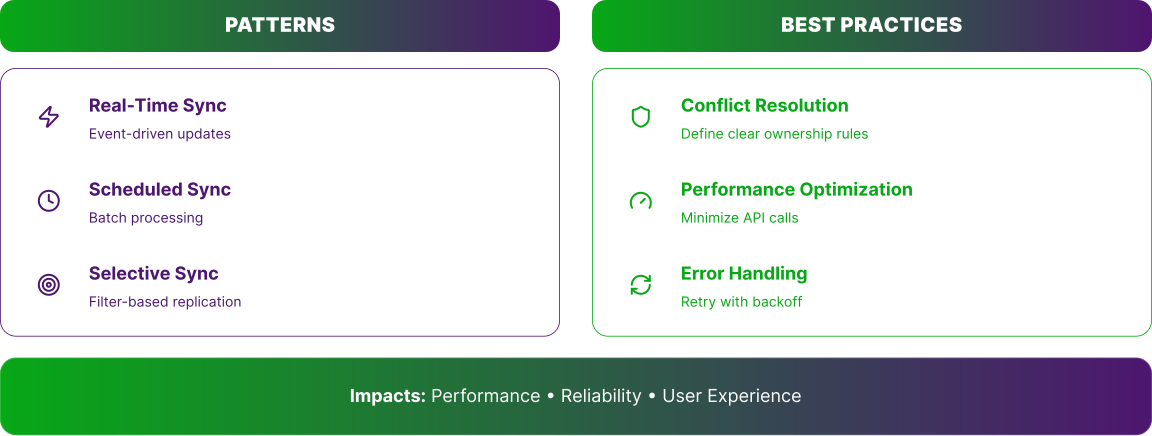
Real-time synchronization provides immediate data consistency between platforms, enabling responsive workflows and timely notifications. This approach works well for high-priority incidents, urgent change requests, and scenarios where immediate visibility is crucial for business operations.
However, real-time synchronization can strain system resources and may not be necessary for all data types. Batch synchronization offers better performance characteristics for bulk data updates, historical record synchronization, and scenarios where slight delays are acceptable.
Optimal integration architectures typically implement hybrid approaches that use real-time synchronization for critical data elements while leveraging batch processing for less time-sensitive information. This balance optimizes both performance and user experience.
Bidirectional Data Flow Management
Bidirectional synchronization enables updates in either system to propagate to the connected platform, maintaining data consistency regardless of where changes originate. This capability proves essential for collaborative workflows where multiple teams interact with the same information.
Implementing bidirectional synchronization requires careful consideration of data ownership, conflict resolution, and infinite loop prevention. Master data management principles help establish clear ownership boundaries and update precedence rules.
Conflict resolution mechanisms handle scenarios where the same record is modified simultaneously in both systems. Effective strategies include last-writer-wins, priority-based resolution, and manual intervention for complex conflicts that require human judgment.
Data Quality and Validation Controls
Integration quality depends heavily on the data being synchronized between platforms. Implementing validation controls at integration boundaries prevents poor-quality data from propagating across systems and causing downstream issues.
Validation rules should verify data completeness, format compliance, and business rule adherence before allowing record synchronization. These controls catch issues early in the integration process, preventing data corruption and maintaining system integrity.
Data cleansing capabilities within the integration layer can automatically correct common formatting issues, standardize field values, and enrich records with additional context from authoritative sources.
Monitoring and Observability in Jira ServiceNow Integration Architecture
Production integration environments require comprehensive monitoring and observability capabilities to ensure reliable operation and rapid issue resolution. These capabilities provide visibility into integration health, performance characteristics, and business impact metrics.
Technical Performance Monitoring
Technical monitoring encompasses system-level metrics such as API response times, error rates, and data throughput volumes. These metrics provide early warning indicators of potential issues before they impact end-user experience or business processes.
Performance baselines established during initial implementation serve as reference points for ongoing monitoring. Significant deviations from baseline performance may indicate system capacity issues, configuration problems, or external factors affecting integration operation.
Automated alerting mechanisms notify technical teams when performance metrics exceed predefined thresholds. Alert escalation procedures ensure appropriate response times for different severity levels, maintaining integration availability and performance standards.
Business Process Visibility
Beyond technical metrics, monitoring capabilities should provide visibility into business process execution and outcomes. This includes tracking workflow completion rates, SLA adherence, and process cycle times across integrated platforms.
Business metrics help demonstrate integration value to organizational stakeholders while identifying optimization opportunities. For example, tracking incident resolution times before and after integration implementation quantifies operational improvements.
Dashboard and reporting capabilities provide different views for various stakeholder groups. Technical teams require detailed system metrics, while business users benefit from process-oriented dashboards that show workflow status and performance trends.
Real-world implementation success stories, such as those detailed in this ServiceNow Jira case study, demonstrate how comprehensive monitoring and observability contribute to sustainable integration success.
Security and Compliance Considerations
Enterprise Jira ServiceNow integration architecture must address stringent security and compliance requirements while maintaining operational efficiency. Security controls should be embedded throughout the integration architecture rather than treated as an afterthought.
Data Protection and Privacy
Data protection requirements vary by industry, geographic location, and organizational policies. Integration architectures must implement appropriate controls for data encryption, access logging, and retention management to ensure compliance with applicable regulations.
Encryption should cover data both in transit and at rest, utilizing industry-standard algorithms and key management practices. Integration platforms should support configurable encryption policies that align with organizational security standards.
Privacy controls include data minimization principles that limit synchronization to necessary information only. Field-level security controls can prevent sensitive data from being synchronized to systems where it is not required for business purposes.
"Organizations report that 78% of integration security incidents result from inadequate access controls and authentication mechanisms."
— Gartner Integration Security Research
Access Control and Authentication
Robust access control mechanisms ensure that integration processes operate with appropriate privileges while maintaining audit trails for compliance purposes. Service accounts used for integration should follow least-privilege principles with access limited to necessary functions only.
Multi-factor authentication, where supported, adds additional security layers for service accounts and administrative access. Regular credential rotation policies reduce the risk of compromised authentication credentials affecting integration security.
Integration platforms should provide comprehensive audit logging that tracks data access, modification, and deletion events across integrated systems. These logs support compliance reporting and security incident investigation requirements.
Implementation Best Practices and Success Factors
Successful enterprise Jira ServiceNow integration implementations follow established best practices that address common challenges and maximize the probability of project success. These practices encompass technical, organizational, and process considerations.
Stakeholder Engagement and Change Management
Integration projects affect multiple organizational stakeholders with different priorities and concerns. Early and ongoing engagement helps build consensus around integration objectives while identifying potential resistance or adoption challenges.
Change management programs should address workflow modifications, new responsibilities, and skill development requirements that result from integration implementation. Training programs help users adapt to automated processes and new collaboration patterns.
Executive sponsorship provides the organizational authority necessary to resolve conflicts, allocate resources, and drive adoption across departmental boundaries. Regular communication of integration benefits and progress maintains stakeholder support throughout the implementation process.
Iterative Development and Continuous Improvement
Integration requirements evolve as organizations learn from initial implementation experiences and business needs change over time. Architectures that support iterative enhancement and continuous improvement provide better long-term value than rigid, monolithic implementations.
Feedback mechanisms capture user experiences, identify optimization opportunities, and guide future enhancement priorities. Regular review cycles ensure that integration capabilities continue to align with organizational objectives and technical constraints.
Version control and deployment automation enable rapid iteration while maintaining integration stability. These capabilities support experimentation with new features and workflows without risking production system reliability.
Documentation and Knowledge Management
Comprehensive documentation ensures that integration knowledge is preserved and accessible to current and future team members. Documentation should cover architectural decisions, configuration details, troubleshooting procedures, and business process impacts.
Knowledge transfer activities help build organizational capability around integration technologies and processes. Cross-training programs reduce dependency on individual team members while improving overall integration sustainability.
Integration platforms that provide self-documenting capabilities, such as visual workflow designers and configuration exports, reduce documentation maintenance overhead while improving accuracy and completeness.
Measuring Integration Success and ROI
Demonstrating the business value of Jira ServiceNow integration architecture requires establishing clear metrics and measurement frameworks that align with organizational objectives. These measurements justify initial investment while guiding ongoing optimization efforts.
Operational Efficiency Metrics
Operational efficiency improvements often represent the most immediate and measurable benefits of integration implementation. Key metrics include reduced manual data entry, faster incident resolution times, and improved change success rates.
Process cycle time measurements compare pre and post-integration performance for critical workflows such as incident management, change approval, and problem resolution. These metrics provide concrete evidence of operational improvements.
Resource utilization metrics track how integration automation affects staff productivity and capacity. Organizations typically report significant time savings that can be redirected to higher-value activities such as process improvement and strategic initiatives.
Quality and Compliance Improvements
Integration implementation often leads to improved data quality, reduced errors, and better compliance with organizational processes. These qualitative improvements may be harder to quantify but provide significant long-term value.
Error reduction metrics track decreases in duplicate work, data entry mistakes, and process deviations that result from automated synchronization and workflow enforcement. These improvements contribute to better customer experience and reduced operational risk.
Compliance metrics measure adherence to organizational processes, regulatory requirements, and industry standards. Integration can improve compliance by enforcing mandatory workflow steps and maintaining comprehensive audit trails.
"Organizations with mature integration architectures report 40% improvement in process compliance and 25% reduction in operational errors."
— TechTarget ITSM Research
Strategic Business Impact
Beyond operational metrics, successful integrations contribute to strategic business objectives such as improved customer satisfaction, faster time-to-market, and enhanced competitive positioning. These strategic impacts may take longer to materialize but provide the greatest long-term value.
Customer satisfaction improvements result from faster issue resolution, better communication, and more reliable service delivery enabled by integrated processes. Customer-facing metrics such as Net Promoter Score and satisfaction ratings provide evidence of these improvements.
Competitive advantage metrics assess how integration capabilities enable new service offerings, improved operational agility, and better resource allocation compared to organizations with fragmented toolchains.
Future-Proofing Your Integration Architecture
Technology landscapes evolve continuously, making architectural flexibility and adaptability crucial for long-term integration success. Future-proofing strategies ensure that current investments remain valuable as organizational needs and technology capabilities advance.
Scalability and Performance Planning
Integration architectures should accommodate projected growth in data volumes, user populations, and transaction frequencies without requiring fundamental redesign. Scalability planning considers both horizontal scaling through additional resources and vertical scaling through performance optimization.
Performance testing during implementation establishes baseline capabilities and identifies potential bottlenecks before they impact production operations. Load testing simulates peak usage scenarios to validate architectural capacity assumptions.
Cloud-native architectures often provide better scalability characteristics than traditional on-premises deployments. No-code Jira ServiceNow integration platforms that leverage cloud infrastructure can automatically scale to meet demand without manual intervention.
Technology Evolution Adaptation
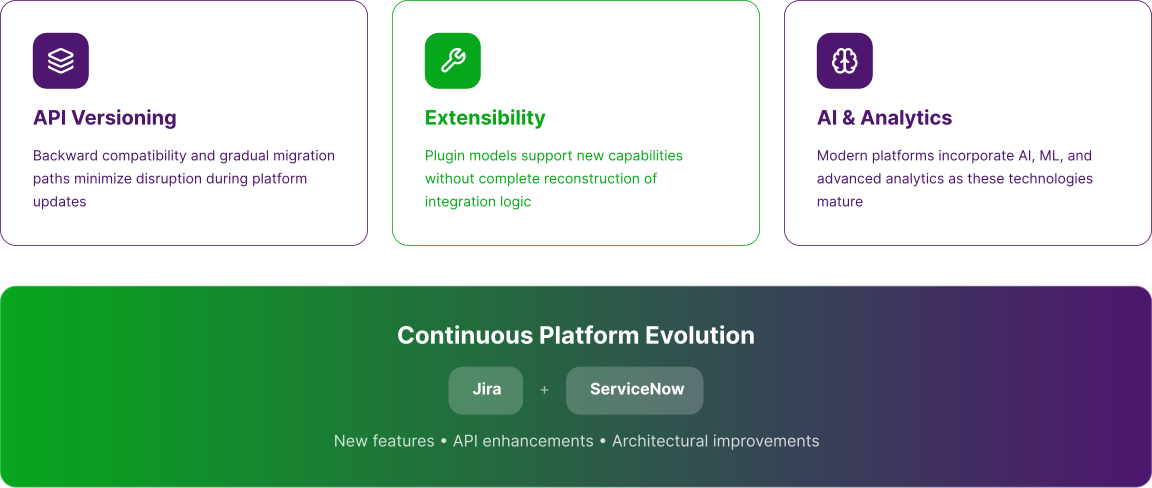
Both Jira and ServiceNow continue evolving with new features, API enhancements, and architectural improvements. Integration architectures should accommodate these changes without requiring complete reconstruction of integration logic.
API versioning strategies ensure that integration capabilities remain functional as platform APIs evolve. Modern integration platforms provide backward compatibility and gradual migration paths that minimize disruption during platform updates.
Emerging technologies such as artificial intelligence, machine learning, and advanced analytics create new opportunities for integration enhancement. Architectures that support extensibility and plugin models can incorporate these capabilities as they mature.
Organizations looking to implement comprehensive integration solutions can explore proven platforms through resources such as enterprise integration capabilities that support current needs while providing flexibility for future enhancements.
Conclusion
Successfully implementing a robust Jira ServiceNow integration architecture requires careful planning, proven architectural patterns, and ongoing optimization based on organizational learning and evolving requirements. The investment in well-designed integration pays dividends through improved operational efficiency, better collaboration between teams, and enhanced ability to deliver value to customers.
Modern no-code integration platforms have democratized enterprise integration development, making sophisticated capabilities accessible to organizations without extensive custom development resources. These platforms provide the reliability, security, and scalability characteristics that enterprise environments require while significantly reducing implementation complexity and time-to-value.
The key to integration success lies not just in the technology choices, but in the organizational commitment to change management, stakeholder engagement, and continuous improvement. Organizations that treat integration as a strategic capability rather than a tactical necessity achieve better outcomes and greater long-term value from their technology investments.
As digital transformation continues accelerating across industries, the ability to seamlessly connect disparate systems becomes a competitive differentiator. Organizations that master integration architecture principles position themselves to adapt quickly to changing business requirements and capitalize on new opportunities in an increasingly connected business environment.