Building vs. Buying a Jira Integration: What Atlassian's Docs Don't Tell You
The real cost of DIY Jira integrations, and the no-code alternative.
A Jira integration connects Jira to another system, like ServiceNow, so issues and incidents sync automatically instead of being copied by hand. You can build one yourself against the Jira REST API, or buy a pre-built, no-code platform that manages the connection for you. The choice rarely comes down to whether the API works. It comes down to who owns the mapping, the maintenance, and the 2 a.m. break-fix call when a field changes.
Why Are Teams Still Debating Build vs. Buy for Jira Integrations?
Every team that connects Jira to ServiceNow, an ITOM tool, or a CRM eventually asks the same question: do we build this ourselves, or buy a platform that already does it? Manual ticket copying wastes hours every week, and the REST APIs on both sides look simple enough to justify a quick internal build. The problem is that "simple enough to start" and "cheap enough to maintain" are two different claims, and Atlassian's docs, understandably, only address the first one.
If you landed here after reading Atlassian's developer documentation on integrating Jira issues with your application, you already know the REST endpoints exist, authentication is well documented, and the sample requests look manageable. That documentation is genuinely good. This guide aims to extend it, as it says nothing about what happens after the first deploy, when a status name changes, a webhook silently stops firing, or someone in Finance asks what this is costing per year.
What Does Building a Custom Jira Integration Actually Require?
Reading the API reference makes the build path look like four steps: authenticate, call an endpoint, parse the response, done. In production, a real Jira-to-ServiceNow (or Jira-to-anything) integration needs all of the following:
- Authentication and token lifecycle management, including OAuth 2.0 refresh handling so the integration doesn't silently die when a token expires.
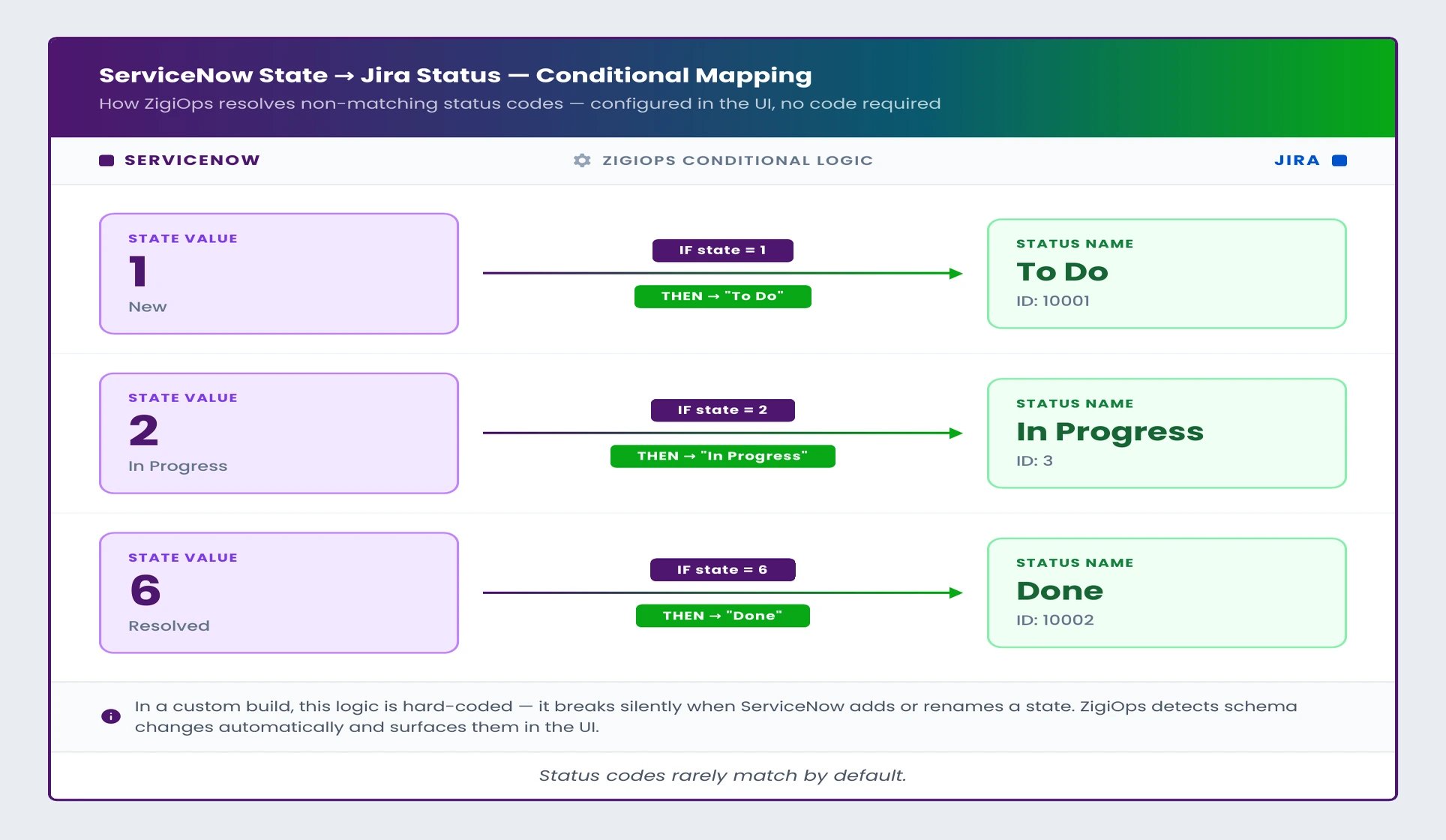
- Semantic field mapping, not just field-to-field copying. Jira's status names (To Do, In Progress, Done) and ServiceNow's numeric state values (1, 2, 6) don't correspond one to one, and getting this wrong doesn't throw an error. It just quietly produces wrong data.
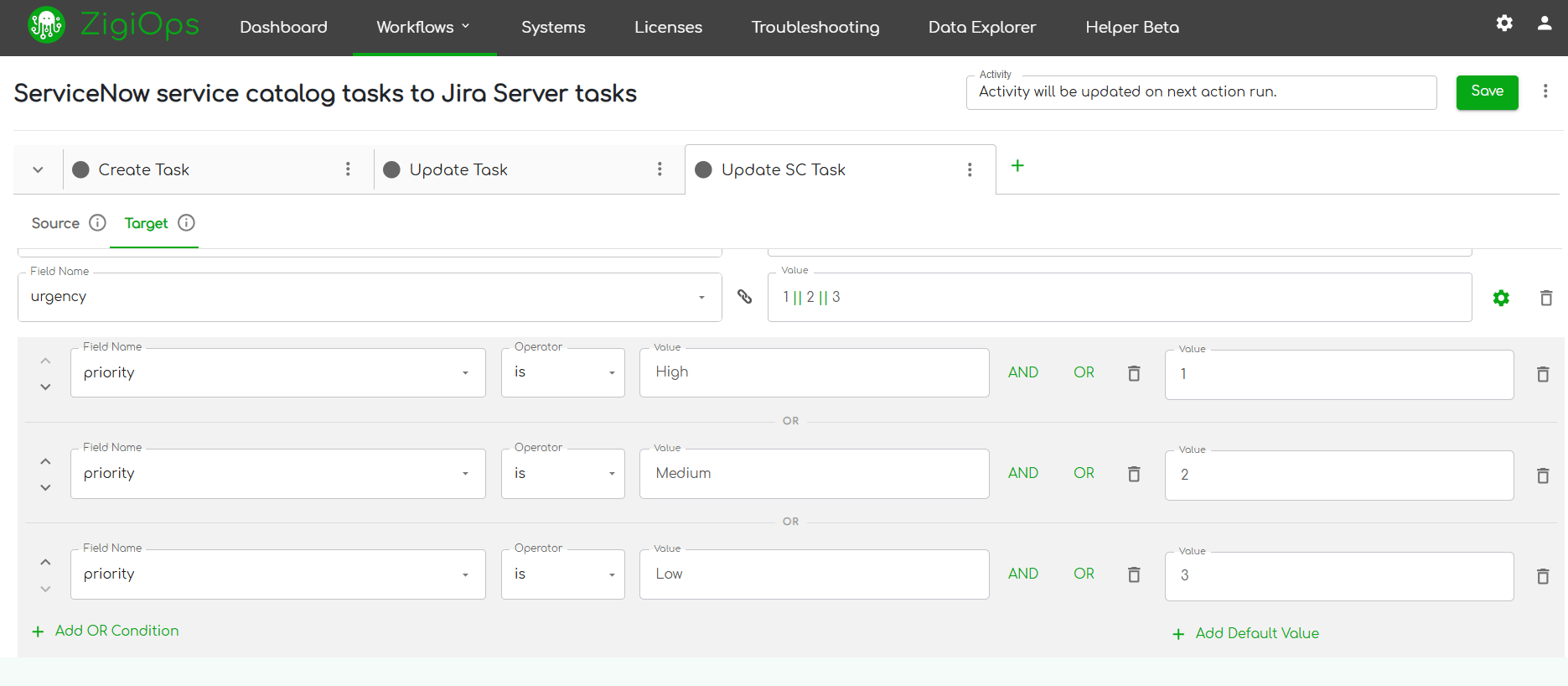
- Conditional logic for priority translation, since ServiceNow calculates priority from impact and urgency while Jira treats it as a flat field.
- Error handling and retries for rate limits, timeouts, and partial failures.
- Monitoring and alerting so someone finds out an integration is broken before a customer does.
- Ongoing maintenance every time either vendor renames a field, changes a workflow, or ships a breaking API update, which Jira did in 2026 with its issue-to-work-item terminology shift.
How Much Does a Custom Jira Integration Really Cost to Build and Maintain?
Industry cost benchmarks give a more complete picture than "the API is free." A moderately complex custom integration, covering authentication, data transformation, error handling, and testing, typically runs tens of thousands of dollars once engineering and support time are combined, and that figure excludes what happens after launch. Ongoing upkeep alone is commonly estimated at roughly 15 to 25 percent of the original build cost every year, and unplanned maintenance tends to arrive as urgent, schedule-disrupting incidents rather than predictable sprint work.
Meanwhile, the market has already voted on which model is scaling faster. Integration Platform as a Service (iPaaS) revenue, the category ZigiOps competes in, exceeded $9 billion in 2024 and is forecast by Gartner to surpass $17 billion by 2028, driven largely by demand for no-code and low-code connectivity that doesn't tie up engineering headcount.
How Does ZigiOps Solve the Jira Integration Build vs. Buy Problem?
ZigiOps was built for exactly the gap between "the API works" and "the integration is production-ready." It connects Jira, ServiceNow, and more than 30 other ITSM, DevOps, monitoring, and CRM tools through a guided, no-code UI, so the mapping logic that normally lives in a developer's head lives in a configuration screen instead. A few specifics that matter for teams evaluating build vs. buy:
- 100% code-free setup. Integrations are configured through the UI, not scripted, so they aren't dependent on one engineer's availability.
- No data storage. ZigiOps processes data in transit and doesn't retain it, which simplifies the compliance conversation considerably compared with a custom pipeline.
- ISO 27001 certified. Enterprise-grade security is built in rather than bolted on after a security review flags gaps.
- Unlimited transactions. No per-record throttling or surprise overage costs as data volume grows.
- Standalone application. It runs independently rather than as a plugin wedged into Jira or ServiceNow, avoiding the fragility of plugin-based integrations breaking on every platform update.
- Schema-aware, conditional mapping that respects Jira's transition rules and ServiceNow's state machine, so a status sync actually reflects the right lifecycle stage instead of just moving a number across.
For a deeper look at how that mapping logic works in practice, see ZigiWave's guide to field mapping in integrations.
What Happens When Nobody Maintains a Custom Jira Integration?
Picture a mid-sized enterprise where DevOps lives in Jira and the Service Desk runs on ServiceNow. An engineer spends a sprint building a REST integration: incidents create Jira issues, comments sync back, and it works in the demo. Three months later, ServiceNow adds a custom field for a new compliance requirement, and the integration doesn't know it exists. Tickets start missing data. Nobody notices until an auditor asks a question the sync can't answer. The fix requires someone to re-open code nobody has touched since launch.
With a schema-aware platform, that same field change is detected automatically, and the mapping is updated in the UI rather than in a code review. That's the practical difference between an integration that was built once and an integration that keeps working.
Can a No-Code Platform Really Replace a Custom Jira Integration?
Can I integrate Jira with ServiceNow using only Atlassian's REST API documentation?
Yes, technically. Atlassian's docs give you everything needed to authenticate and call Jira's endpoints. What they don't cover is field mapping logic, error handling, monitoring, or what happens when either system's schema changes — all of which fall on your team to build and maintain.
Does building a custom integration always cost less than buying a platform?
Not once maintenance is counted. Initial development for a moderately complex integration often runs into the tens of thousands of dollars in engineering time, and annual upkeep typically adds another 15 to 25 percent of that cost, before factoring in the cost of an outage.
Is a no-code integration platform less secure than a custom-built one?
Not inherently, and often the opposite. ZigiOps is ISO 27001 certified and doesn't store transferred data — security guarantees a custom build has to design, implement, and audit from scratch.
Can ZigiOps handle the same field mapping complexity as a custom Jira integration?
Yes. ZigiOps supports conditional and schema-aware field mapping, including status translation, priority logic, and custom fields, configured through the UI without writing code.
What happens if Jira or ServiceNow changes a field or workflow after the integration is live?
With a custom build, someone has to notice, diagnose, and patch it. ZigiOps is schema-aware and flags new or changed fields automatically, so mapping updates happen in the interface rather than in a code deployment.
What's the One Question That Exposes the Hidden Cost of a DIY Jira Integration?
Before greenlighting a custom Jira integration, ask who owns it after the developer who built it moves teams or leaves. That single question surfaces most of the hidden cost that Atlassian's docs, fairly, never had to address.
Curious How Real-Time Sync Compares to Polling-Based Jira Integrations?
This piece focuses on cost and ownership. For the technical side of the same decision, see ZigiWave's notes on ZigiOps security architecture.
Ready to See a No-Code Jira Integration Set Up in Minutes?
If your team is weighing a custom Jira build against a ready-made platform, see the no-code approach in action before committing engineering time to either path. Book a Demo with ZigiWave and bring your specific Jira and ServiceNow use case to the call.