ServiceNow Integrations: 2026 Architecture & Implementation Guide
ServiceNow integrations drive automation, orchestration, and growth
ServiceNow integrations have evolved from simple data exchanges to sophisticated orchestration platforms that power digital transformation across enterprises. As organizations navigate increasingly complex IT landscapes in 2026, the ability to seamlessly connect ServiceNow with diverse systems has become a critical differentiator for operational excellence.
The modern enterprise ecosystem demands robust integration strategies that can adapt to hybrid cloud environments, legacy system constraints, and emerging technologies. ServiceNow's platform continues to expand its integration capabilities, offering IT leaders unprecedented opportunities to streamline operations, enhance service delivery, and drive business value through connected workflows.
This comprehensive guide explores the current state of ServiceNow integrations, architectural best practices, real-world use cases, and strategic implementation approaches that enterprise IT leaders need to master in 2026. Whether you're planning your first integration project or optimizing existing connections, understanding these fundamentals will accelerate your organization's digital transformation journey.
Understanding ServiceNow Integration Architecture in 2026
The ServiceNow integration platform has matured significantly, offering multiple architectural patterns to meet diverse enterprise requirements. Modern ServiceNow integrations leverage cloud-native technologies, API-first design principles, and intelligent automation to create resilient, scalable connections between systems.
At its core, ServiceNow's integration architecture centers around three fundamental components: Integration Hub, REST/SOAP APIs, and custom integration solutions. The Integration Hub serves as the central orchestration layer, providing pre-built connectors for popular enterprise applications while maintaining security and governance standards.
The platform's API-first approach enables organizations to expose ServiceNow capabilities to external systems while consuming data and services from third-party applications. This bidirectional connectivity ensures that ServiceNow can function as both a service provider and consumer within complex enterprise architectures.
Core Integration Components
ServiceNow's integration ecosystem consists of several key technological components that work together to enable seamless data flow and process automation. Understanding these components is essential for designing effective integration strategies.
- Integration Hub: Centralized platform for managing connectors, workflows, and data transformations with built-in monitoring and error handling capabilities
- REST API: Primary interface for real-time data exchange, supporting JSON payloads and OAuth authentication mechanisms
- SOAP Web Services: Legacy integration support for systems requiring XML-based communication protocols
- ServiceNow Store Spokes: Pre-certified integration packages for popular enterprise applications including Slack, Microsoft Teams, and AWS
- Custom Flow Designer: Visual workflow builder for creating complex integration logic without extensive coding requirements
- MID Server: On-premises component enabling secure communication between ServiceNow cloud instances and internal enterprise system
.svg)
"Organizations that implement comprehensive integration strategies see 35% faster incident resolution times and 28% improvement in overall IT service delivery metrics."
— Gartner IT Service Management Research
Modern Integration Patterns
Contemporary ServiceNow integrations employ sophisticated architectural patterns that address scalability, reliability, and maintainability requirements. These patterns have evolved to support microservices architectures, event-driven systems, and real-time data processing demands.
The Hub-and-Spoke pattern positions ServiceNow as the central integration hub, reducing point-to-point connections and simplifying data governance. This approach minimizes integration complexity while providing centralized monitoring and control over data flows between enterprise systems.
Event-driven architectures enable real-time responsiveness by triggering ServiceNow workflows based on external system events. This pattern is particularly effective for incident management, where rapid response to infrastructure alerts can significantly impact business operations and user experience.
Essential ServiceNow Integration Platform Features
The ServiceNow integration platform offers comprehensive capabilities designed to meet enterprise-grade requirements for security, performance, and governance. These features enable organizations to build robust integrations that can scale with business growth while maintaining operational excellence.
Security remains paramount in integration design, with ServiceNow providing multiple authentication mechanisms, encryption standards, and access control frameworks. The platform supports OAuth 2.0, mutual TLS authentication, and role-based access controls that ensure only authorized systems and users can access sensitive data.
Performance optimization features include connection pooling, request throttling, and intelligent caching mechanisms that prevent system overload while maintaining responsive user experiences. These capabilities are essential for high-volume integration scenarios common in large enterprise environments.
Advanced Platform Capabilities
ServiceNow's advanced integration capabilities extend beyond basic data exchange to include intelligent automation, machine learning-powered insights, and predictive analytics. These features enable organizations to create self-healing integrations that can adapt to changing business requirements.
- Intelligent Data Mapping: AI-powered field mapping suggestions that accelerate integration development and reduce configuration errors
- Real-time Monitoring: Comprehensive dashboards providing visibility into integration performance, error rates, and data quality metrics
- Automated Error Recovery: Self-healing capabilities that can retry failed operations, route around system outages, and notify administrators of persistent issues
- Version Control: Built-in configuration management enabling safe deployment of integration changes across development, testing, and production environments
- Compliance Frameworks: Pre-configured templates supporting GDPR, HIPAA, SOX, and other regulatory requirements through automated data handling policies
Data Transformation and Orchestration
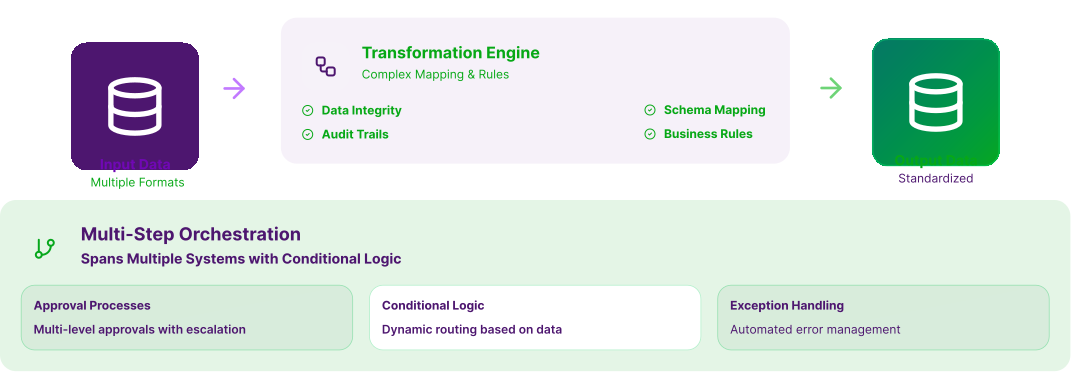
Modern ServiceNow enterprise integrations require sophisticated data transformation capabilities to handle diverse data formats, schemas, and business rules. The platform's transformation engine supports complex mapping scenarios while maintaining data integrity and audit trails.
Orchestration capabilities enable organizations to create multi-step workflows that span multiple systems, incorporating approval processes, conditional logic, and exception handling. These workflows can be triggered by various events, including user actions, system alerts, or scheduled operations.
The platform's visual workflow designer empowers IT administrators to create and modify integration logic without extensive programming knowledge. This democratization of integration development accelerates time-to-value while reducing dependency on specialized technical resources.
Strategic Use Cases for ServiceNow Integrations
ServiceNow integrations deliver maximum value when aligned with specific business objectives and operational requirements. Understanding common use cases helps organizations prioritize integration initiatives and measure success against defined metrics.
Incident management represents one of the most impactful integration scenarios, where ServiceNow connects with monitoring tools, ticketing systems, and communication platforms. These integrations enable automated incident creation, intelligent routing, and coordinated response activities that minimize downtime and improve user satisfaction.
Change management integrations streamline approval processes by connecting ServiceNow with project management tools, configuration databases, and deployment platforms. This connectivity ensures that all changes follow established governance procedures while maintaining complete audit trails for compliance purposes.
IT Service Management Integration Scenarios
ITSM integrations form the backbone of modern IT operations, enabling seamless information flow between ServiceNow and essential enterprise systems. These integrations reduce manual effort, eliminate data silos, and improve service delivery consistency across the organization.
- Monitoring Tool Integration: Automatic incident creation from Nagios, SolarWinds, Datadog, and other monitoring platforms with intelligent deduplication and priority assignment
- Asset Management Synchronization: Real-time asset discovery and inventory updates from network scanners, vulnerability management tools, and cloud platforms
- Communication Platform Integration: Bidirectional connectivity with Slack, Microsoft Teams, and email systems for collaborative incident resolution and status updates
- Security Tool Orchestration: Automated security incident response workflows integrating with SIEM platforms, vulnerability scanners, and threat intelligence feeds
- Cloud Platform Integration: Native connectivity with AWS, Azure, and Google Cloud for automated provisioning, cost management, and resource optimization
Business Process Automation
Beyond traditional ITSM use cases, ServiceNow integrations enable comprehensive business process automation that spans multiple departments and systems. These scenarios demonstrate the platform's versatility in addressing diverse organizational needs.
HR service delivery benefits significantly from ServiceNow integrations with HRIS systems, identity management platforms, and collaboration tools. Automated onboarding workflows can provision user accounts, assign equipment, and ensure compliance with security policies without manual intervention.
Financial management integrations connect ServiceNow with ERP systems, procurement platforms, and budget management tools. These connections enable automated cost allocation, purchase order processing, and financial reporting that provides accurate visibility into IT spending and resource utilization.
"Companies implementing automated IT service management processes through integrated platforms report 45% reduction in manual tasks and 32% improvement in service request fulfillment times."
— Forrester IT Service Management Study
Best Practices for ServiceNow Enterprise Integrations
Successful ServiceNow enterprise integrations require careful planning, systematic implementation approaches, and ongoing optimization efforts. Organizations that follow established best practices achieve faster time-to-value while minimizing risks and technical debt.
The implementation journey begins with comprehensive requirements gathering and stakeholder alignment. Understanding business objectives, technical constraints, and success metrics ensures that integration initiatives deliver measurable value while meeting operational requirements.
Architecture design represents a critical phase where technical decisions impact long-term maintainability and scalability. Selecting appropriate integration patterns, data models, and security frameworks requires deep understanding of both ServiceNow capabilities and enterprise system requirements.
Planning and Design Considerations
Effective integration planning addresses multiple dimensions including technical architecture, data governance, security requirements, and operational procedures. Comprehensive planning reduces implementation risks while establishing foundations for future expansion and enhancement.
- Integration Mapping: Document all system touchpoints, data flows, and transformation requirements using standardized notation and governance frameworks
- Security Assessment: Evaluate authentication mechanisms, encryption requirements, and access control policies for each integration endpoint
- Performance Planning: Define service level agreements, capacity requirements, and monitoring strategies for integration performance and availability
- Change Management: Establish processes for integration lifecycle management including development, testing, deployment, and maintenance procedures
- Risk Mitigation: Identify potential failure scenarios and develop contingency plans including rollback procedures and alternative integration paths
Technical Implementation Strategies
Technical implementation success depends on following proven development methodologies while leveraging ServiceNow's native capabilities effectively. Organizations should prioritize reusable components, standardized patterns, and comprehensive testing approaches.
Agile development methodologies work particularly well for integration projects, enabling iterative delivery of functionality while incorporating user feedback and operational learnings. Breaking complex integrations into smaller, manageable components accelerates development while reducing technical risks.
Testing strategies must address multiple scenarios including happy path operations, error conditions, performance under load, and security validation. Automated testing frameworks enable continuous validation while reducing manual effort and improving reliability.
Selecting the Right ServiceNow Integration Platform
Choosing an appropriate ServiceNow integration platform requires evaluating multiple factors including technical capabilities, operational requirements, and strategic business objectives. The right platform choice accelerates implementation while providing foundations for long-term success.
Native ServiceNow integration capabilities provide deep platform integration and comprehensive support, making them ideal for organizations heavily invested in the ServiceNow ecosystem. However, third-party integration platforms may offer superior capabilities for complex multi-system scenarios or specialized use cases.
Evaluation criteria should encompass technical functionality, ease of use, vendor support quality, total cost of ownership, and strategic alignment with organizational technology roadmaps. A systematic evaluation process ensures optimal platform selection while avoiding costly mistakes.
.svg)
Platform Evaluation Framework
A structured evaluation framework helps organizations compare integration platform options objectively while considering both immediate needs and future requirements. This framework should address technical, operational, and strategic dimensions of platform selection.
- Connectivity Options: Pre-built connectors, API support, protocol compatibility, and custom integration development capabilities
- Data Processing: Transformation engines, mapping tools, validation frameworks, and data quality management features
- Operational Management: Monitoring dashboards, error handling, performance optimization, and administrative capabilities
- Security and Compliance: Authentication methods, encryption standards, audit trails, and regulatory compliance features
- Scalability and Performance: Throughput capacity, concurrent connection limits, and horizontal scaling capabilities
- Vendor Ecosystem: Partner network, community support, documentation quality, and professional services availability
Implementation Support and Resources
Successful integration projects require access to appropriate expertise, documentation, and support resources throughout the implementation lifecycle. Organizations should evaluate vendor support offerings while considering internal capability development needs.
Professional services capabilities can significantly accelerate implementation timelines while ensuring best practices adoption. However, organizations should balance external assistance with internal knowledge transfer to maintain long-term operational capabilities.
Community resources, documentation quality, and training programs contribute to implementation success and ongoing operational effectiveness. Platforms with vibrant user communities and comprehensive educational resources enable organizations to maximize their integration investments.
"Organizations utilizing no-code integration platforms report 60% faster deployment times and 40% reduction in maintenance overhead compared to custom-coded solutions."
— Gartner Integration Platform as a Service Market Guide
Security and Compliance in ServiceNow Integrations
Security considerations permeate every aspect of ServiceNow integration design and implementation. Modern threat landscapes require comprehensive security frameworks that protect data in transit, at rest, and during processing while maintaining operational efficiency.
Authentication and authorization mechanisms form the first line of defense, with ServiceNow supporting multiple industry-standard protocols including OAuth 2.0, SAML, and certificate-based authentication. Proper implementation of these mechanisms ensures that only authorized systems and users can access sensitive information.
Encryption requirements vary by industry and regulatory environment, with many organizations requiring end-to-end encryption for all data exchanges. ServiceNow integrations should implement appropriate encryption standards while considering performance implications and key management requirements.
Regulatory Compliance Frameworks
Compliance requirements significantly impact integration architecture and operational procedures. Understanding applicable regulations and implementing appropriate controls ensures that ServiceNow integrations meet legal and industry requirements while avoiding costly violations.
- GDPR Compliance: Data minimization, consent management, right to erasure, and cross-border transfer restrictions for European personal data
- HIPAA Requirements: Protected health information handling, access controls, audit logging, and business associate agreements for healthcare organizations
- SOX Compliance: Financial data integrity, segregation of duties, change control procedures, and comprehensive audit trails for public companies
- PCI DSS Standards: Cardholder data protection, network security, vulnerability management, and regular security testing for payment card industry
- ISO 27001 Framework: Information security management systems, risk assessment procedures, and continuous improvement processes
Security Monitoring and Incident Response
Continuous security monitoring enables organizations to detect and respond to potential threats before they impact business operations. ServiceNow integrations should include comprehensive logging, alerting, and incident response capabilities.
Security information and event management (SIEM) integration provides centralized visibility into integration security events while enabling automated threat detection and response. These capabilities are essential for maintaining security posture in complex integration environments.
Incident response procedures should address integration-specific scenarios including data breaches, unauthorized access attempts, and system compromises. Well-defined response procedures minimize damage while ensuring appropriate stakeholder communication and regulatory reporting.
Performance Optimization and Scalability
Performance optimization ensures that ServiceNow integrations can handle expected workloads while maintaining responsive user experiences. Understanding performance characteristics and implementing appropriate optimization strategies prevents bottlenecks and system degradation.
Scalability considerations become critical as organizations expand their integration footprint and data volumes grow. Proper architecture design and platform selection enable integrations to scale horizontally and vertically as business requirements evolve.
Monitoring and analytics capabilities provide visibility into integration performance trends while enabling proactive optimization. Organizations should implement comprehensive monitoring strategies that track key performance indicators and provide early warning of potential issues.
Performance Tuning Strategies
Systematic performance tuning approaches help organizations optimize ServiceNow integration performance while minimizing resource consumption. These strategies address multiple performance dimensions including throughput, latency, and resource utilization.
- Connection Pooling: Reuse database and API connections to reduce connection overhead and improve response times
- Batch Processing: Group multiple operations into single transactions to reduce network overhead and improve throughput
- Caching Strategies: Implement intelligent caching for frequently accessed data while ensuring data freshness requirements
- Load Balancing: Distribute integration workloads across multiple servers to improve availability and performance
- Query Optimization: Optimize database queries and API calls to minimize response times and resource consumption
- Asynchronous Processing: Implement non-blocking operations for time-consuming tasks to improve user experience
"High-performing IT organizations achieve 2.5 times faster recovery from incidents through optimized integration platforms that enable rapid information sharing and automated response workflows."
— Google Cloud State of DevOps Report 2023
Future Trends in ServiceNow Integrations
The ServiceNow integration landscape continues evolving rapidly, driven by advances in artificial intelligence, cloud computing, and automation technologies. Understanding emerging trends helps organizations make strategic decisions that position them for future success.
Artificial intelligence and machine learning capabilities are increasingly integrated into ServiceNow platforms, enabling intelligent data mapping, predictive analytics, and automated decision-making. These capabilities reduce manual effort while improving integration accuracy and effectiveness.
Cloud-native architectures are becoming the standard for new integration deployments, offering improved scalability, reliability, and cost-effectiveness compared to traditional on-premises solutions. Organizations are migrating existing integrations to cloud platforms while adopting cloud-native design principles for new initiatives.
Emerging Technologies and Capabilities
Next-generation ServiceNow integration capabilities leverage cutting-edge technologies to deliver enhanced functionality and improved user experiences. Organizations should monitor these developments while evaluating their potential impact on integration strategies.
- AI-Powered Integration: Machine learning algorithms that automatically suggest optimal integration patterns, data mappings, and performance optimizations
- Event-Driven Architectures: Real-time event processing capabilities that enable immediate response to business events across integrated systems
- Low-Code/No-Code Platforms: Visual development tools that democratize integration development while maintaining enterprise-grade security and governance
- Microservices Integration: Native support for microservices architectures enabling fine-grained integration control and improved system resilience
- Blockchain Integration: Distributed ledger capabilities for secure, transparent data sharing across organizational boundaries
- IoT Device Integration: Native connectivity with Internet of Things devices for real-time monitoring and automated response capabilities
ZigiOps: Streamlining ServiceNow Integration Development
Organizations seeking to accelerate their ServiceNow integration initiatives can benefit from specialized platforms designed to simplify integration development and management. ZigiOps provides comprehensive ServiceNow integration capabilities through a no-code platform that reduces implementation complexity while maintaining enterprise-grade security and performance.
ZigiOps eliminates the traditional barriers to ServiceNow integration development by providing pre-built connectors, visual workflow designers, and intelligent data mapping capabilities. This approach enables IT teams to develop and deploy integrations faster while reducing dependency on specialized technical expertise.
The platform's comprehensive integration ecosystem supports connections with popular enterprise applications including Jira, Azure DevOps, Salesforce, and numerous monitoring tools. This extensive connectivity enables organizations to create unified workflows that span multiple systems and business processes.
Key ZigiOps Advantages
ZigiOps addresses common ServiceNow integration challenges through innovative approaches to development, deployment, and management. These advantages enable organizations to achieve integration success while minimizing risks and resource requirements.
- No-Code Development: Visual interface eliminates coding requirements while providing full control over integration logic and data transformations
- Pre-Built Templates: Industry-specific integration templates accelerate development while ensuring best practices compliance
- Real-Time Synchronization: Bidirectional data synchronization maintains consistency across integrated systems without manual intervention
- Advanced Monitoring: Comprehensive dashboards provide visibility into integration performance, error rates, and data quality metrics
- Enterprise Security: Built-in security frameworks support OAuth, SSL/TLS encryption, and role-based access controls
- Scalable Architecture: Cloud-native platform scales automatically to handle varying workloads and data volumes
Conclusion
ServiceNow integrations represent a critical capability for modern enterprises seeking to optimize IT operations, enhance service delivery, and drive digital transformation initiatives. Success in 2026 requires understanding evolving architectural patterns, implementing robust security frameworks, and selecting appropriate integration platforms that align with organizational objectives.
The integration landscape continues evolving rapidly, with artificial intelligence, cloud-native architectures, and no-code development platforms reshaping how organizations approach integration challenges. IT leaders who stay current with these trends while focusing on fundamental best practices will position their organizations for long-term success.
Strategic implementation approaches that prioritize business value, operational excellence, and technical sustainability enable organizations to maximize their ServiceNow integration investments. By following proven methodologies, leveraging appropriate tools and platforms, and maintaining focus on continuous improvement, enterprises can build integration capabilities that support current needs while adapting to future requirements.
"The most successful digital transformation initiatives are built on robust integration foundations that enable seamless data flow and process automation across the enterprise ecosystem."
— Forrester Enterprise Architecture Predictions 2024
Organizations embarking on ServiceNow integration journeys should begin with clear objectives, comprehensive planning, and appropriate platform selection. Whether leveraging native ServiceNow capabilities or specialized integration platforms like ZigiOps, the key to success lies in balancing technical excellence with business value delivery while maintaining operational sustainability throughout the integration lifecycle.