The Enterprise ITSM Integration Playbook: Architecture, AI, & Observability 2026

The pressure on IT operations teams has never been greater. Enterprises today run hybrid infrastructures, distributed DevOps pipelines, and sprawling SaaS ecosystems — all of which generate incident data, alerts, and service requests that must be coordinated across multiple platforms simultaneously. Without a coherent ITSM integration strategy, these platforms become silos that slow down response times, inflate operational costs, and expose organizations to avoidable risk.
This playbook is designed for IT managers, system administrators, and CTOs who are building or refining their enterprise service management integration architecture for 2026 and beyond. It covers the foundational patterns, AI-driven capabilities, observability requirements, and real-world deployment considerations that separate high-performing IT organizations from those still firefighting in reactive mode.
Whether you are connecting ServiceNow to Jira, bridging your monitoring stack with your service desk, or designing a fully automated event-to-resolution workflow, the decisions you make at the architecture level today will determine your operational agility for years to come.
Why ITSM Integration Has Become a Strategic Imperative
For most of the last decade, ITSM integration was treated as a technical convenience — a way to reduce copy-paste work between tools. In 2026, that framing is dangerously outdated. Integration is now a core architectural concern that affects service reliability, developer experience, compliance posture, and the effectiveness of AI-powered automation.
The average large enterprise operates between 15 and 30 distinct IT operations tools. Without tight ITSM integration, incidents discovered in observability platforms like Dynatrace or Datadog never automatically create tickets in ServiceNow. Changes approved in an ITSM system never propagate to the CI/CD pipeline. Security alerts from SIEM tools never trigger the right escalation workflows. The result is a fragmented operational environment where humans manually bridge gaps that should be automated.
"Integrating AIOps with observability can reduce Mean Time to Repair (MTTR) by 50%.”
— Forrester, AIOps and Observability
The business case for a robust ITSM integration strategy is not abstract. Faster mean time to resolve (MTTR), lower ticket volumes through automation, reduced onboarding friction for new tools, and stronger compliance audit trails are all direct outcomes of well-architected integrations. The question is no longer whether to integrate, but how to do it at enterprise scale without creating brittle, unmaintainable point-to-point connections.
Core Architecture Patterns for Enterprise ITSM Integration
Before selecting tools or building workflows, enterprise architects must choose the right integration topology. The wrong pattern at this stage creates technical debt that compounds rapidly as the tool landscape evolves. There are three dominant patterns in modern enterprise service management integration architecture, each with distinct trade-offs.
Point-to-Point Integration
Point-to-point is the most common pattern in organizations that have grown their tool stack organically. Each integration is built independently between two specific tools — ServiceNow to PagerDuty, Jira to Confluence, Datadog to Slack. While fast to deploy initially, this model creates an exponentially growing web of dependencies. With ten tools, you can have up to 45 separate integrations to maintain. Each vendor API update becomes a potential breaking change across the entire mesh.
Point-to-point ITSM integration is viable for small environments or isolated use cases, but it is not a scalable ITSM integration strategy for enterprises managing complex, evolving toolchains.
Hub-and-Spoke Integration
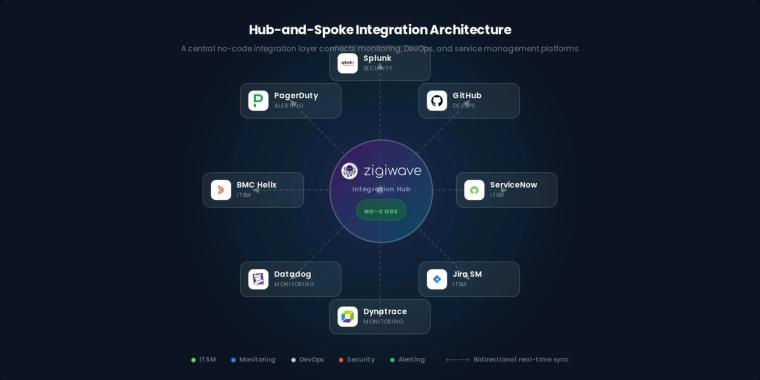
The hub-and-spoke model introduces a central integration layer — a middleware platform or integration bus — through which all tools communicate. Rather than each tool needing to know how to talk to every other tool, each tool only needs a single connection to the hub. This dramatically reduces integration complexity and provides a single point of visibility, governance, and control.
Hub-and-spoke is the dominant architecture for serious enterprise service management integration programs. It enables centralized logging, transformation, error handling, and access control. Platforms like ZigiOps are purpose-built for this model, providing a no-code hub that connects ITSM, monitoring, DevOps, and security tools without requiring engineering resources for every new integration.
Event-Driven Integration
Event-driven architecture takes the hub-and-spoke model further by decoupling producers and consumers of data through event streams. Rather than synchronous API calls, tools publish events to a broker and other tools subscribe to the events they care about. This pattern is increasingly common in cloud-native environments and is the foundation of real-time observability-to-ITSM pipelines.
Event-driven ITSM integration is particularly powerful for high-volume alerting scenarios where a single infrastructure failure can trigger hundreds of events. With proper event correlation and deduplication built into the integration layer, only a single, enriched incident ticket is created in the ITSM platform, containing full context from across the stack.
"Integration platforms that support event-driven architectures and two-way synchronization are becoming foundational infrastructure for IT operations, not optional add-ons."
— Forrester Research, Enterprise Integration Platforms Wave
Two-way ITSM Integration: The Non-Negotiable Requirement
One of the most common and costly mistakes in ITSM integration projects is building unidirectional flows and calling them complete. A unidirectional integration that creates a ticket in ServiceNow when Dynatrace detects an anomaly is useful. But if a technician updates the ticket status in ServiceNow and that update never flows back to Dynatrace — or to the Jira board where the engineering team is working — the integration has solved only half the problem.
Two-way ITSM integration ensures that changes made in any connected system are reflected across all relevant platforms in near real time. This is not just a convenience feature — it is a correctness requirement. When teams are working from stale or incomplete data, they duplicate work, miss escalations, and make decisions on outdated context.
The technical challenges of true two-way sync are significant. Conflict resolution when the same record is updated in two systems simultaneously, loop prevention to stop updates from triggering infinite update cycles, and field-level mapping fidelity across tools with different data models all require careful design. For a deep technical exploration of these challenges, see ZigiWave's analysis of two-way ITSM integration challenges.
A mature ITSM integration strategy treats two-way sync as a baseline requirement, not an enhancement. When evaluating integration platforms, demand native support for two-way sync with configurable conflict resolution, field transformation, and loop detection built in — not bolted on.
AI and Intelligent Automation in ITSM Integration
Artificial intelligence is reshaping every layer of IT operations, and ITSM integration is no exception. The most impactful AI applications in 2026 are not standalone AI tools — they are AI capabilities embedded directly into the integration layer, enabling intelligent routing, enrichment, and prediction at the point where data flows between systems.
Intelligent Incident Enrichment
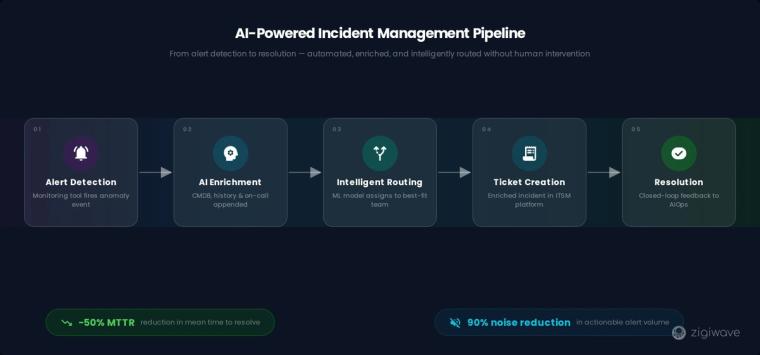
When an alert fires in a monitoring tool, it typically arrives in the ITSM platform as a bare-bones notification with minimal context. AI-powered enrichment within the integration pipeline can automatically append relevant information before the ticket is created: affected CI details from the CMDB, historical incident patterns for the same component, on-call engineer assignments from the workforce management tool, and related open changes from the change management module.
This enrichment does not require human intervention. It happens in milliseconds as data passes through the integration layer, transforming a low-context alert into an actionable, context-rich incident record. The result is a measurable reduction in time-to-diagnose and a significant decrease in the cognitive load on on-call engineers.
Predictive Escalation and Routing
Machine learning models trained on historical incident data can predict, with high accuracy, which tickets are likely to breach SLA thresholds before they actually do. When this predictive capability is embedded in the ITSM integration pipeline, at-risk tickets can be automatically re-prioritized, re-assigned, or escalated before a breach occurs — without waiting for a human to notice the approaching deadline.
Similarly, AI-driven routing eliminates the guesswork in initial ticket assignment. By analyzing the ticket content, affected system, historical resolution patterns, and current team workloads, the integration layer can route new incidents directly to the most appropriate individual or team, bypassing the generic assignment queues that slow down resolution times.
AIOps and Noise Reduction
Large-scale IT environments generate thousands of alerts per day. Without intelligent filtering, ITSM platforms become overwhelmed with low-priority noise, burying the signals that actually require human attention. AIOps platforms integrated with your ITSM system through a robust ITSM integration strategy can correlate related alerts, suppress known false positives, and group symptoms of the same root cause into a single parent incident.
"AIOps platforms that integrate natively with ITSM workflows can reduce actionable alert volumes by up to 90%, allowing IT teams to focus on high-impact issues rather than alert fatigue."
— Gartner, Market Guide for AIOps Platforms
Observability-Driven ITSM Integration Architecture
Modern observability goes far beyond traditional monitoring. Where monitoring tells you that a metric crossed a threshold, observability gives you the ability to ask arbitrary questions about system state — even questions you did not think to ask when you designed the dashboards. For enterprise service management integration, observability is the upstream data source that feeds the entire ITSM workflow.
The Observability-to-ITSM Pipeline
A well-designed observability-to-ITSM pipeline operates in several stages. First, the observability platform detects an anomaly and generates a structured alert with full telemetry context — metrics, logs, and traces relevant to the anomalous behavior. Second, the integration layer receives this alert and applies enrichment logic, deduplication rules, and routing policies. Third, a fully enriched incident ticket is created in the ITSM platform, already assigned, prioritized, and linked to the relevant configuration items.
This pipeline eliminates the most time-consuming manual steps in incident management. Engineers no longer need to correlate alerts with tickets manually, look up CMDB records to identify blast radius, or route tickets through a dispatch queue. The ITSM integration layer handles all of this automatically, at machine speed.
Closing the Loop: ITSM Actions Triggering Observability Responses
The most sophisticated architectures complete the loop by allowing ITSM actions to trigger responses in the observability layer. When an engineer acknowledges an incident in ServiceNow, that acknowledgment can automatically suppress related alerts in the monitoring tool to prevent noise. When a change request is approved and scheduled, the observability platform can automatically apply maintenance windows to suppress expected alerts during the change window.
This closed-loop architecture is only possible with true two-way ITSM integration between the service management and observability platforms. It represents the state of the art in ITOps automation and is increasingly a requirement in enterprise SLA frameworks.
ITSM Integration Strategy for Telecom and Regulated Industries
The complexity of ITSM integration scales with the complexity of the operating environment, and few environments are more complex than telecommunications. Telecom operators manage heterogeneous infrastructure spanning legacy OSS/BSS systems, modern cloud platforms, network management tools, and customer-facing service portals — all of which must be integrated into a coherent service management workflow.
For telecom and similarly regulated industries such as financial services and healthcare, an effective ITSM integration strategy must account for several additional requirements beyond the standard enterprise use case:
— Regulatory compliance and audit trail integrity: Every integration event must be logged with full provenance, timestamps, and change history to satisfy regulatory audit requirements.— High availability and failover: Integration pipelines must be fault-tolerant, with automatic retry logic and failover mechanisms to ensure no data is lost during system outages.— Legacy system compatibility: Integrations must bridge modern REST APIs and legacy SOAP or proprietary protocol interfaces without requiring modifications to the legacy systems.— Multi-tenant data isolation: In managed service scenarios, data from different customers or business units must be strictly isolated within the integration pipeline.
ZigiWave has developed specific expertise in this domain. Explore how ZigiOps addresses the unique demands of ITSM integrations in telecom environments, including real-world deployment patterns for Tier-1 operators managing thousands of simultaneous incidents across distributed network infrastructure.
ServiceNow as the ITSM Integration Hub: Patterns and Pitfalls
ServiceNow is the dominant enterprise ITSM platform in the market, and for most large organizations, it serves as the central hub of the entire enterprise service management integration architecture. Understanding how to integrate effectively with ServiceNow — and where native capabilities fall short — is essential knowledge for any enterprise integration architect.
Native ServiceNow Integration Capabilities
ServiceNow provides a rich set of native integration capabilities through its IntegrationHub, Flow Designer, and REST/SOAP APIs. These tools are well-suited for relatively simple, low-volume integrations with common enterprise tools. ServiceNow's spoke library includes pre-built connectors for Jira, Slack, Microsoft Teams, and several major monitoring platforms.
However, native ServiceNow integrations have well-documented limitations at enterprise scale. Custom field mappings require scripting knowledge in ServiceNow's Glide scripting language. Two-way sync is not a native capability of most out-of-the-box spokes and typically requires custom development. Complex transformation logic, conditional routing, and cross-platform orchestration quickly exhaust the capabilities of IntegrationHub's no-code interface, pushing teams into costly custom development.
Extending ServiceNow with External Integration Platforms
For enterprises that need more than ServiceNow's native integration capabilities can deliver, external integration platforms provide the flexibility and depth required. ZigiOps, for example, enables organizations to build complex two-way ITSM integration workflows with ServiceNow without writing a single line of code, while providing full control over field mapping, transformation logic, filtering rules, and sync frequency.
This approach is particularly valuable for organizations running heterogeneous ITSM environments — for example, a central ServiceNow instance that must stay synchronized with Jira Service Management instances operated by individual business units or acquired companies. Explore ZigiOps's full range of ServiceNow integrations to understand how these patterns are implemented in production environments.
"The most successful IT organizations treat their ITSM platform not as a monolithic system of record, but as a connected hub that orchestrates data and workflows across the entire IT operations toolchain."
— TechTarget, IT Operations Strategy
No-Code Integration Platforms: Accelerating Enterprise ITSM Integration
The traditional approach to building enterprise integrations — custom scripts, middleware configurations, and bespoke API connectors built by specialist developers — is no longer tenable at the pace modern IT environments demand. Tools change, APIs evolve, and business requirements shift faster than development teams can write and maintain integration code. No-code integration platforms have emerged as the answer to this velocity challenge.
What No-Code ITSM Integration Actually Means
The term "no-code" is sometimes used loosely in the integration market. In the context of enterprise ITSM integration, it means specifically: the ability to configure two-way data flows, field mappings, transformation logic, conditional routing, and error handling through a visual interface — without writing scripts, modifying source code, or deploying custom middleware infrastructure.
True no-code platforms allow IT operations teams, not just developers, to own and maintain their integrations. This shifts the integration ownership model in a fundamental way: the people who best understand the operational requirements — IT managers and system administrators — can directly configure and adapt integrations as those requirements evolve, without waiting for development resources.
ZigiOps: Purpose-Built for IT Operations Integration
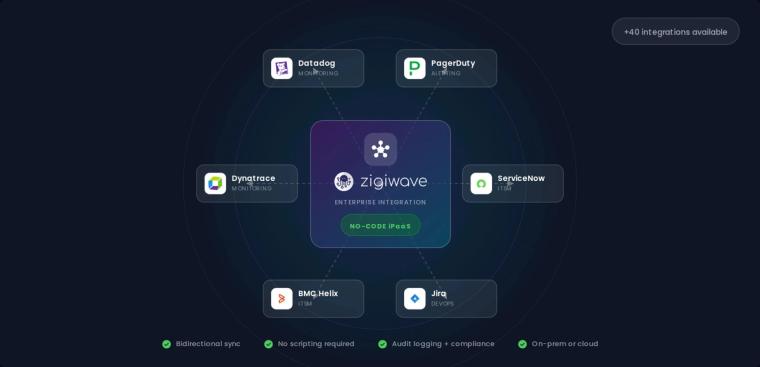
ZigiOps is built from the ground up for the specific challenges of enterprise service management integration. Unlike general-purpose iPaaS platforms that treat IT operations as one vertical among many, ZigiOps is purpose-built for ITSM, monitoring, DevOps, and security tool integration. This means pre-built connectors that understand the native data models of platforms like ServiceNow, Jira, BMC Helix, Dynatrace, Datadog, PagerDuty, and Splunk — not generic REST connectors that require extensive manual configuration.
Key capabilities that make ZigiOps effective for enterprise-scale ITSM integration include:
— Two-way sync with loop prevention: Native support for two-way data flows with built-in mechanisms to prevent update loops and handle conflict resolution gracefully.— Granular field mapping and transformation: Visual field mapping with support for conditional logic, value translation, and cross-platform data model normalization.— No-code conditional routing: Rules-based routing that directs data to different destinations based on field values, event types, or system state — without scripting.— Audit logging and compliance support: Complete event logging for every integration action, supporting compliance requirements in regulated industries.— Scalable, agent-less architecture: Deployable on-premises or in the cloud, with no agents required on the integrated systems — critical for security-sensitive environments.
For organizations evaluating integration platforms, ZigiWave's full library of supported ITSM and IT operations integrations provides a comprehensive reference for available connectors and supported use cases.
Building Your 2026 ITSM Integration Strategy: A Practical Framework
With the architectural patterns, technology capabilities, and platform considerations in place, the final step is translating this knowledge into an actionable ITSM integration strategy for your organization. The following framework provides a structured approach to building integrations that are scalable, maintainable, and aligned with business outcomes.
Phase 1: Integration Landscape Assessment
Before building or buying anything, map your current integration landscape with honesty. Identify every point-to-point integration currently in production, document the data flows and dependencies, and assess the maintenance burden of each. This audit typically reveals both the hidden cost of the existing integration estate and the highest-priority gaps that are creating operational risk.
Key questions to answer in this phase:
— Which manual data-transfer tasks are engineers performing daily that should be automated?— Where are incidents falling through the cracks between tools?— Which existing integrations are fragile, poorly documented, or dependent on a single team member's knowledge?— What new tools are being evaluated that will require integration in the next 12 months?
Phase 2: Define Integration Requirements by Workflow
Group integration requirements around operational workflows rather than tool pairs. Incident management, change management, problem management, and service request fulfillment each have distinct data flow requirements. Defining requirements at the workflow level ensures that the ITSM integration strategy serves operational outcomes, not just technical connectivity.
For each workflow, define:
— Which systems are involved as data producers and consumers— Whether the flow requires unidirectional or two-way sync— What data transformations and field mappings are required— What business rules govern routing, escalation, and conflict resolution— What SLA or compliance requirements apply to the integration
Phase 3: Select the Right Integration Architecture and Platform
Based on the workflow requirements defined in Phase 2, select the integration architecture (hub-and-spoke, event-driven, or hybrid) and evaluate platforms against the specific capabilities your workflows require. Prioritize platforms that offer true no-code configuration, native support for the tools in your stack, and proven two-way sync over platforms that promise broad coverage but deliver shallow integrations.
Evaluate any candidate platform against a real-world integration scenario before committing. The ability to configure a complete two-way ITSM integration workflow — including field mapping, conditional routing, and error handling — without developer involvement is a concrete, testable criterion that separates genuine no-code platforms from marketing claims.
Phase 4: Instrument, Monitor, and Iterate
Integration pipelines are not set-and-forget infrastructure. They require ongoing monitoring to detect failures, performance degradation, and data quality issues before they affect operations. Build integration health monitoring into your observability stack from day one, with alerting on failed syncs, data validation errors, and processing latency.
Establish a quarterly review cadence to assess whether your integration architecture is keeping pace with changes in the tool landscape, operational requirements, and business priorities. A mature ITSM integration strategy is a living program, not a one-time project.
Key Metrics for Measuring ITSM Integration Effectiveness
An enterprise integration program that cannot be measured cannot be improved. The following metrics provide a balanced scorecard for evaluating the effectiveness of your ITSM integration architecture across operational, quality, and business dimensions:
— Mean Time to Resolve (MTTR) by incident category: Track whether integrated workflows are reducing resolution time for the incident types they cover.
— Integration-driven ticket creation rate: The percentage of incidents first detected by monitoring tools and automatically created in the ITSM platform — a measure of automation coverage.
— Cross-platform data latency: The time between an event occurring in one system and the corresponding record being created or updated in the connected system.
— Integration failure rate: The percentage of integration events that fail to process successfully — a direct measure of pipeline reliability.
— Duplicate incident rate: The frequency with which multiple tickets are created for the same underlying incident — a measure of deduplication and correlation effectiveness.
— Manual touchpoint reduction: The reduction in manual data entry or transfer tasks following integration deployment — a measure of engineer time recovered.
— SLA compliance rate by integrated workflow: Whether integrations that include SLA-aware routing and escalation logic are improving SLA attainment rates.
Conclusion: ITSM Integration as Competitive Infrastructure
The enterprises that will lead on IT service reliability, operational efficiency, and digital transformation in 2026 are not necessarily those with the most tools. They are those whose tools work together — cohesively, automatically, and intelligently. A mature ITSM integration architecture is the connective tissue that makes this possible.
From choosing the right integration topology to implementing two-way data flows, embedding AI-driven enrichment, and building closed-loop observability pipelines, every decision in this playbook compounds. The organizations that treat ITSM integration as a strategic program — with dedicated architecture, governance, and continuous improvement — will outperform those that treat it as a series of one-off technical tasks.
ZigiOps is purpose-built to help IT operations teams execute this kind of strategic enterprise service management integration program at scale, without the engineering overhead that has historically made serious integration work the exclusive domain of large platform teams. If your organization is ready to move from a fragmented tool landscape to a coherent, automated, and observable IT operations architecture, explore what ZigiOps's enterprise ITSM integration capabilities can deliver — and see how teams across telecom, financial services, and enterprise IT are already operating at the next level.