From Integration to Orchestration: The 2026 Shift
This article breaks down the key IT automation trends defining 2026
The way enterprise IT teams connect systems, move data, and automate processes is undergoing a fundamental transformation. For years, the dominant model was integration — linking two systems together so they could exchange data. But in 2026, the conversation has decisively shifted toward orchestration: coordinating entire chains of automated workflows that span multiple platforms, teams, and business functions.
Understanding today's IT automation trends means recognizing that integration alone is no longer a competitive advantage. It is a baseline expectation. What separates high-performing IT organizations from the rest is their ability to orchestrate complex, multi-step processes without manual intervention — and to do so at enterprise scale.
This article breaks down the key IT automation trends defining 2026, explains why the shift from integration to orchestration is happening now, and shows how modern workflow orchestration tools and enterprise integration platforms are enabling this next chapter of IT operations.
Why IT Automation Trends Are Forcing a Rethink of Integration
Traditional integration strategies were built around connecting two endpoints: a source system and a destination system. A ticket created in ServiceNow could trigger an update in Jira. An alert from a monitoring tool could create an incident record. These connections delivered real value, but they were fundamentally reactive and limited in scope.
The problem with point-to-point integration at scale is well documented. As organizations add more tools — ITSM platforms, monitoring solutions, cloud infrastructure, security systems, and DevOps pipelines — the number of individual integrations grows exponentially. What starts as a manageable set of connections quickly becomes a brittle, unmaintainable web of dependencies.
This is why the most important IT automation trends in 2026 are not about connecting more systems — they are about orchestrating smarter workflows across the systems you already have. The goal is no longer integration for its own sake. It is end-to-end process automation that reduces human intervention, accelerates resolution times, and surfaces actionable intelligence across the entire IT estate.
To understand the full spectrum of options available, it helps to explore the distinction between native versus middleware integrations — a foundational decision that shapes how far your automation can ultimately reach.
The Core IT Automation Trends Reshaping Enterprise IT in 2026
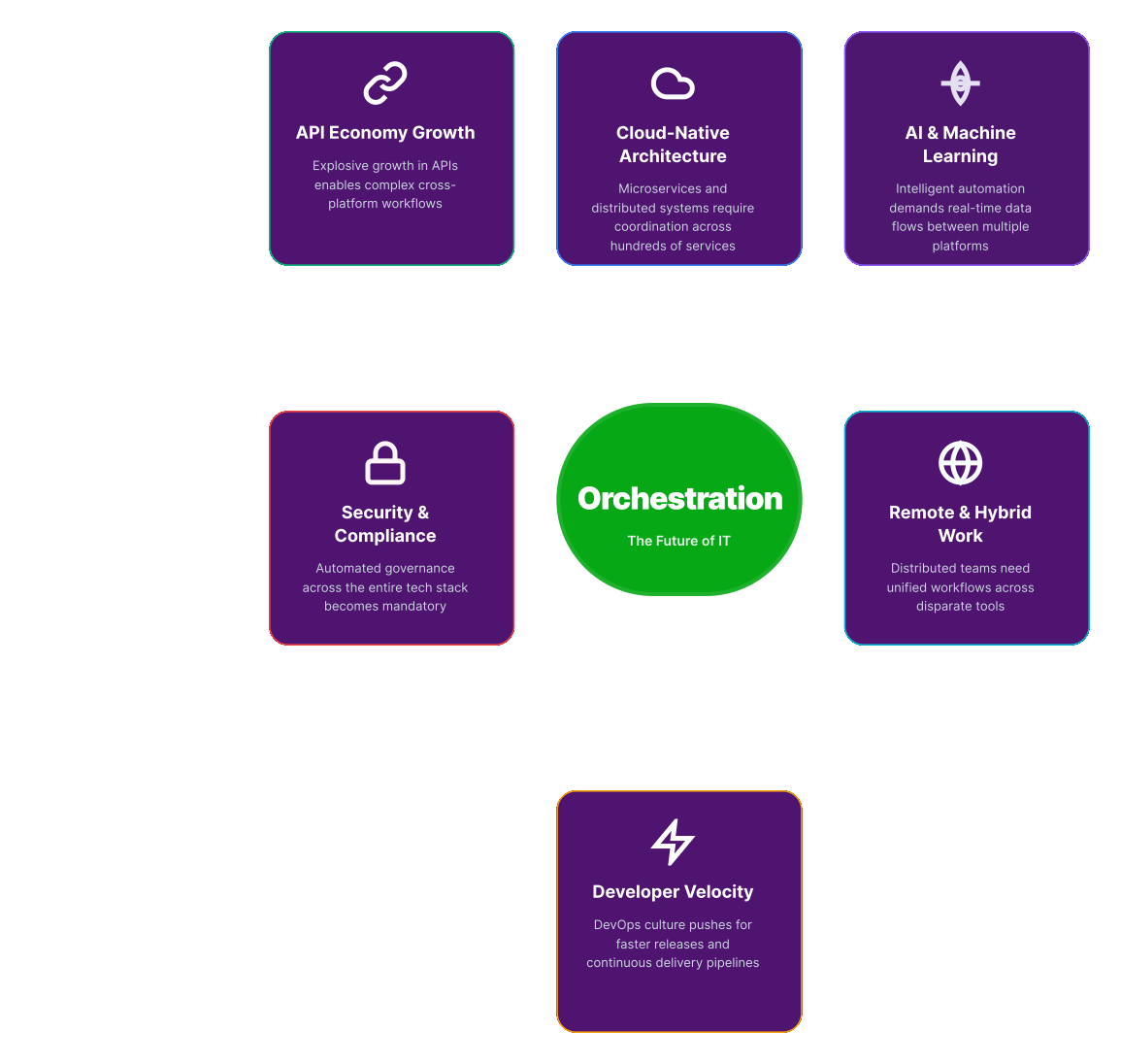
Several converging forces are driving the current wave of IT automation trends. Each one adds pressure to move beyond simple integration toward true orchestration. Here are the most significant shifts enterprise IT leaders need to understand heading into 2026.
1. The Rise of Workflow Orchestration Tools as the New Integration Layer
Workflow orchestration tools have matured from niche automation utilities into mission-critical infrastructure. Rather than simply passing data between two systems, these platforms coordinate sequences of actions across multiple systems, enforce conditional logic, handle error states, and provide full visibility into process execution.
The shift is significant because it means IT teams are no longer thinking about integrations as individual connections. They are thinking about processes as first-class objects — workflows that have owners, SLAs, audit trails, and governance requirements. This is precisely where workflow orchestration tools deliver value that legacy integration middleware cannot match.
For IT operations teams, this often means orchestrating workflows that span incident management, change management, observability, and security response — all in a single automated chain. The ability to manage these end-to-end processes from a single enterprise integration platform is one of the defining IT automation trends of this era.
2. No-Code and Low-Code Automation Is Becoming the Standard
One of the most consequential IT automation trends of the past three years has been the democratization of automation tooling. IT managers and system administrators no longer need to rely on developers to build and maintain integrations. No-code and low-code platforms have made it possible for operations teams to design, deploy, and modify complex workflows without writing a single line of code.
This shift has dramatic implications for speed and agility. When a new monitoring tool is added to the stack, or a security team needs a new escalation workflow, operations teams can build and test the integration themselves — often in hours rather than weeks. This self-service model is now a core expectation in modern IT automation trends, not a nice-to-have feature.
"Low-code/no-code development technologies are among the most impactful for application and software engineering leaders, as they reduce development time and lower the barrier to creating workflows across enterprise systems."
—
Gartner, Low-Code Development Technologies
ZigiOps is built on exactly this principle. Its no-code interface allows IT operations teams to configure bidirectional integrations and multi-step workflows between platforms like ServiceNow, Jira, Dynatrace, PagerDuty, and Splunk — without developer involvement. Learn more about how this approach enables end-to-end process automation at integration platform and workflow automation
3. AI-Augmented Automation and Intelligent Routing
Artificial intelligence is no longer a future consideration in enterprise IT automation — it is an active component of production workflows today. AI-augmented automation introduces intelligent decision-making into orchestration pipelines, enabling systems to route incidents based on predicted severity, auto-assign tickets based on historical resolution patterns, and suppress alert noise through anomaly correlation.
This is one of the fastest-evolving IT automation trends because it directly addresses one of the biggest pain points in IT operations: alert fatigue and slow mean time to resolve (MTTR). When AI can distinguish a critical infrastructure event from a routine threshold breach and route it accordingly, the entire incident management lifecycle accelerates.
Vendors across the enterprise integration platform market are racing to embed AI capabilities into their orchestration layers. The platforms that succeed will be those that combine intelligent routing with the governance and auditability that enterprise IT requires.
4. Event-Driven Architecture Replacing Scheduled and Polling-Based Integrations
Traditional integrations often relied on scheduled polling — checking a source system at regular intervals for new data and pushing it to a destination. This approach introduces latency, consumes unnecessary resources, and scales poorly in high-volume environments.
Event-driven architecture (EDA) is now one of the dominant IT automation trends among enterprise IT teams. In an event-driven model, workflows are triggered in real time by specific events — a deployment completing, a threshold being breached, a change request being approved. This eliminates polling delays and allows orchestration engines to respond to the actual state of systems as it changes.
For organizations running hybrid cloud environments, EDA is not just a performance improvement — it is a prerequisite for reliable automation at scale. Workflow orchestration tools that support event-driven triggers are increasingly favored over those that rely on scheduled batch processing.
5. Security and Compliance as First-Class Automation Concerns
As automation footprints expand, so does the attack surface. One of the most important emerging IT automation trends is the integration of security controls directly into orchestration workflows — not as an afterthought, but as a fundamental design requirement.
This means enforcing role-based access controls on who can create or modify workflows, encrypting data in transit between integrated systems, maintaining immutable audit logs of all automated actions, and ensuring that integrations comply with data residency and regulatory requirements.
For enterprises operating in regulated industries — financial services, healthcare, government — this is not optional. The enterprise integration platform you choose must be able to demonstrate compliance as rigorously as it demonstrates connectivity. ZigiWave's approach to this challenge is detailed in their resource on secure enterprise integration.
Why Traditional Integration Platforms Are No Longer Enough
Many organizations built their integration strategies around middleware platforms that were designed for a different era. These platforms excelled at moving structured data between enterprise applications in batch processes. But the modern IT environment demands something different: real-time, conditional, multi-system orchestration that can adapt to changing states without manual reconfiguration.
The limitations of legacy integration middleware become visible quickly when organizations try to automate complex ITSM processes. A typical incident-to-resolution workflow might touch a monitoring platform, an alerting tool, an ITSM system, a CMDB, a communication platform, and a reporting dashboard. Legacy middleware can connect pairs of these systems. Workflow orchestration tools can coordinate the entire chain.
There is also the question of maintenance overhead. Legacy integration platforms typically require specialized developer skills to configure and maintain. Every change to an upstream system — a new API version, a changed data schema, an updated authentication method — requires developer intervention to update the integration. This creates a bottleneck that slows the entire IT organization.
Modern enterprise integration platforms designed for orchestration address this directly. They abstract the complexity of individual system APIs behind configurable connectors, expose a visual workflow designer that non-developers can use, and handle schema changes gracefully without requiring custom code updates. This is the architectural difference that separates integration from orchestration — and it is the core driver behind the IT automation trends shaping 2026.
Workflow Orchestration Tools: What to Look For in 2026
Not all workflow orchestration tools are created equal. As the market matures, the gap between platforms that deliver genuine operational value and those that offer only surface-level automation has widened considerably. Here is what enterprise IT leaders should evaluate when assessing workflow orchestration tools for 2026 deployment.
- Breadth of pre-built connectors: The fastest path to automation is through pre-built, maintained connectors for the tools you already use. Look for platforms with deep native support for your ITSM, monitoring, observability, security, and DevOps tools — not just generic REST API connectors that require manual configuration for every endpoint.
- Bidirectional data synchronization: Orchestration requires more than one-way data pushes. Your platform must support bidirectional sync, ensuring that updates made in any connected system are reflected across the entire workflow chain without creating data conflicts or duplicate records.
- Conditional logic and branching: Real-world IT processes are rarely linear. The orchestration engine must support conditional branching, multi-path workflows, and error-handling logic that mirrors how your team actually operates — not a simplified version designed to fit a rigid automation template.
- Real-time event triggers: As discussed earlier, event-driven triggers are now a baseline requirement. Evaluate whether the platform can respond to webhooks, API events, and system state changes in real time — not just scheduled polls.
- Audit trails and governance controls: Enterprise deployments require full visibility into what automation has done, when, and why. Your orchestration platform must provide immutable logs, role-based access controls, and workflow version history to satisfy both internal governance requirements and external compliance audits.
- Scalability and performance at volume: A platform that performs well with 10 integrations may degrade significantly at 100. Evaluate how the platform handles high-volume event processing, concurrent workflow execution, and failover scenarios before committing to enterprise-wide deployment.
- No-code configurability: Given the pace of change in IT environments, the ability for operations teams to modify workflows without developer involvement is no longer optional. Prioritize platforms that offer genuine no-code configuration for the most common use cases.
You can explore how ZigiOps approaches these requirements across its growing library of supported integrations at ZigiWave Integrations.
The Enterprise Integration Platform Market in 2026
The enterprise integration platform market has consolidated significantly over the past three years. Vendors that once competed purely on connectivity — how many systems they could integrate — are now competing on orchestration capability, AI augmentation, and time-to-value for non-technical users.
This market evolution is directly reflected in enterprise buying behavior. IT leaders are no longer evaluating integration platforms based primarily on connector libraries. They are asking harder questions: How long does it take to deploy a new workflow? Can my operations team maintain it without developer support? How does the platform handle failures in the middle of a multi-step process? What does the audit trail look like for a compliance review?
"The integration platform as a service (iPaaS) market is evolving rapidly, with buyers increasingly demanding orchestration capabilities, AI-driven automation, and low-code interfaces that reduce reliance on specialized integration developers." — Gartner, Integration Platform as a Service (iPaaS) Definition
For IT operations teams specifically, the most relevant segment of the enterprise integration platform market is focused on ITSM and ITOps automation: connecting monitoring, alerting, incident management, change management, and reporting tools into coherent automated workflows. This is where platforms like ZigiOps have built their differentiation — deep, bidirectional integration across the specific tools that IT operations teams rely on, delivered through a no-code interface that operations staff can manage independently.
The shift in buyer expectations also has implications for how IT leaders evaluate total cost of ownership. Legacy integration middleware often carried significant hidden costs: developer time for initial configuration, ongoing maintenance as APIs changed, and the organizational risk of having critical workflows maintained by a small number of developers who held the institutional knowledge. Modern orchestration platforms that enable self-service configuration reduce these costs substantially — a factor that is increasingly central to procurement decisions.
IT Automation Trends in Action: Key Use Cases for 2026
Understanding IT automation trends at a conceptual level is valuable. Seeing them applied to specific, high-impact use cases is essential for building an internal business case. Here are the orchestration scenarios that enterprise IT teams are prioritizing in 2026.
Automated Incident Management Across Monitoring and ITSM
The most common and highest-value orchestration use case in IT operations is automated incident management. When a monitoring tool detects an anomaly, the orchestration workflow should automatically create an incident in the ITSM platform, enrich it with relevant CMDB data, route it to the appropriate team based on the affected service, notify stakeholders through the preferred communication channel, and update all systems as the incident progresses through to resolution.
This end-to-end automation eliminates manual handoffs, reduces MTTR, and ensures that incident records are complete and accurate without depending on engineers to manually update multiple systems during a high-pressure incident response.
Change Management Workflow Automation
Change management is a process that touches multiple systems and multiple teams. A change request raised in Jira may need to be reflected in ServiceNow, assessed against CMDB data, approved through an automated gate, and then tracked through to post-implementation review. Orchestrating this process end-to-end — with bidirectional data sync ensuring consistency across all systems — is a major focus of current IT automation trends in enterprise organizations.
Security Operations Automation and SOAR Integration
Security operations teams are among the most aggressive adopters of orchestration. When a security alert fires, the workflow needs to triage the alert, cross-reference it against threat intelligence feeds, create an incident in the ITSM system, notify the security team, and initiate a containment action — all within seconds. This is the domain of Security Orchestration, Automation, and Response (SOAR), and it represents one of the fastest-growing segments of the IT automation trends landscape.
AIOps and Observability Pipeline Automation
As organizations deploy observability platforms across their infrastructure, the volume of telemetry data — metrics, logs, traces — becomes too large for human analysts to process manually. AIOps platforms apply machine learning to this data to identify patterns, predict failures, and recommend actions. Orchestration tools connect the output of these AI engines to the ITSM workflows that act on their recommendations, closing the loop between detection and remediation.
This integration between AIOps and ITSM orchestration is one of the most technically demanding — and most rewarding — applications of current IT automation trends. Organizations that execute it well report significant improvements in both system availability and engineering team productivity.
How ZigiOps Addresses the Integration-to-Orchestration Shift
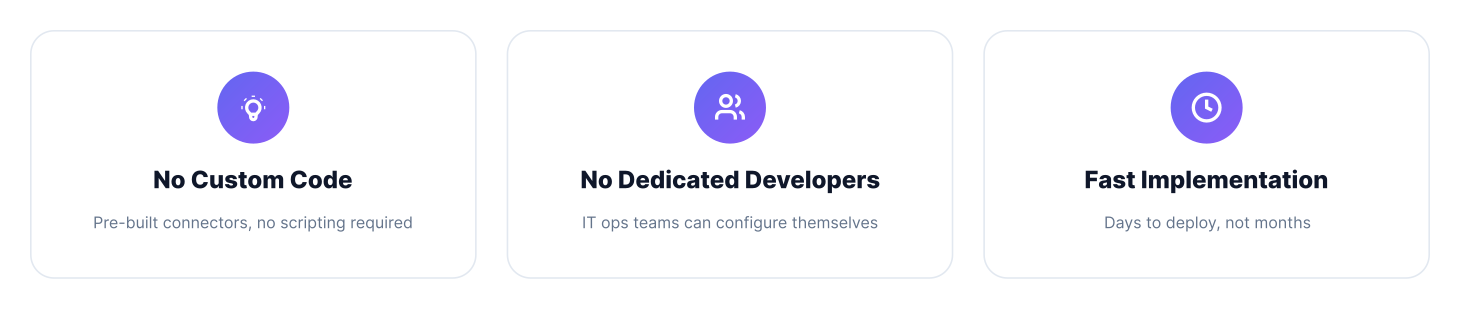
ZigiOps is ZigiWave's no-code enterprise integration platform built specifically for IT operations teams. It enables deep, bidirectional integrations across the ITSM, monitoring, observability, security, and DevOps tools that enterprise IT organizations depend on — without requiring custom code, dedicated developers, or long implementation timelines.
The platform is designed to reflect exactly the IT automation trends described in this article. It supports event-driven triggers, conditional workflow logic, bidirectional data synchronization, and full audit logging — all configured through a visual, no-code interface that IT operations teams can manage independently. When upstream APIs change or new tools are added to the stack, the ZigiOps connector library and configuration interface allow teams to adapt their workflows without developer involvement.
ZigiOps also addresses the security and compliance requirements that are increasingly central to enterprise integration decisions. Data processed through the platform can be configured to remain within your own infrastructure, satisfying data residency requirements that cloud-based iPaaS platforms often struggle to meet. For a deeper look at this capability, explore ZigiWave's approach to secure enterprise integration.
For IT leaders evaluating how to evolve their integration strategy toward orchestration, ZigiOps represents a practical, production-proven path. It bridges the gap between the point-to-point integrations most organizations have today and the orchestrated, AI-augmented, event-driven automation workflows that the most advanced IT organizations are running in 2026.
To understand how an enterprise integration platform can serve as the foundation for broader workflow automation, visit integration platform and workflow automation insights from ZigiWave.
Building Your Automation Strategy for 2026 and Beyond
The IT automation trends outlined in this article are not abstract projections — they are active forces reshaping how enterprise IT organizations operate right now. The shift from integration to orchestration is accelerating, driven by the convergence of no-code tooling, AI augmentation, event-driven architecture, and rising security requirements.
For IT managers, system administrators, and CTOs, the strategic question is not whether to invest in orchestration — it is how to structure that investment for maximum return. Here are the foundational steps for building an automation strategy aligned with 2026 realities. For IT managers, system administrators, and CTOs, the strategic question is not whether to invest in orchestration — it is how to structure that investment for maximum return. Here are the foundational steps for building an automation strategy aligned with 2026 realities.
- Audit your current integration landscape: Before adding new orchestration capability, map the integrations you already have. Identify which are point-to-point, which are brittle or poorly maintained, and which represent the highest-value automation opportunities. This audit will reveal where orchestration can deliver the fastest ROI.
- Prioritize process over technology: The most successful automation programs start with a clear process definition — what outcome are we trying to automate, what systems does it touch, and what are the decision points? Technology selection follows process design, not the other way around.
- Choose platforms that enable self-service: Given the pace of change in IT environments, automation platforms that require developer involvement for every modification create a bottleneck that limits agility. Prioritize workflow orchestration tools that empower operations teams to build and maintain their own workflows.
- Build security in from the start: Treat security and compliance requirements as first-class design constraints, not post-deployment concerns. Select an enterprise integration platform that provides the governance controls, audit logging, and data security features your organization requires — before you need them.
- Measure and iterate: Establish clear metrics for each automated workflow — MTTR reduction, ticket deflection rate, manual steps eliminated — and review them regularly. Automation strategies that are measured and iterated on consistently outperform those that are deployed and left unchanged.
For additional technical context on how integration architecture choices affect your long-term automation capability, the ZigiWave resource on native versus middleware integrations provides a practical framework for evaluating your current approach.
Conclusion: The 2026 Imperative for IT Automation Trends
The shift from integration to orchestration is the defining IT automation trend of 2026. Organizations that recognize this shift and invest accordingly will build IT operations that are faster, more resilient, and more responsive to business demands. Those that continue to treat integration as a collection of individual connections — rather than as the foundation for end-to-end process orchestration — will find themselves managing increasing complexity with decreasing efficiency.
The good news is that the technology to make this shift is mature, accessible, and proven. Workflow orchestration tools like ZigiOps offer enterprise IT teams a practical path from where they are today — a collection of point-to-point integrations — to where they need to be: a coherent, automated, governed orchestration layer that powers the entire IT operations function.
The IT automation trends of 2026 are not waiting for organizations to catch up. The question for every IT leader is whether their automation strategy is positioned to lead, or whether it is already falling behind. The shift from integration to orchestration is the answer — and the time to act on it is now.
Further Reading and Sources:
TechTarget: IT Automation Definition and Overview
ServiceNow Documentation: IT Operations Management Overview