Cross-Platform Integration Architecture: Hub-and-Spoke vs Mesh [ZigiOps]
Hub-and-spoke vs mesh: governance, scale, and use cases.
Choosing the right cross-platform integration architecture is one of the most consequential infrastructure decisions an enterprise can make. Get it right and your IT tools communicate seamlessly, your teams work faster, and your data stays consistent across systems. Get it wrong and you end up with brittle point-to-point connections, data silos, and a maintenance burden that compounds with every new tool you add.
This guide breaks down the two dominant patterns used in modern cross-platform integration architecture — hub-and-spoke and mesh — and explains exactly how to evaluate each model for your enterprise environment. We also show how ZigiOps, ZigiWave's no-code enterprise integration platform, supports both architectures without writing a single line of code.
What Is Cross-Platform Integration Architecture?
Cross-platform integration architecture refers to the structural design that governs how disparate software systems — across different vendors, protocols, and environments — exchange data and trigger workflows. In enterprise IT, this typically involves connecting ITSM platforms, monitoring tools, project management software, CRMs, CMDBs, cloud services, and DevOps pipelines.
Unlike simple one-to-one integrations, a full cross-platform integration architecture must account for scalability, fault tolerance, data transformation logic, security boundaries, and operational governance. The architecture you choose defines not just how your tools talk today, but how easily you can add new tools, retire old ones, and evolve your stack over time.
Two architectural patterns dominate enterprise discussions: the hub-and-spoke model and the mesh model. Each has distinct advantages, tradeoffs, and ideal use cases.
"By 2026, over 50% of large enterprises will use integration platform as a service (iPaaS) as their primary integration mechanism, replacing legacy middleware approaches that require heavy custom coding."
— Gartner, Integration Platform as a Service Research
Hub-and-Spoke Integration Architecture
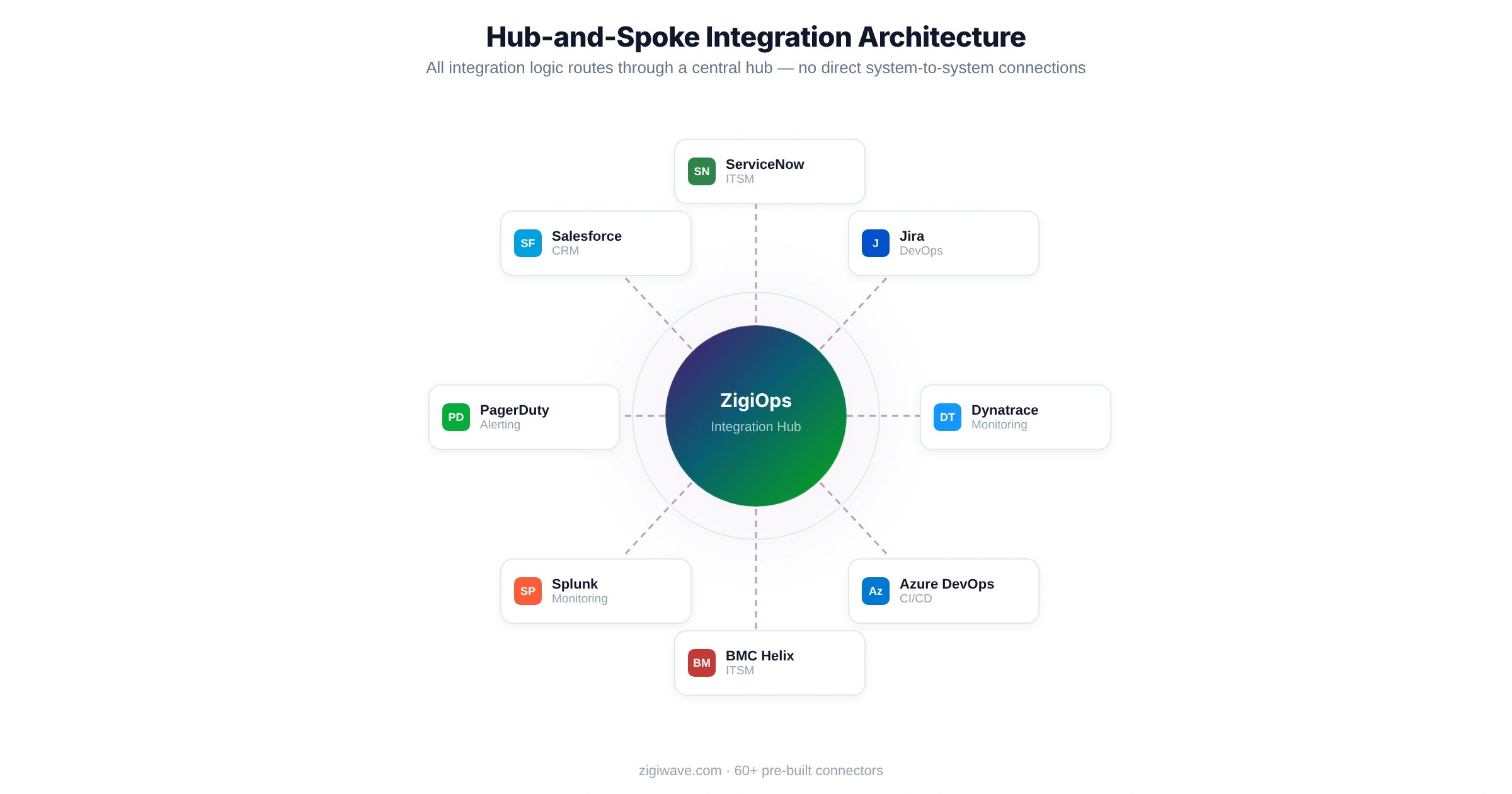
The hub-and-spoke model is the most widely deployed pattern in integration architecture enterprise environments. It places a central integration hub — sometimes called an Enterprise Service Bus (ESB), integration broker, or iPaaS platform — at the core of all communication. Every connected application speaks only to the hub, not to each other.
How Hub-and-Spoke Works
In a hub-and-spoke topology, each "spoke" is an application or service that sends and receives data exclusively through the central hub. The hub handles all routing, transformation, enrichment, and error handling. If ServiceNow needs to send an incident to Jira, it sends it to the hub — and the hub routes it to Jira with the appropriate field mappings applied.
This centralization is both the model's greatest strength and its most discussed limitation. When the hub is robust and well-maintained, the entire ecosystem benefits. When the hub experiences latency or downtime, every connected system feels it.
Advantages of Hub-and-Spoke
The hub-and-spoke model offers meaningful benefits for enterprises managing complex tool ecosystems:
Centralized governance — All integration logic, transformations, and routing rules live in one place. Auditing, monitoring, and compliance enforcement are dramatically simpler.
Reduced complexity at the edges — Individual applications only need one connection (to the hub), not N-1 connections to every other system. This significantly reduces the number of integration points to maintain.
Simplified onboarding — Adding a new application means building one connector to the hub, not multiple point-to-point integrations with every existing system.
Consistent data transformation — Business logic for field mapping, data enrichment, and format conversion is applied uniformly at the hub level rather than being scattered across dozens of bespoke integrations.
Easier troubleshooting — When a data flow fails, engineers know exactly where to look: the hub. Log centralization and single-point debugging reduce mean time to resolution (MTTR).
Limitations of Hub-and-Spoke
No architecture is without tradeoffs. The hub-and-spoke model carries risks that must be actively managed:
Single point of failure — If the hub goes down, all integrations stop. High-availability configurations and redundant deployments are essential for production environments.
Performance bottleneck — At high data volumes, routing everything through a central hub can introduce latency. This is especially relevant for real-time event streaming use cases.
Vendor lock-in risk — Many hub implementations are tightly coupled to a specific vendor's platform, making migrations costly and complex.
Hub sprawl — In large enterprises, teams often deploy multiple independent hubs for different departments, reintroducing the complexity the model was meant to eliminate.
Mesh Integration Architecture
The mesh model — sometimes called a "service mesh" or "decentralized integration" pattern — distributes integration logic across the network rather than centralizing it. In a mesh topology, each service or application can communicate directly with any other service, typically via APIs, event streams, or message queues.
Modern implementations of mesh cross-platform integration architecture often leverage microservices frameworks, API gateways, and event-driven architectures (EDA). The goal is to eliminate the bottleneck and single point of failure inherent in hub-and-spoke, while enabling greater autonomy for individual teams and services.
Mesh Integration Architecture
The mesh model — sometimes called a "service mesh" or "decentralized integration" pattern — distributes integration logic across the network rather than centralizing it. In a mesh topology, each service or application can communicate directly with any other service, typically via APIs, event streams, or message queues.
Modern implementations of mesh cross-platform integration architecture often leverage microservices frameworks, API gateways, and event-driven architectures (EDA). The goal is to eliminate the bottleneck and single point of failure inherent in hub-and-spoke, while enabling greater autonomy for individual teams and services.
How Mesh Integration Works
In a mesh topology, services publish and subscribe to events or call each other's APIs directly. An event broker (such as Apache Kafka or AWS EventBridge) may coordinate message delivery without being a centralized transformation hub. Each service retains its own integration logic, schemas, and data contracts.
This model aligns naturally with cloud-native and microservices architectures, where teams ship independently and services scale horizontally. It is also a natural fit for integration architecture enterprise environments that have adopted a "platform engineering" or "API-first" philosophy.
"Event-driven architecture (EDA) and API-led connectivity are converging to form the backbone of next-generation enterprise integration, enabling organizations to achieve both agility and scalability at the same time."
— Forrester, The Forrester Wave: Enterprise Integration Platform As A Service
Advantages of Mesh Integration Architecture
The mesh pattern offers distinct advantages, particularly for modern cloud-native enterprises:
No single point of failure — Because integration logic is distributed, the failure of one service or integration path does not cascade across the entire ecosystem.
High scalability — Individual services can scale independently. There is no central bottleneck that must be scaled to accommodate the entire organization's data volume.
Team autonomy — Development teams can manage their own integrations, schemas, and data contracts without waiting for a central integration team to implement changes.
Lower latency for direct service-to-service communication — Without a central routing layer, messages can be exchanged more quickly between services that communicate frequently.
Resilience — Distributed architectures with circuit breakers and retry logic can continue operating in degraded mode even when individual nodes fail.
Limitations of Mesh Integration Architecture
The mesh model also introduces significant challenges that must not be underestimated:
Governance complexity — Without centralized control, enforcing consistent data standards, security policies, and compliance rules across a mesh is extremely difficult.
Debugging and observability gaps — Tracing a failed data flow through dozens of distributed service-to-service connections requires mature distributed tracing tooling (e.g., OpenTelemetry, Jaeger).
Exponential connection growth — In a fully connected mesh of N services, there are N(N-1)/2 potential connection paths. Managing this at scale becomes an operational challenge without strong API governance.
Inconsistent transformation logic — Each service may implement its own field mapping and data transformation rules, leading to discrepancies and data quality issues over time.
Higher initial investment — Building and operating a mesh architecture requires sophisticated tooling, experienced engineers, and mature DevOps practices.
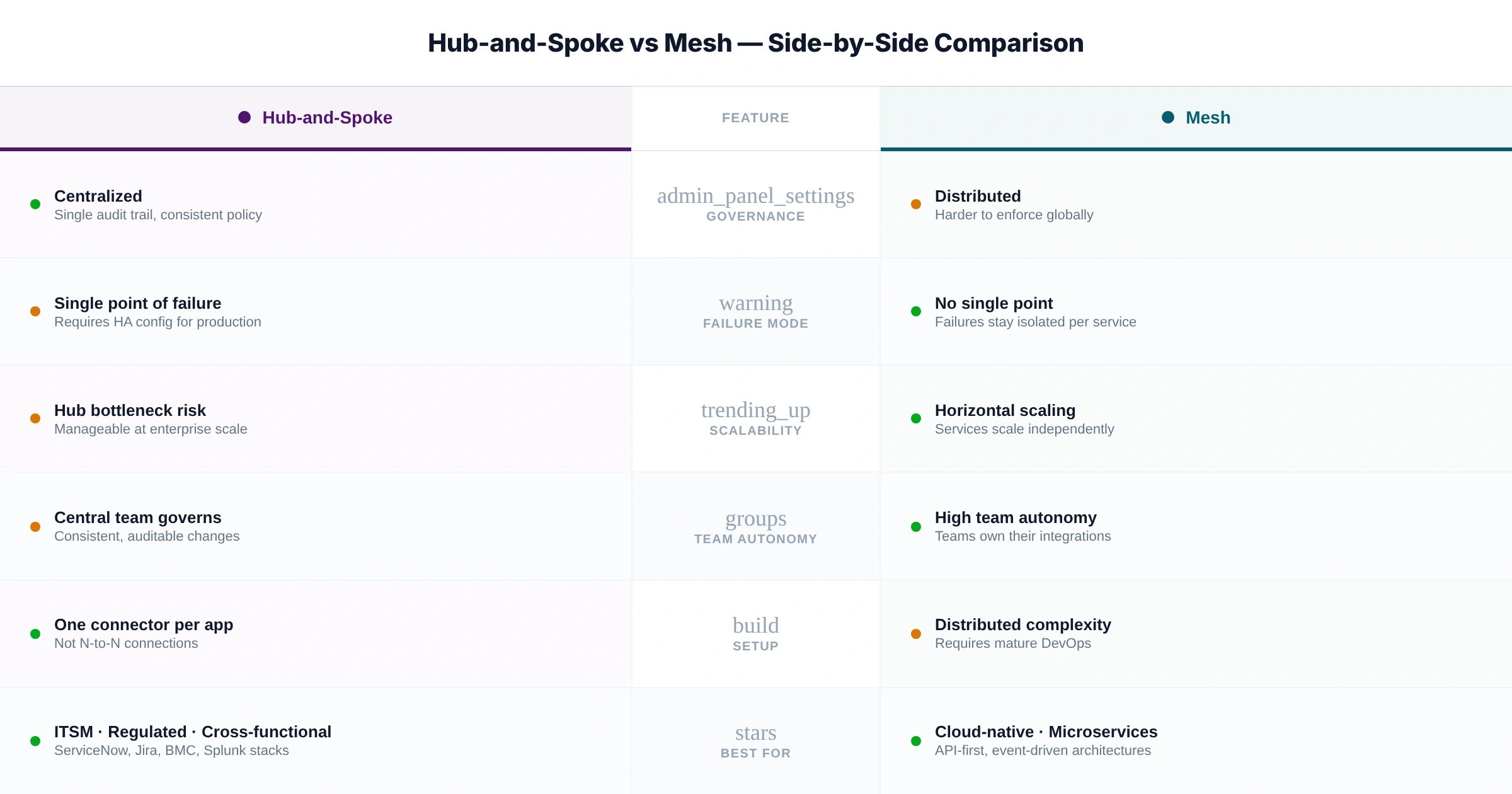
Hub-and-Spoke vs Mesh: Side-by-Side Comparison
When evaluating cross-platform integration architecture options, a direct comparison helps clarify which model aligns with your organization's maturity, scale, and operational priorities.
How to Choose the Right Cross-Platform Integration Architecture
The choice between hub-and-spoke and mesh is rarely binary. Most mature integration architecture enterprise environments use a hybrid approach — deploying a hub for governed, cross-functional workflows while allowing mesh patterns within specific domains or microservices clusters.
The right starting point depends on several key factors specific to your organization.
Assess Your Current Integration Complexity
If your enterprise currently manages 5–20 integrated systems with a central IT team governing data flows, hub-and-spoke is almost certainly the right foundation. The operational overhead of a mesh at this scale is not justified, and the governance benefits of centralization are significant.
If you are running hundreds of microservices with independent teams and an API-first engineering culture, mesh patterns may already be embedded in your architecture — and your challenge is adding governance and observability, not choosing a topology.
Evaluate Your Governance Requirements
Regulated industries — healthcare, financial services, government — typically require strict audit trails, data residency controls, and centralized policy enforcement. These requirements align strongly with hub-and-spoke, where all data flows through a single governed layer.
Enterprises subject to GDPR, HIPAA, SOC 2, or ISO 27001 should carefully evaluate how a mesh architecture can enforce consistent data handling policies before committing to a decentralized model.
Consider Your Team's Technical Maturity
Mesh architectures require teams that are comfortable with distributed systems, API versioning, contract testing, and observability tooling. Organizations without this expertise often find that the theoretical benefits of mesh are outweighed by the operational reality of managing it.
A no-code enterprise integration platform like ZigiOps can dramatically lower the barrier to implementing robust hub-and-spoke integrations — enabling IT teams to build, configure, and maintain complex data flows without specialized middleware development skills.
"Organizations that adopt low-code and no-code integration platforms reduce their integration development time by 50–70% compared to traditional hand-coded approaches, while also reducing the skills barrier for IT operations teams."
— Gartner, Low-Code and No-Code Application Development Technologies
Integration Architecture Enterprise Best Practices
Regardless of which topology you choose, the following practices are essential for any successful integration architecture enterprise deployment.
Design for Failure from Day One
Every integration will eventually fail — whether due to API changes, network partitions, or schema evolution. Design your architecture with retry logic, dead-letter queues, circuit breakers, and alerting built in before the first production incident occurs.
Standardize on a Canonical Data Model
In hub-and-spoke environments, define a canonical data model that serves as the universal language for all integrations. Every incoming and outgoing message is translated to and from this canonical format at the hub. This eliminates the N-to-N transformation problem that plagues point-to-point integrations.
Invest in End-to-End Observability
Whether you choose hub-and-spoke or mesh, you need complete visibility into every data flow. This means correlation IDs that persist across system boundaries, structured logging, and dashboards that show the health of your integrations in real time. For ITSM environments, this visibility is especially critical — see how enterprise Jira–ServiceNow integration achieves this with ZigiOps.
Plan for Schema Evolution
APIs change. Fields get added, renamed, or deprecated. Your integration architecture must handle these changes gracefully without causing downstream failures. Versioning strategies, backward-compatible schema changes, and automated contract testing are all essential in long-lived enterprise environments.
Evaluate Your Enterprise Integration Platform Carefully
The enterprise integration platform you choose will shape your architecture for years. Evaluate vendors not just on feature lists, but on connector breadth, deployment flexibility (cloud, on-prem, hybrid), data transformation capabilities, and total cost of ownership. For a detailed comparison of leading platforms, see our Workato vs Exalate vs ZigiOps comparison.
How ZigiOps Supports Both Integration Architecture Models
ZigiOps is ZigiWave's no-code enterprise integration platform built specifically for IT Operations. It enables IT teams to build and manage sophisticated cross-platform integration architecture deployments without writing code, hiring middleware specialists, or enduring months-long implementation cycles.
ZigiOps as a Hub-and-Spoke Engine
ZigiOps excels as the central hub in hub-and-spoke deployments. It provides pre-built connectors for the most widely used ITSM, monitoring, DevOps, and project management platforms — including ServiceNow, Jira, Dynatrace, BMC Helix, Salesforce, PagerDuty, Splunk, and many more.
All data transformation, field mapping, filtering, and routing logic is configured visually through ZigiOps' no-code interface. Bidirectional sync, real-time event triggers, and conditional logic are all available without touching a single line of code. This makes ZigiOps ideal for IT Managers and system administrators who need enterprise-grade integration capabilities without enterprise-grade complexity.
ZigiOps also supports hybrid deployment models — running on-premises, in your private cloud, or connecting to SaaS platforms — which is essential for enterprises with strict data residency requirements. You can explore the full connector library at zigiwave.com/integrations.
ZigiOps in Mesh and Hybrid Environments
In mesh or hybrid architectures, ZigiOps can serve as the governed integration layer for cross-domain workflows — handling the complex, multi-system data flows that require transformation and business logic — while lighter-weight service-to-service calls within a domain operate independently.
This hybrid approach gives enterprises the governance and observability of hub-and-spoke for their most critical integrations, while preserving the autonomy and scalability of mesh within specific service clusters.
"The most successful enterprise integration strategies in 2024 are hybrid by design — using centralized governance layers for regulated, cross-functional workflows while enabling decentralized, event-driven patterns within product and service domains."
— TechTarget, Hybrid Integration Platform: What It Is and Why You Need One
Real-World Integration Architecture Enterprise Use Cases
ZigiOps powers cross-platform integration architecture deployments across a range of enterprise scenarios:
Incident management synchronization — Bidirectional sync between ServiceNow and Jira Software, ensuring that incidents created in either system are automatically reflected in the other with full field mapping and priority logic applied.
Monitoring-to-ITSM escalation — Dynatrace or Splunk alerts automatically create incidents in ServiceNow or BMC Helix, with enriched context — host, application, severity, and impacted services — pre-populated from the monitoring payload.
Change management workflows — Change requests approved in ServiceNow automatically trigger deployment pipelines in Jenkins or Azure DevOps, closing the loop between ITSM and DevOps toolchains.
CMDB enrichment — Asset and configuration data from discovery tools and cloud providers is continuously synchronized into ServiceNow CMDB, keeping configuration items current without manual data entry.
These use cases reflect how the future of enterprise application integration is moving — toward automated, bidirectional, and context-rich data flows. For a deeper look at where this is heading, read our analysis of the future of enterprise application integration.
The Future of Cross-Platform Integration Architecture
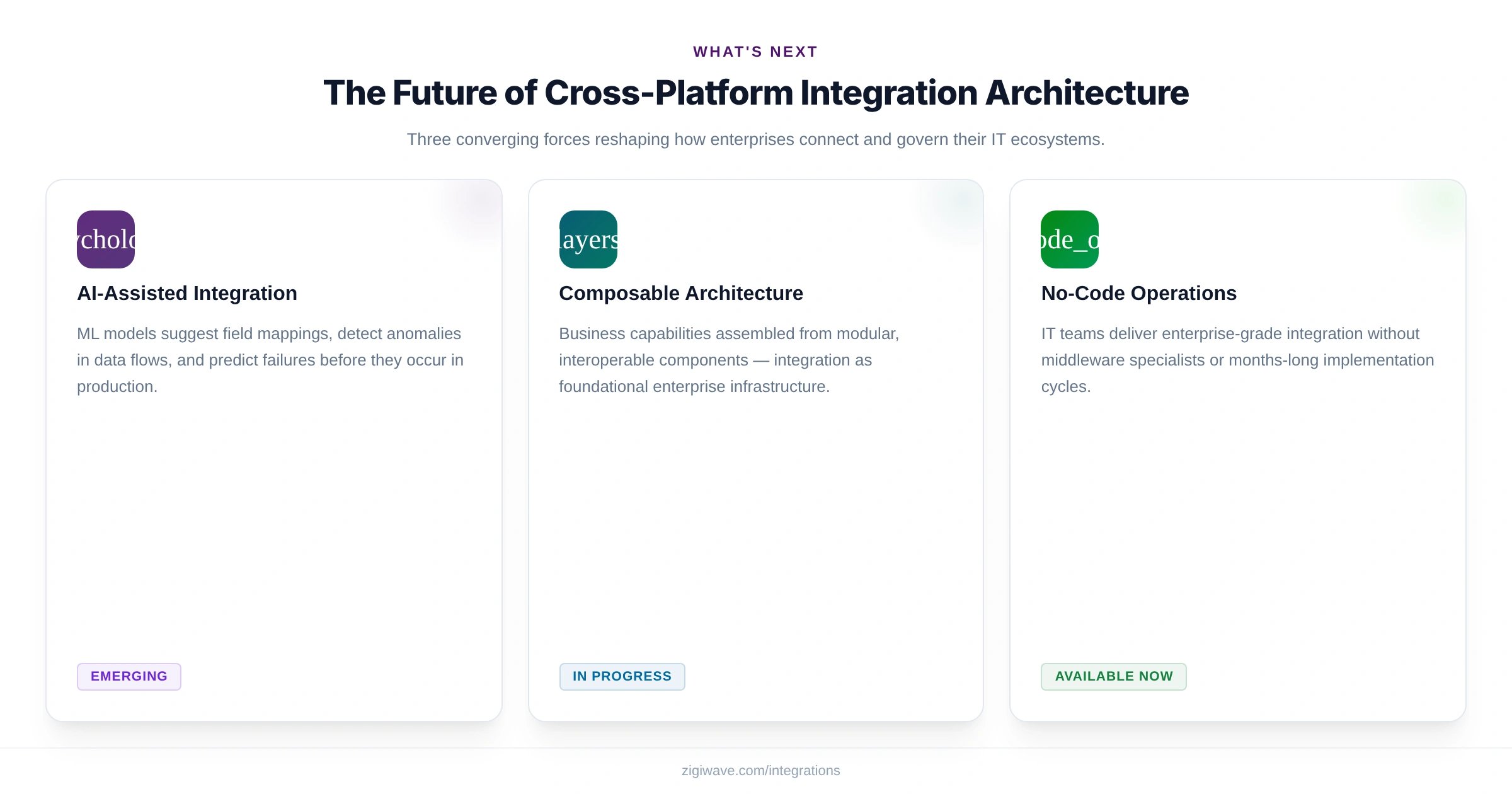
The evolution of cross-platform integration architecture is being driven by several converging forces: the explosion of SaaS tools in enterprise stacks, the shift to cloud-native infrastructure, increasing regulatory complexity, and the growing expectation that IT Operations teams deliver value without waiting months for integration projects to complete.
AI-assisted integration — where machine learning models suggest field mappings, detect anomalies in data flows, and predict integration failures before they occur — is emerging as the next frontier. Platforms that combine no-code accessibility with AI-driven intelligence will define the next generation of enterprise integration platform capabilities.
The shift toward composable enterprise architecture — where business capabilities are assembled from modular, interoperable components — also reinforces the importance of robust cross-platform integration architecture as a foundational discipline, not an afterthought.
For IT leaders evaluating their integration strategy today, the right question is not "hub-and-spoke or mesh?" but rather: "How do we build an integration architecture that is governed, observable, adaptable, and accessible to our entire IT team — not just integration specialists?"
Authoritative guidance from The Open Group TOGAF Architecture Framework and IBM's Enterprise Integration resources both emphasize that the best enterprise architectures are those that prioritize flexibility and governance simultaneously — a balance that purpose-built platforms like ZigiOps are designed to deliver.
Conclusion: Choosing Your Cross-Platform Integration Architecture
Both hub-and-spoke and mesh represent valid, proven approaches to cross-platform integration architecture. The right choice depends on your organization's size, technical maturity, governance requirements, and the specific systems you need to connect.
For most enterprise IT environments — particularly those managing ITSM, DevOps, monitoring, and project management tool ecosystems — the hub-and-spoke model provides the strongest foundation. It delivers centralized governance, consistent data transformation, and operational simplicity that aligns with how IT Operations teams actually work.
ZigiOps gives you a no-code path to implementing that architecture without the complexity, cost, or time investment of traditional middleware. Whether you are connecting two systems or twenty, ZigiOps scales with your needs while keeping your integration logic visible, manageable, and maintainable.
If you are ready to evaluate how ZigiOps can support your cross-platform integration architecture, explore the full connector library at zigiwave.com/integrations or review our detailed platform comparison guide to see how ZigiOps stacks up against the alternatives.