Enterprise Integration Platform Guide 2026: Why Zero Data Storage Matters
The 2026 guide to enterprise integration platforms and zero data storage.
An enterprise integration platform is software that connects disparate business applications, enabling automated, real-time data exchange across your organization without manual intervention. In 2026, the defining question is not just whether a platform can connect your tools, but whether it does so without storing your sensitive data in the process.
If you manage IT operations across multiple tools, you already know the frustration. Incidents land in ServiceNow. Tickets live in Jira. Alerts fire from your monitoring stack. And somewhere in between, a human is copying and pasting data that should be flowing automatically.
Enterprise integration platforms exist to fix this. But in 2026, with GDPR enforcement tighter than ever and enterprise security audits becoming table stakes, the platform you pick needs to do more than move data. It needs to do it without holding onto that data at any point.
This guide covers how enterprise integration platforms work, the key architectural patterns to understand, how AI is changing configuration, and, critically, why zero data storage is the compliance differentiator no one talks about enough.
What Is an Enterprise Integration Platform?
An enterprise integration platform, sometimes called an Enterprise Application Integration (EAI) platform, is a layer of software that sits between your business applications and orchestrates how they exchange data. Rather than building point-to-point connections between every pair of tools, an integration platform provides a central hub for defining, managing, and monitoring all your integrations.
According to Wikipedia, " System integration involves integrating existing, often disparate systems in such a way "that focuses on increasing value to the customer". In enterprise contexts, this means connecting ITSM platforms, DevOps pipelines, monitoring systems, CRM tools, and cloud services so that data flows between them accurately and in real time.
Modern enterprise integration platforms typically support three core capabilities: connecting to third-party systems via APIs, transforming data between formats, and automating multi-step workflows across tools. The best ones do all three without requiring a single line of code.
Enterprise Integration Patterns: ESB, Message Queues, and Beyond
Understanding integration patterns helps you evaluate platforms more critically. Here are the main architectural approaches in use today:
Enterprise Service Bus (ESB)
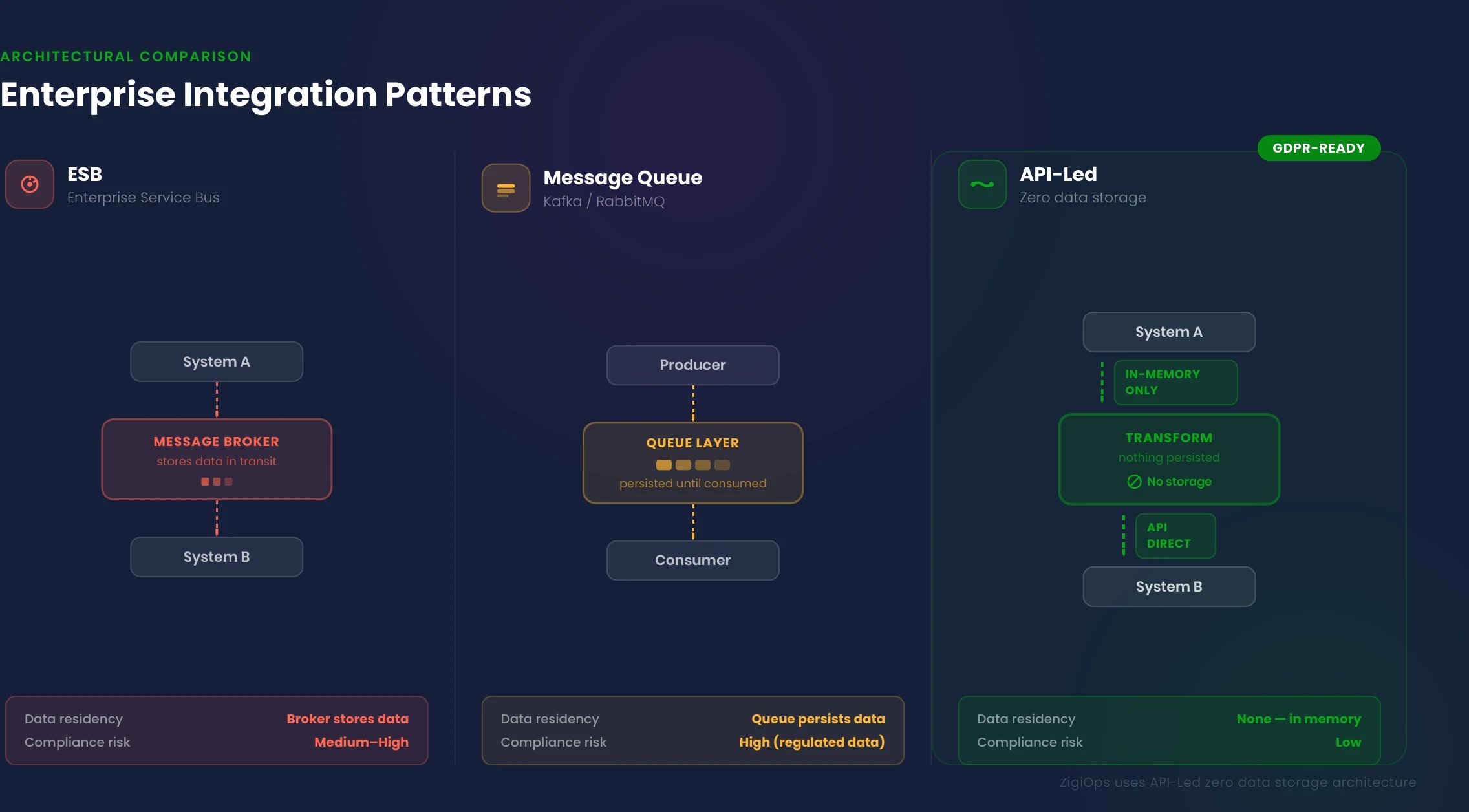
The ESB model routes messages between systems through a centralized broker. It was the dominant pattern in the 2000s and 2010s, offering strong decoupling and routing flexibility. The downside: ESBs tend to become complex, expensive to maintain, and in many implementations, they store message data temporarily in transit. For regulated industries, that transient storage creates compliance surface area.
Message Queues
Message queue-based integration is powerful for high-throughput, event-driven architectures. However, queue systems inherently persist messages until they are consumed, meaning your business data sits in a queue layer. For GDPR-sensitive data like personal information in support tickets, this persistence requires careful governance.
API-Led Connectivity and Zero-Touch Data Transfer
The more modern approach routes data directly between systems via APIs in real time, without storing anything in an intermediate layer. This is the model that enterprise integration platforms like ZigiOps use. Data is fetched from System A and written directly to System B, with transformation happening in memory. Nothing is persisted on the integration layer itself. For organizations subject to GDPR, HIPAA, or SOC 2, this architecture simplifies compliance dramatically.
Integration Pattern Comparison
Note: Compliance risk ratings reflect typical implementations. Always review your specific vendor's data handling policies
The Hidden Risk: Why Data Storage in Your Integration Layer Is a Compliance Liability
Most integration platform evaluations focus on feature checklists: Which connectors are supported? How fast is setup? What does pricing look like? Rarely does the question of data residency come up until a data breach, an audit, or a GDPR inquiry forces it.
Here is the core issue: when an integration platform stores data, even temporarily, that data becomes subject to the same governance requirements as any other data store in your organization. Every integration record containing a ticket description, user email, or incident detail is potentially personal data under GDPR. If your integration platform is holding that data at any point, you need to know where, for how long, and under what encryption and access controls.
The GDPR's data minimization principle (Article 5(1)(c)) requires that personal data be "adequate, relevant and limited to what is necessary in relation to the purposes for which they are processed." An integration platform that stores data as part of its architecture processes more data than necessary, by definition. The European Data Protection Board's guidance on data minimization makes this expectation explicit: "storage limitation" is a core design requirement, not an afterthought.
This is where zero data storage architecture becomes a genuine differentiator. Platforms built on this principle never write integration data to disk. Transformations happen in memory, and the processed record is immediately delivered to the target system. The integration layer itself holds no data that could be subpoenaed, breached, or misplaced.
AI-Assisted Integration Configuration: A Neutral Look
AI is entering the enterprise integration space fast. Most vendors are now embedding AI assistants that can suggest field mappings, auto-detect data schemas, or recommend workflow configurations based on how other customers have set up similar integrations.
The value is real. AI-assisted configuration can reduce setup time significantly, especially for organizations with limited integration expertise. But it is worth understanding the different approaches:
- Vendor-specific AI assistants (like Exalate's Aida) are trained on that vendor's data model and work best within that ecosystem. They offer deep capability for supported systems but limited transferability.
- General LLM-powered mapping uses foundation models (GPT-4, Gemini) to suggest field mappings based on schema analysis. More flexible, but output quality depends heavily on schema clarity and prompt engineering.
- Guided UI with intelligent defaults (the approach used by ZigiOps) provides a structured configuration flow where the platform guides you step-by-step through authentication, trigger setup, field mapping, and testing. No AI required for the user, because the UI removes ambiguity at every stage.
The most important question to ask any vendor: where is your AI processing happening, and does it involve sending customer data to a third-party model? For regulated industries, the answer to that question shapes your risk posture significantly.
Enterprise Compliance Requirements: GDPR and ISO 27001 in Practice
For enterprise buyers in regulated industries, two compliance frameworks dominate integration platform evaluations: GDPR for data privacy (especially in Europe and for any organization processing EU resident data), and ISO 27001 for information security management.
What GDPR Actually Requires of Your Integration Platform
GDPR does not explicitly require you to use a specific type of integration architecture. But several of its core principles have direct implications for how integration platforms should be designed:
• Data minimization (Article 5(1)(c)): Only process and store data that is strictly necessary for the purpose.
• Storage limitation (Article 5(1)(e)): Data should not be kept longer than necessary.
• Integrity and confidentiality (Article 5(1)(f)): Data must be protected against unauthorized access, including during processing.
• Data processor accountability (Article 28): If your integration platform vendor processes personal data, they must do so under a formal data processing agreement.
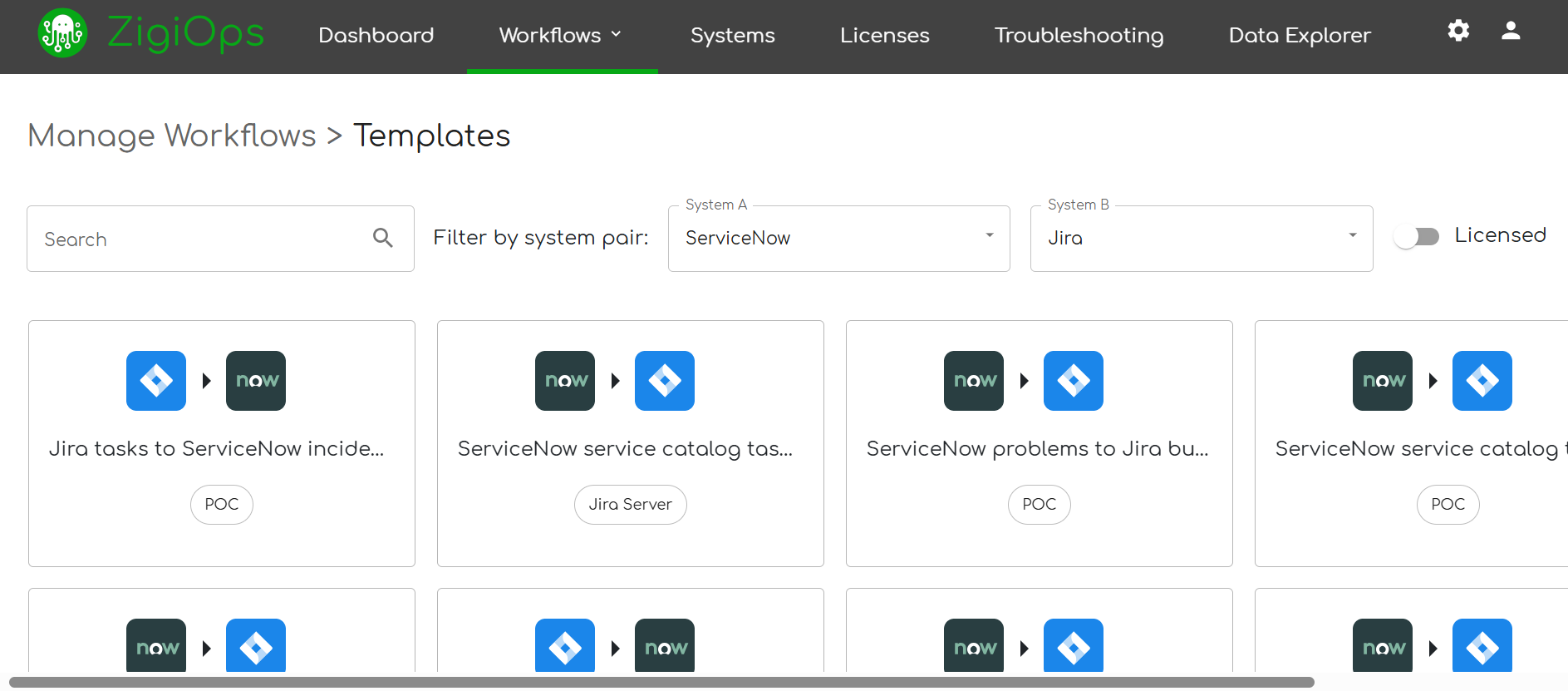
A zero data storage integration platform satisfies the storage limitation and minimization principles by design. No data persists on the platform. If your integration vendor does not store data, you eliminate an entire category of GDPR exposure.
ISO 27001: What Certification Actually Means
ISO 27001 is the international standard for Information Security Management Systems. Certification means an independent auditor has verified that a vendor has implemented controls across 93 security categories, from access management and asset classification to cryptography and supplier relationships. ServiceNow's trust documentation lists ISO 27001 as one of its core compliance certifications, reflecting the standard's importance in enterprise technology procurement.
For integration platform buyers, ISO 27001 certification from your vendor means the vendor has undergone a rigorous third-party security audit. It is not a guarantee of perfection, but it is a meaningful baseline, especially compared to vendors who rely on self-attestation alone.
ZigiOps is ISO 27001 certified. Combined with its zero data storage architecture, this means your integration layer has both the certified security controls and the architectural design to minimize data exposure from the start.
The ITSM Business Case: Vertical-Specific ROI
Generic ROI claims like "save 15 hours per week" are easy to produce and hard to verify. The business case for enterprise integration in IT and ITSM contexts is more specific, and more compelling, when you look at actual workflow impacts.
Incident Management
In ITSM environments, incidents often span multiple tools: detected in a monitoring system like Dynatrace or Datadog, tracked in ServiceNow, with development work managed in Jira. Without integration, the same incident is manually re-entered across three systems. Each re-entry introduces delay, errors, and gaps in the audit trail.
With automated integration, an incident detected in your monitoring tool triggers a ServiceNow incident automatically, which then creates a linked Jira issue for the dev team. Status updates flow back in both directions. A resolution in Jira closes the ServiceNow ticket. No manual handoffs. No missed updates. MTTR drops because the team is not waiting for information that should already be in front of them.
Change Management
Change requests that originate in Jira or Azure DevOps frequently need to be tracked in ServiceNow for ITIL compliance. Manual synchronization between change management systems is a known source of audit failures. Integration platforms that handle bidirectional sync ensure that change records remain consistent across systems, supporting ITIL processes without forcing teams to duplicate work.
Asset and Configuration Management
CMDB accuracy is a perennial IT operations challenge. Atlassian’s documentation on CMDB acknowledges the complexity of maintaining consistent configuration data across platforms. Automated integration between your asset management tools and CMDB keeps configuration item data current without requiring manual reconciliation cycles.
ITSM Integration ROI: Indicative Estimates by Workflow
Estimates based on typical enterprise ITSM team workflows. Actual savings depend on integration complexity and team size.
ZigiOps: Zero Data Storage Enterprise Integration in Practice
ZigiOps is a standalone, 100% code-free enterprise integration platform built specifically for IT, ITSM, DevOps, and operations teams. It connects over 50 enterprise systems including ServiceNow, Jira, Dynatrace, Datadog, Azure DevOps, Salesforce, and more, with no coding required at any stage of setup or operation.
The platform is designed around four principles that directly address the gaps in most enterprise integration platform evaluations:
• Zero data storage: ZigiOps does not store any of the data it transfers. Data flows directly between source and target systems via API, with transformations handled in memory. Nothing is written to a ZigiOps database or intermediate storage layer.
• ISO 27001 certified: ZigiOps has achieved ISO 27001 certification, providing enterprise buyers with independent verification of its security management controls.
• No transaction limits: Unlike many SaaS integration platforms that tier pricing by data volume, ZigiOps places no limits on the number of transactions. Your integration scales with your operations without unexpected cost spikes.
• Standalone application, not a plugin: ZigiOps runs independently rather than as a plugin inside another platform. This means better stability, full control over your deployment, and no dependency on a parent platform's release cycle.
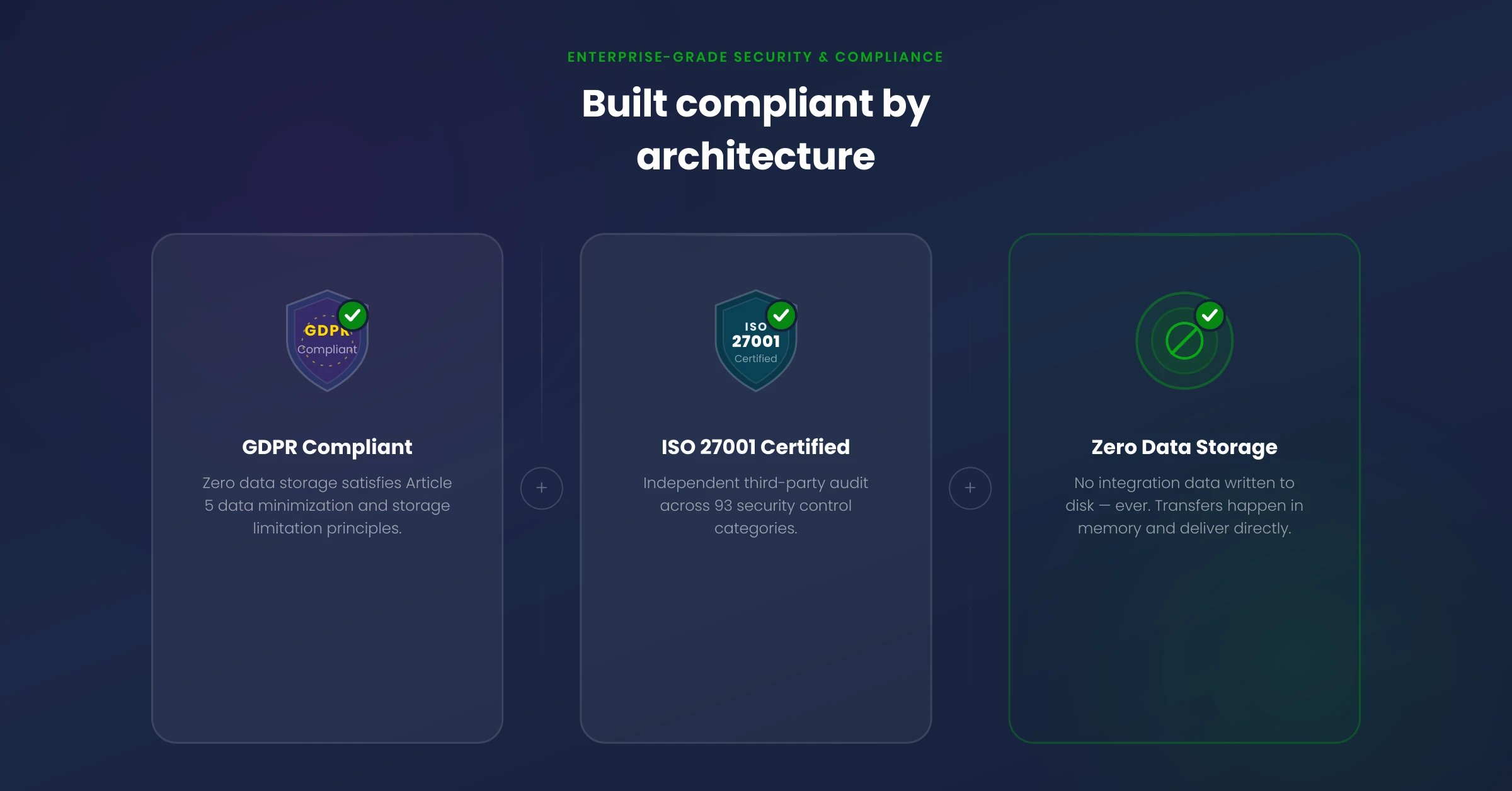
Teams using ZigiOps to connect their ITSM and DevOps tools can explore ready-to-use integration templates on the ZigiWave integrations page. For teams running ServiceNow alongside Jira, the ServiceNow-Jira integration guide walks through a typical setup end-to-end.
How to Evaluate an Enterprise Integration Platform: A Decision Checklist
Most integration platform evaluations get stuck on connector counts and pricing. Here is a more complete checklist for enterprise buyers, particularly those in regulated industries:
FAQ: Enterprise Integration Platforms in 2026
What is an enterprise integration platform?
An enterprise integration platform is software that connects separate business applications and automates data exchange between them. It eliminates manual data entry, reduces errors, and ensures teams working in different tools always have consistent, up-to-date information.
What is the difference between an ESB and a modern integration platform?
An Enterprise Service Bus (ESB) is an older architectural pattern that routes messages through a centralized broker, often storing data in transit. Modern API-led integration platforms move data directly between systems via APIs without intermediate storage, reducing compliance risk and architectural complexity.
Does GDPR apply to enterprise integration platforms?
Yes. If your integration platform processes personal data (such as names, email addresses, or support ticket details), it acts as a data processor under GDPR and must comply with data minimization, storage limitation, and confidentiality requirements. Platforms that store data in transit create additional compliance obligations that zero data storage architectures avoid.
Ready to see zero data storage integration in action? Connect your ITSM, DevOps, and monitoring tools with ZigiOps — no code, no data storage, no surprises on your next security audit. Book a Demo