Enterprise Integration Platform in 2026: Ready for AI?
Discover what enterprise application integration means in 2026
Enterprise application integration has always been the backbone of how IT organizations share data, coordinate workflows, and keep business systems aligned. But in 2026, it is no longer enough to simply connect applications and move data between them. The rise of agentic AI - autonomous AI systems that take action, make decisions, and orchestrate workflows without constant human input - is redefining what an enterprise integration platform must deliver.
If your integration infrastructure was built for point-to-point connections or batch data transfers, it may already be falling behind. Now, let's break down what enterprise application integration looks like today, why agentic AI integration is changing the rules, and how to evaluate whether your platform is ready for what comes next.
What Is Enterprise Application Integration in 2026?
Enterprise application integration (EAI) refers to the frameworks, tools, and processes that enable disparate software systems - across IT operations, business units, and cloud environments - to communicate, share data, and work together as a cohesive whole. In its earliest form, EAI meant building custom point-to-point connectors between systems like CRMs, ERPs, and ITSM tools.
In 2026, the definition has expanded considerably. Modern enterprise application integration must handle real-time event streaming, bidirectional synchronization, complex transformation logic, and increasingly, the data pipelines that feed AI agents. It is no longer purely a technical concern - it is a strategic capability that determines how fast an organization can respond, adapt, and automate.
- The scope of enterprise application integration today typically includes:
- Connecting cloud-native and legacy on-premise systems in hybrid architectures
- Enabling real-time data synchronization across ITSM, DevOps, monitoring, and security tools
- Supporting API-based integrations alongside event-driven and message-based patterns
- Providing visibility and governance over data flows at enterprise scale
- Feeding structured, reliable data into AI and machine learning systems
"By 2026, more than 80% of enterprises will have deployed some form of application integration middleware, yet fewer than 30% will have integration strategies that are AI-ready." - Gartner Reports
This gap between deployment and readiness is precisely where most organizations find themselves today. They have integration in place, but it was not designed for the demands of intelligent automation or autonomous AI workflows.
Core Components of a Modern Enterprise Integration Platform
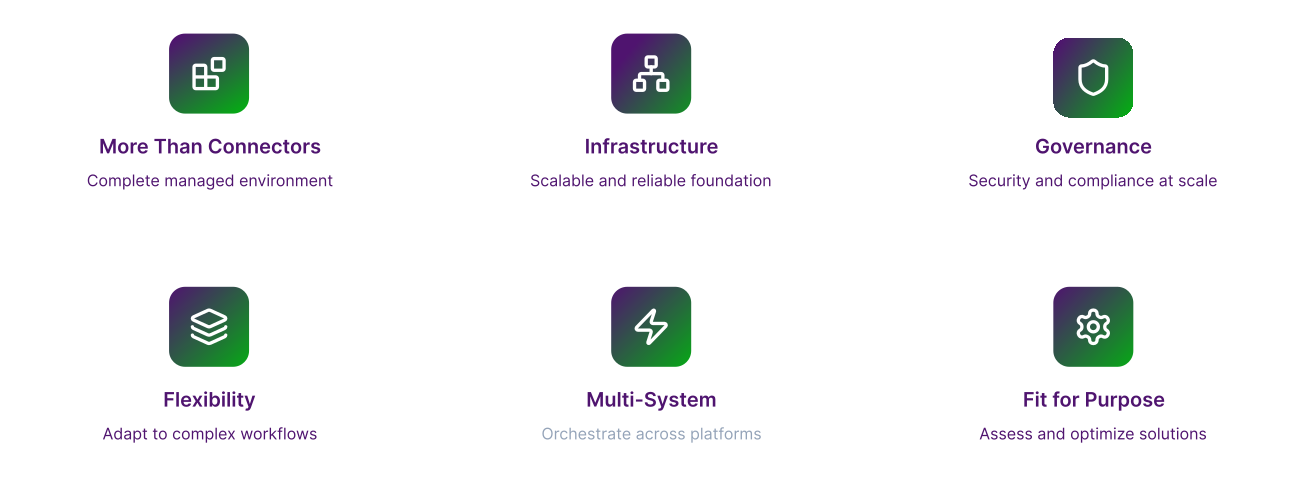
A modern enterprise integration platform is more than a collection of connectors. It is a managed environment that provides the infrastructure, governance, and flexibility to support complex, multi-system workflows at scale. Understanding its core components helps IT leaders assess whether their current solution is truly fit for purpose.
1. Connectivity and Protocol Support
A capable enterprise integration platform must support a wide range of connectivity options - REST APIs, SOAP, GraphQL, webhooks, message queues, and proprietary vendor APIs. The more protocols and systems it supports natively, the less custom development your team needs to maintain.
Equally important is the ability to connect both modern SaaS platforms and legacy systems that may still run on older protocols. In most enterprise environments, both coexist, and your integration layer must bridge that gap reliably.
2. Data Transformation and Mapping
Raw data rarely moves cleanly from one system to another. Fields have different names, formats differ, and business rules must be applied in transit. Enterprise application integration platforms must provide robust data transformation capabilities - ideally through visual, no-code mapping tools that do not require developer intervention for every change. This is especially critical in ITSM environments, where a ticket in ServiceNow may need to map to an issue in Jira, an alert in PagerDuty, and a record in a CMDB - each with its own schema and field structure.
3. Workflow Orchestration
Beyond simple data transfer, enterprise application integration increasingly involves orchestrating multi-step workflows that span multiple systems. When an incident is detected in a monitoring tool, the integration layer should be able to trigger ticket creation, notify on-call teams, update a CMDB, and escalate to a change management process - all automatically.
This kind of orchestration requires conditional logic, error handling, retry mechanisms, and the ability to manage state across systems. Platforms that only offer basic one-way sync are not equipped for this level of complexity.
4. Security and Compliance Controls
Enterprise application integration touches sensitive data across many systems. Security cannot be an afterthought. Role-based access controls, data encryption in transit and at rest, audit logging, and compliance with frameworks like SOC 2, ISO 27001, and GDPR are baseline requirements for any enterprise-grade platform.
For IT teams managing integrations in regulated industries - healthcare, finance, government - these controls are non-negotiable. You can explore how ZigiOps approaches this challenge in detail at ZigiWave's secure enterprise integration resource.
5. Monitoring, Observability, and Alerting
If you cannot see what your integrations are doing, you cannot trust them. A mature enterprise integration platform provides real-time monitoring of data flows, error rates, latency, and system health. It should surface anomalies proactively and provide the logs and audit trails needed to diagnose issues quickly.
Why Agentic AI Integration Changes Everything
Agentic AI refers to AI systems that do not just analyze or recommend - they act. These systems can autonomously plan multi-step tasks, call external tools and APIs, make decisions based on context, and loop back to refine their actions based on outcomes. Think of an AI agent that detects an anomaly in your infrastructure, opens an incident ticket, queries your CMDB for affected assets, notifies the relevant team in Slack, and proposes a remediation plan - all without a human initiating each step.
This is not science fiction. Platforms like ServiceNow, Microsoft Copilot, and Atlassian Intelligence are already deploying agentic capabilities into production ITSM environments. The question is whether your enterprise application integration layer can support them.
"Agentic AI will be the most transformative enterprise technology trend through 2028, with organizations that invest in AI-ready integration infrastructure seeing up to 40% faster incident resolution times." - Icetea Software
What Agentic AI Demands from Enterprise Application Integration
Agentic AI integration requires a fundamentally different kind of data infrastructure than traditional batch processing or scheduled syncs. AI agents need:
- Real-time data access: Agents cannot wait for nightly data syncs. They need up-to-date information from all connected systems to make accurate decisions.
- Bidirectional action capability: Agentic AI does not just read data — it writes back. Your integration layer must support both inbound and outbound operations reliably and securely.
- Contextual data enrichment: A ticket number alone is not useful to an AI agent. It needs enriched context — related assets, historical incidents, owner information, SLA status — assembled from multiple systems in real time.
- Low-latency event handling: Agents respond to events. Your enterprise application integration platform must be able to detect, process, and route events with minimal delay.
- Reliable error handling and idempotency: Agents may retry actions. Your integration layer must handle duplicate events gracefully to avoid creating duplicate tickets, alerts, or records.
Organizations that are still relying on brittle, point-to-point integrations or outdated middleware will find that their agentic AI investments deliver far less value than expected — because the data feeding those agents is stale, incomplete, or unreliable.
Enterprise Application Integration Patterns You Need to Know
Not all integration approaches are created equal. Understanding the dominant patterns in enterprise application integration helps IT architects make better decisions about which approach fits their environment — and which will scale to support AI workloads.
- Point-to-Point Integration: This is the simplest form of enterprise application integration, where two systems are directly connected through a custom-built connector. It works for small environments but becomes unmanageable at scale. With 10 systems, you need up to 45 individual connectors. Maintenance overhead grows exponentially with every new tool added.
- Hub-and-Spoke Integration: In this pattern, a central hub mediates all communication between systems. It reduces the number of connections needed but can create a single point of failure. Traditional enterprise service buses (ESBs) follow this model and are still found in many legacy environments.
- API-Led Connectivity: Popularized by vendors like MuleSoft, API-led connectivity organizes integrations into layers — system APIs that expose core systems, process APIs that orchestrate business logic, and experience APIs that deliver data to end applications. This approach improves reusability and governance but requires significant development investment.
- Event-Driven Integration: Event-driven architectures decouple systems by having them publish and subscribe to events rather than calling each other directly. This pattern is increasingly important for agentic AI integration, where agents need to react to real-time events across the enterprise without polling systems continuously.
- No-Code Integration Platforms: No-code and low-code enterprise integration platforms allow IT operations teams to build and manage integrations without writing custom code. This democratizes integration, reduces dependency on specialized developers, and dramatically shortens deployment timelines. For IT teams that need to move fast and adapt frequently, no-code platforms offer a compelling balance of flexibility and speed.
"Low-code and no-code platforms are reshaping the integration market, enabling business technologists and IT operators to build sophisticated data pipelines without traditional development resources." - Venturesian
Key Use Cases for Enterprise Application Integration in IT Operations
For IT Managers, system administrators, and CTOs, the value of enterprise application integration is most visible in operational outcomes. Here are the use cases where a strong integration foundation makes a measurable difference.
ITSM and DevOps Tool Synchronization
Most IT organizations operate with a mix of ITSM platforms (ServiceNow, Jira Service Management, BMC Helix), DevOps tools (Jira Software, GitHub, Azure DevOps), and monitoring solutions (Datadog, Dynatrace, PagerDuty). Keeping these systems in sync - so that incidents, changes, and deployments are reflected accurately across all platforms - is a core enterprise application integration challenge.
Without it, teams waste time manually updating tickets, context gets lost between tools, and SLA compliance suffers. With proper integration, a single incident can flow through detection, triage, escalation, and resolution with full traceability across every system involved.
Incident Management and AIOps
AIOps platforms rely on high-quality, real-time data from across the IT environment. Enterprise application integration is what makes that data available - correlating alerts from multiple monitoring tools, enriching them with CMDB context, and routing them to the right response workflows. As agentic AI integration matures, the same infrastructure will support autonomous remediation agents that act on those correlated events.
Change and Release Management
Change management workflows often span ITSM platforms, CMDB, CI/CD pipelines, and approval systems. Enterprise application integration enables these workflows to operate automatically — triggering change records when deployments are initiated, updating asset records when configurations change, and closing approvals when conditions are met.
Security Operations Integration
Security teams need integration between SIEM platforms, vulnerability management tools, ITSM systems, and communication platforms. When a critical vulnerability is detected, the integration layer should automatically create a remediation ticket, assign it based on asset ownership data from the CMDB, and notify the relevant team — without manual intervention.
Security-focused enterprise application integration requires particular attention to data governance and access controls. For guidance on building secure integration architectures, refer to ZigiWave's resource on secure enterprise integration.
.svg)
How to Evaluate Your Enterprise Integration Platform for 2026
With the demands of agentic AI integration and the growing complexity of enterprise IT environments, selecting or reassessing your enterprise integration platform requires a structured approach. Here are the criteria that matter most in 2026.
Does It Support Real-Time, Bidirectional Sync?
Many legacy integration tools were built for scheduled batch transfers. In 2026, that is insufficient. Your platform must support real-time event-driven synchronization and write-back capabilities across all connected systems. This is the foundation that agentic AI integration requires.
Is It No-Code or Low-Code for IT Operations Teams?
Enterprise application integration should not require a team of integration specialists or months of development time for every new workflow. Evaluate whether your platform enables IT operations staff - not just developers - to build, modify, and manage integrations independently.
What Is the Breadth of Native Connectors?
Assess how many of your existing tools are supported natively. Custom-built connectors create technical debt and break when vendors update their APIs. A platform with a wide, maintained connector library reduces this risk significantly.
You can explore ZigiOps' growing library of pre-built integrations.
How Does It Handle Data Governance and Security?
Evaluate audit logging, role-based access, encryption standards, and compliance certifications. In regulated industries, these are not optional features — they are requirements. Ask vendors for their security architecture documentation and third-party audit reports.
Can It Scale to Support AI Data Pipelines?
Agentic AI integration places new demands on throughput, latency, and data quality. Your platform should be able to handle high-frequency event streams, support data enrichment in transit, and maintain data consistency across distributed systems without performance degradation.
What Does the Vendor's AI Roadmap Look Like?
Integration platform vendors are at different stages of incorporating AI capabilities — from AI-assisted mapping and anomaly detection to fully AI-driven workflow generation. Understanding where your vendor is headed helps you assess whether your platform will continue to serve your needs as agentic AI adoption accelerates.
How ZigiOps Addresses Enterprise Application Integration for AI-Ready IT Operations
ZigiOps is a no-code enterprise integration platform purpose-built for IT operations teams. It is designed to connect the tools that IT organizations depend on — ServiceNow, Jira, BMC Helix, PagerDuty, Dynatrace, Datadog, GitHub, and dozens more — with real-time, bidirectional synchronization and deep data transformation capabilities.
What sets ZigiOps apart in the context of enterprise application integration for 2026 is its combination of operational depth and deployment simplicity. IT teams can configure complex, multi-step integration workflows through a visual interface without writing code. Integrations that would traditionally take weeks of development can be deployed in hours.
Key capabilities relevant to modern enterprise application integration include:
- No-code workflow builder that enables IT operations staff to design, deploy, and modify integration flows independently
- Bidirectional real-time sync across ITSM, monitoring, DevOps, and security tools with configurable field mapping and transformation logic
- Pre-built connector library covering the most widely used IT operations platforms, with regular updates to support evolving vendor APIs
- On-premise and cloud deployment options to support hybrid enterprise architectures with varying compliance requirements
- Audit logging and role-based access controls aligned with enterprise security and compliance standards
- Scalable event-driven architecture capable of supporting the high-throughput data pipelines that agentic AI workflows require
For IT organizations preparing their integration infrastructure for agentic AI, ZigiOps provides a reliable, governed data layer that AI agents can trust — ensuring the information they act on is accurate, current, and complete.
The Road Ahead: Enterprise Application Integration as a Strategic Asset
For too long, enterprise application integration has been treated as plumbing — necessary but unglamorous infrastructure that gets attention only when it breaks. In 2026, that perception is no longer sustainable. Integration is the connective tissue of the intelligent enterprise. It determines how fast your organization can respond to incidents, how effectively your teams can collaborate across tools, and critically, how capable your AI systems will be.
Organizations that invest in a modern, flexible enterprise integration platform today are building the foundation for agentic AI integration tomorrow. Those that do not will find themselves constrained - not by the AI technology itself, but by the inability to get reliable data to it fast enough to act on.
The competitive advantage in IT operations is increasingly being won not by the organizations with the most sophisticated AI models, but by those with the most reliable, real-time integration infrastructure feeding those models.
.svg)
Practical Steps to Modernize Your Enterprise Application Integration
If you are assessing whether your current setup is ready, here is a practical starting framework:
- Audit your current integration landscape: Map every point-to-point connection, custom script, and scheduled sync in your environment. Identify which ones are fragile, undocumented, or not monitored.
- Identify AI-adjacent workflows: Determine which processes: incident management, change management, asset discovery, security response are candidates for agentic AI augmentation. These are your highest-priority integration modernization targets.
- Evaluate platforms against AI-readiness criteria: Use the evaluation framework above to assess your current platform and any alternatives against real-time sync, bidirectionality, scalability, and security requirements.
- Prioritize governance from day one: As you expand your integration footprint, ensure every new workflow is documented, monitored, and governed. Ungoverned integrations are a security and reliability risk that compounds over time.
- Start with a high-value, well-defined use case: Rather than attempting a full integration modernization programme at once, identify one workflow where better integration would deliver measurable operational improvement. Deliver it, measure it, and use it to build the business case for broader investment.
For teams looking to build secure, compliant integration architectures as part of this journey, ZigiWave's guide to secure enterprise integration provides a detailed reference for IT security and operations leaders.
So, Is Your Enterprise Integration Platform Ready?
Enterprise application integration in 2026 is not the same discipline it was five years ago. The combination of hybrid cloud complexity, tool proliferation, and the emergence of agentic AI integration has raised the bar significantly. An enterprise integration platform that was adequate in 2021 may be actively limiting your organization's ability to compete today.
The organizations that will lead in IT operations over the next three years are those that recognize enterprise application integration as a strategic investment — not a maintenance burden. They are building integration infrastructures that are real-time, bidirectional, governable, and scalable enough to serve as the data foundation for autonomous AI systems.
The question is not whether your organization needs a modern enterprise integration platform. The question is whether you are moving fast enough to build it before your competitors do.
If you are ready to evaluate whether ZigiOps can serve as the enterprise application integration foundation your IT operations need, explore the full range of available integrations or learn more about building secure integration architectures at ZigiWave's secure integration resource hub.