Enterprise Integration Governance Best Practices
Best Practices in Enterprise Integration Governance
Enterprises run on interconnected systems. ITSM platforms, monitoring tools, cloud services, ticketing systems, and CMDB databases must all exchange data reliably and securely. But as the number of integrations grows, so does the complexity — and so does the risk.
Without a structured approach, organizations face data inconsistencies, security vulnerabilities, compliance gaps, and operational failures that cascade across the entire IT environment. A single ungoverned integration can corrupt records across five downstream systems before anyone notices something is wrong.
This is precisely why enterprise integration governance has become a strategic priority for IT leaders. It provides the policies, standards, oversight mechanisms, and tooling needed to ensure that every integration across your organization operates reliably, securely, and in alignment with business objectives.
Why Enterprise Integration Governance Matters
Organizations today manage an average of hundreds, sometimes thousands, of point-to-point integrations connecting SaaS applications, on-premises systems, cloud platforms, and third-party APIs. Each ungoverned connection represents a potential point of failure, a compliance liability, or a security gap.
The consequences of poor governance are well-documented and expensive:
- Data quality failures arise when systems pass inconsistent or malformed records between platforms, corrupting reports, dashboards, and operational decisions that depend on accurate data.
- Security incidents occur when authentication credentials are poorly managed, rotated infrequently, or when data traverses unencrypted channels that nobody thought to audit.
- Regulatory violations emerge when personally identifiable information flows through pipelines without proper controls, exposing the organization to GDPR, HIPAA, or SOC 2 liability.
- Operational disruptions compound when no single person or team has a clear picture of which integrations exist, who owns them, or how they behave under failure conditions.
According to Gartner research on integration platform trends, organizations that implement integration governance frameworks reduce integration-related outages by up to 40% compared to those relying on ad hoc approaches. That figure is not surprising once you understand the mechanism: governance does not eliminate failure, but it dramatically reduces the time it takes to detect, diagnose, and resolve it.
The foundational mindset shift required here is recognizing that integrations are not just technical artifacts. They are business assets that require lifecycle management, governance policies, and accountability structures — the same treatment given to any other critical IT system. When organizations apply enterprise integration management disciplines to their integration layer, they reduce risk, improve agility, and build a foundation for sustainable digital transformation.
Poor data quality costs organizations an average of $12.9 million annually, with integration gaps and undocumented data flows among the leading contributing factors. Governance is not overhead; it is loss prevention.
.svg)
The Six Core Pillars of Enterprise Integration Governance
A robust enterprise integration governance framework rests on six foundational pillars. Each addresses a distinct dimension of integration risk and complexity. Together, they create a cohesive system of control that scales with your organization.
Integration Ownership and Accountability: Every integration must have a clearly defined owner: a team or individual responsible for its design, operation, monitoring, and eventual retirement. Without clear ownership, integrations drift into orphan status — running without oversight, consuming resources, and accumulating technical debt that nobody has the authority or context to address.
Ownership should be formalized in your integration registry (covered below) and treated as a non-negotiable governance requirement from day one. When an integration owner changes roles or leaves the organization, a documented handoff process ensures continuity. This single practice distinguishes mature enterprise integration management programs from organizations still operating in reactive mode.
The practical test is simple: for every integration in your environment, can you answer “who do I call at 2am when this breaks?” If the answer is “I’m not sure,” you have an ownership gap.
- Standardized Integration Policies: Policies define the rules that all integrations must follow. Without them, every team makes its own decisions about authentication, error handling, and logging — producing an integration landscape that is inconsistent, difficult to audit, and nearly impossible to secure uniformly.
Effective integration policies typically cover:
- Authentication and authorization standards: Which mechanisms are permitted (OAuth 2.0, API keys, certificates), and how credentials are stored, managed, and rotated on a defined schedule.
- Data classification and handling rules: How different categories of data — PII, financial records, operational telemetry — must be treated as they move between systems, including encryption requirements and retention limits.
- Error handling and retry logic: Mandatory requirements for how integrations respond to failures, timeouts, and data validation errors, including dead-letter queue management and alerting thresholds.
- Logging and audit trail requirements: What events must be logged, for how long, and in what format to support both incident investigation and compliance audits.
- Change management procedures: How modifications to existing integrations are reviewed, approved, tested, and deployed, with rollback capabilities required before any change goes live.
Standardized policies reduce variability, making integrations easier to audit, troubleshoot, and improve over time. They also create a shared language across development, operations, and security teams — a prerequisite for effective governance at scale.
Integration Registry and Documentation
You cannot govern what you cannot see. An integration registry is a centralized catalog that documents every integration in your environment: its purpose, the systems it connects, its owner, its data flows, its dependencies, and its current operational status. This registry becomes the authoritative source of truth for all enterprise integration governance decisions.
Documentation within the registry should go well beyond basic metadata. It should capture:
• The business justification for the integration’s existence
• The data transformation logic applied at each stage
• Agreed service levels and acceptable failure thresholds
• Documented failure modes and the expected system behavior under each
When integrations are properly documented, onboarding new team members, conducting audits, and planning system changes becomes significantly less painful. More importantly, when something breaks, your team spends minutes diagnosing rather than hours reconstructing how the integration was supposed to work.
A registry does not need to be sophisticated to be effective. A well-maintained Confluence space or structured spreadsheet is far better than no registry at all. The discipline matters more than the tooling, at least at the start.
Security and Compliance Controls
Security must be embedded into every integration from the design phase — not bolted on as an afterthought when a compliance audit reveals a gap. Integration governance best practices define mandatory security controls that apply universally, including encryption in transit and at rest, principle of least privilege for all API access, and regular credential rotation on documented schedules.
For organizations operating under regulatory frameworks such as GDPR, HIPAA, SOC 2, or ISO 27001, compliance controls require additional rigor. Your governance framework must define how integrations involving regulated data are designed, monitored, and audited — and this requires close collaboration between IT, security, legal, and compliance teams.
A practical approach: classify every integration by its data sensitivity at design time. Low-sensitivity integrations get standard controls. Integrations involving PII, financial data, or regulated health information get elevated controls, mandatory security review before deployment, and more frequent audit cycles. This tiered approach scales without requiring maximum scrutiny on every connection.
Monitoring, Observability, and Alerting
Governance without visibility is theater. A core component of enterprise integration governance is comprehensive monitoring across all integration pipelines, covering real-time health checks, latency tracking, error rate monitoring, data volume anomaly detection, and automated alerting when integrations deviate from expected behavior.
Observability goes meaningfully beyond basic uptime monitoring. It means having enough telemetry to understand why an integration is behaving unexpectedly, not just that it is. This distinction matters in practice: knowing that an integration is failing is the starting point; knowing whether the failure is caused by a schema change, an authentication timeout, a downstream system outage, or a data volume spike determines how quickly it gets resolved.
Teams that invest in observability resolve integration incidents faster, catch degradation before it becomes failure, and make governance decisions based on evidence rather than intuition.
Lifecycle Management
Integrations have a lifecycle: they are designed, built, tested, deployed, operated, evolved, and eventually retired. Applying formal lifecycle management to every integration ensures that each stage is governed by defined processes and approval gates — preventing the accumulation of legacy, redundant, or deprecated integrations that create unnecessary risk and cost.
Lifecycle governance is particularly important at the retirement stage, which organizations consistently underinvest in. An integration that has been replaced or made redundant but never formally decommissioned continues consuming resources, appearing in audits, and occasionally causing confusion when teams assume it is still active. A defined retirement process, including data migration confirmation, dependency checks, and decommission sign-off, closes this gap.
Integration Governance Best Practices: A Practical Framework
Understanding the pillars of governance is necessary. Translating them into day-to-day operational practices is where organizations typically struggle. The following integration governance best practices are drawn from the operational realities of enterprise IT environments.
Establish a Center of Excellence for Integration
A dedicated Integration Center of Excellence (CoE) brings together architects, developers, security specialists, and operations engineers to define and enforce integration standards across the organization. The critical framing here is that the CoE is an enabling function, not a bureaucratic bottleneck. Its purpose is to accelerate delivery by providing reusable patterns, pre-approved tooling, and expert guidance — not to create approval queues that slow teams down.
The CoE owns the integration policy framework, maintains the integration registry, conducts periodic governance reviews, and drives continuous improvement in integration practices. Organizations with a functioning Integration CoE are significantly more likely to achieve digital transformation goals on schedule, largely because they stop reinventing governance decisions for every new integration project.
A CoE does not require a large dedicated team to be effective. Even two or three senior practitioners who meet regularly, maintain shared standards, and are available to advise integration projects can provide most of the value.
Adopt API-First Design Principles
API-first design means treating APIs as the primary contract between systems — designed, reviewed, and governed before implementation begins. This approach enforces consistency in how integrations are constructed, versioned, and documented. The OpenAPI Specification provides an industry-standard format for defining and documenting APIs that supports governance at scale.
For enterprise integration governance, API-first means that every new integration begins with a specification review that covers security posture, data classification, and alignment with existing standards. This prevents ad hoc integrations from circumventing governance controls and ensures new connections are built on a consistent, auditable foundation.
The practical payoff is significant: API-first integrations are easier to test, easier to version, and dramatically easier to replace or extend when requirements change.
Automate Governance Enforcement
Manual governance processes do not scale. As the number of integrations grows, relying on human review for every policy check creates bottlenecks and introduces inconsistency. Automating governance enforcement — through integration platforms that embed policy checks, automated testing pipelines, and continuous compliance scanning — dramatically improves both the effectiveness and the consistency of your governance program.
Automation should target the highest-friction governance activities first: credential rotation enforcement, SLA breach alerting, data schema validation, and anomaly detection. These are areas where manual processes are both most burdensome and most prone to human error.
The comparison between automated and manual governance is not subtle. Manual processes create compliance gaps at the boundaries: between shifts, between team members, between quarterly reviews. Automated enforcement is continuous.
Address Data Compatibility Proactively
One of the most persistent sources of integration failures is data incompatibility: systems exchanging data in formats, structures, or schemas that do not align. Effective enterprise integration management requires governance controls that address data compatibility from the design phase, including data mapping standards, schema validation rules, and versioning policies for data contracts.
The key governance insight here is that data compatibility issues are not purely technical problems — they are governance failures. A schema change deployed without coordination, a field renamed without updating downstream consumers, a new required field added without informing API partners: these failures happen at the process level, not the code level. Governance fixes them at the source.
When compatibility issues do arise in production — and they will — your governance framework should define escalation paths, rollback procedures, and impact assessment processes before the incident happens, not during it.
Implement Role-Based Access Control for Integration Management
Not everyone who interacts with your integration platform should have the same level of access. Role-based access control (RBAC) ensures users can only see, modify, or execute integrations within their defined scope of authority. This reduces the risk of accidental misconfigurations, unauthorized data access, and the class of incidents that begin with “I was just trying to fix something quickly.”
RBAC policies for integration platforms should mirror your broader identity and access management (IAM) framework. Access reviews should be conducted regularly — at least quarterly — to ensure that permissions remain appropriate as roles, responsibilities, and team structures evolve. Permissions that made sense six months ago frequently do not reflect current organizational reality.
Define and Track Integration SLAs
Every integration supporting a business-critical process should have a defined Service Level Agreement that specifies expected availability, latency thresholds, data freshness requirements, and acceptable error rates. These SLAs create measurable accountability for integration performance and provide the baseline against which monitoring alerts are calibrated.
SLA tracking should be reported regularly to both technical and business stakeholders. When SLAs are consistently met, it builds confidence in the integration platform. When they are breached, the governance framework provides the structure to investigate root causes, implement corrective actions, and prevent recurrence.
A useful discipline: require that every SLA breach produces a brief post-incident review, even for minor ones. The pattern across multiple small breaches often reveals a systemic issue that would otherwise go unaddressed until a major incident forces attention.
Conduct Regular Governance Reviews and Audits
Governance frameworks are not static documents. As your IT environment evolves — new systems onboarded, old ones retired, regulations updated, business requirements shifted — your enterprise integration governance policies must evolve with it. Scheduled governance reviews, conducted at minimum annually and ideally quarterly, ensure your framework remains effective and current.
Audits serve a complementary purpose: they verify that governance policies are actually being followed in practice, not just documented on paper. Integration audits should examine policy compliance, documentation completeness, security control effectiveness, and SLA performance. Findings should feed directly into a continuous improvement process with assigned owners and tracked remediation timelines.
The most common audit finding in organizations new to integration governance is not malicious non-compliance — it is well-intentioned teams that were never told about the policies that apply to them. Communication and training are governance activities, not afterthoughts.
Choosing the Right Tools for Enterprise Integration Governance
Governance frameworks are only as effective as the tools used to implement them. The right integration platform should natively support governance requirements, providing visibility, policy enforcement, and auditability as built-in capabilities rather than features that need to be constructed around an ungoverned toolset.
When evaluating integration platforms for enterprise integration governance, prioritize the following capabilities:
• Centralized visibility: A single view across all integration flows, with real-time status, historical performance data, and full audit logs accessible to operations and governance teams.
• No-code or low-code design: Visual integration builders that enable teams to create governed integrations without bypassing security and policy controls through custom code that nobody else can audit or maintain.
• Built-in security controls: Native support for OAuth, API key management, encryption, and role-based access control — not bolt-on security that requires separate configuration and management.
• Data transformation and validation: Tools to map, transform, and validate data at every stage of the integration pipeline, enforcing data compatibility standards defined by your governance framework.
• Alerting and incident management: Integration with ITSM platforms to route integration alerts into existing incident management workflows, rather than creating a separate alerting silo.
• Versioning and change tracking: A full audit trail of integration changes, with rollback capabilities that make it safe to deploy updates without fear of irreversible damage.
• Scalability: The ability to handle growing integration volumes without performance degradation or governance gaps that emerge as load increases.
According to Gartner’s research on the Integration Platform as a Service (iPaaS) market, the industry is evolving rapidly toward platforms that embed governance and compliance capabilities as core features. Organizations that select platforms with strong governance foundations are better positioned to scale their integration programs without proportional increases in governance overhead.
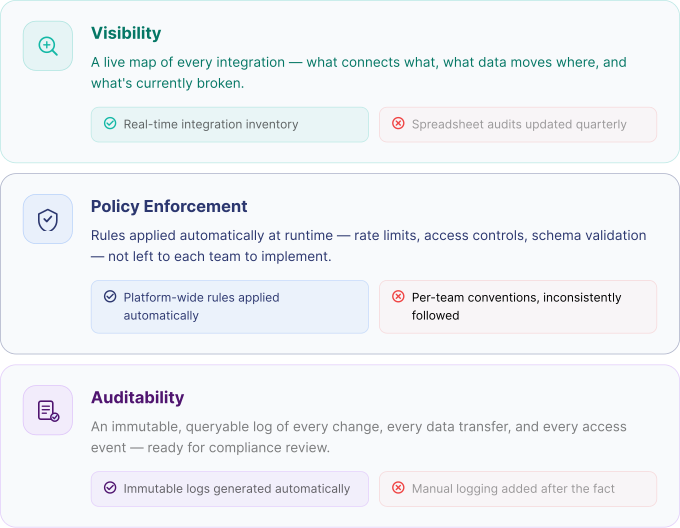
The ZigiOps Approach to Enterprise Integration Governance
ZigiOps, ZigiWave’s no-code enterprise integration platform, is purpose-built for the demands of enterprise integration management in complex IT operations environments. Rather than requiring custom code that is difficult to audit, document, and maintain, ZigiOps provides a guided visual interface where integrations are configured, monitored, and governed through a unified platform.
IT teams can connect tools including ServiceNow, Jira, Dynatrace, PagerDuty, BMC Helix, Splunk, and dozens of other enterprise platforms without writing a single line of code. ZigiOps is a standalone application — not a plugin — and stores no transferred data, meaning your data flows through without creating additional compliance surface area.
Key governance capabilities built into ZigiOps include:
•Bi-directional, real-time data synchronization that keeps records consistent across systems without manual intervention or reconciliation workflows.
•Configurable data mapping and transformation that enforces the data compatibility standards defined by your governance framework, applied consistently at the integration layer.
•Full audit logging of all data flows and configuration changes, supporting compliance requirements and incident investigation without additional tooling.
•Native ITSM integrations that route integration alerts and incidents into the platforms your operations teams already use, keeping visibility consolidated rather than fragmented.
•ISO 27001 certification and no data storage architecture, providing the security posture enterprise governance frameworks require.
•No vendor lock-in, giving your organization the flexibility to adapt your integration architecture as your technology landscape and business requirements evolve.
These capabilities directly address the core requirements of integration governance best practices — providing visibility, enforcing standards, enabling automation, and supporting compliance without adding operational complexity. Explore the full range of ZigiOps integrations to see how your existing tools can be connected within a governed, enterprise-grade framework.
Pitfalls in Enterprise Integration Governance - and How to Avoid Them
Even organizations with strong intentions around enterprise integration governance fall into predictable traps. Recognizing them in advance is considerably cheaper than discovering them through a failed audit or a production incident.
Treating governance as a one-time project rather than an ongoing program. Integration governance is not a deployment milestone — it is a continuous operational discipline. Organizations that launch a governance initiative and then deprioritize it find their integration landscape reverting to ungoverned chaos within 12 to 18 months as new integrations are added without oversight. Governance requires a permanent home in your operating model, not a project plan with an end date.
Focusing exclusively on new integrations while ignoring legacy connections. Legacy integrations often carry the highest risk: undocumented, poorly monitored, and built to standards that have long since been superseded. A comprehensive governance program must include a remediation roadmap for bringing existing integrations into compliance. Governing only new integrations while leaving the legacy estate unaddressed is equivalent to installing a security door on a building with open windows.
Under-investing in tooling. Manual governance processes — spreadsheet-based registries, ad hoc monitoring, manual policy reviews — do not scale beyond a certain integration volume. Organizations that under-invest in platform capabilities find that governance overhead grows faster than the business value delivered by new integrations. At some point, the cost of maintaining manual governance exceeds the cost of the tooling that would automate it.
Siloing governance responsibility within a single team. Effective enterprise integration governance requires participation from IT, security, compliance, architecture, and business stakeholders. When governance is treated as the exclusive responsibility of one team, critical perspectives are missed and adoption across the organization remains limited. Governance is a cross-functional discipline, not a department.
Neglecting data compatibility as a governance concern. Data compatibility issues are among the most common sources of integration failures, yet they are routinely treated as technical problems rather than governance failures. Building data compatibility standards, schema validation requirements, and data contract versioning policies into your governance framework prevents these issues from recurring. Address them at the process level, not just the code level.
Building a Roadmap for Enterprise Integration Governance
For organizations at the beginning of their governance journey, the scope can feel overwhelming. A phased roadmap makes the initiative manageable and delivers incremental value at each stage.
Phase 1: Discovery and Inventory (Months 1-3) Conduct a comprehensive audit of all existing integrations. Document ownership, data flows, security posture, and operational status for every integration in your environment. This produces the initial integration registry and identifies the highest-risk connections requiring immediate remediation. Do not let the perfect be the enemy of the good here — an incomplete registry that improves over time is far more valuable than a comprehensive registry that never gets built.
Phase 2: Policy Development and CoE Formation (Months 3-6) Define integration governance policies covering security, data handling, error management, logging, and change management. Establish the Integration Center of Excellence with defined roles, responsibilities, and operating procedures. Begin applying policies to all new integrations immediately, even before the legacy remediation program is complete.
Phase 3: Tooling and Automation (Months 6-12) Select and deploy an integration platform that natively supports your governance requirements. Implement centralized monitoring, automated compliance checks, and integrated alerting. Begin migrating high-risk legacy integrations to the governed platform, prioritizing connections that involve regulated data or support business-critical processes.
Phase 4: Continuous Improvement (Ongoing) Establish quarterly governance reviews and annual audits. Track KPIs including integration availability, SLA compliance rates, security incident rates, and time-to-deploy for new integrations. Use these metrics to refine your enterprise integration governance framework as your IT environment and business requirements evolve. Governance matures through iteration, not through a single well-crafted policy document.
.svg)
Conclusion: Enterprise Integration Governance as a Competitive Advantage
Enterprise integration governance is not a compliance checkbox — it is a strategic capability that determines how effectively your organization can leverage its technology investments, respond to change, and manage operational risk at scale.
Organizations that govern their integrations well move faster, experience fewer disruptions, and maintain greater confidence in the data that drives their decisions. Those that do not find themselves in a cycle of reactive firefighting, where every system change carries unpredictable downstream consequences and every audit reveals new gaps.
The integration governance best practices outlined in this article — establishing clear ownership, standardizing policies, maintaining an integration registry, embedding security controls, investing in observability, and conducting regular audits — provide a comprehensive framework for building a governance program that scales with your organization. The journey requires sustained commitment. The operational and business returns are substantial, measurable, and compounding.
ZigiOps is designed to accelerate this journey. By providing a no-code, ISO 27001-certified integration platform with built-in governance capabilities, ZigiWave enables IT teams to connect their tools, enforce their policies, and maintain full visibility across their integration landscape — without the overhead of custom code or the risk of ungoverned point-to-point connections.