The Cost of Running Freshservice and Jira Without an Integration
Why & how the lack of proper Freshservice Jira integration stalls IT teams?
Organizations worldwide rely on Freshservice for IT service management and Jira for project tracking and development workflows. However, running these platforms in isolation creates a web of hidden costs that can significantly impact your bottom line and operational efficiency.
While the obvious expenses of software licensing are clear, the true financial impact of operating Freshservice Jira environments without proper integration extends far beyond subscription fees. These hidden costs compound over time, affecting productivity, data accuracy, customer satisfaction, and strategic decision-making capabilities.
For IT managers and CTOs evaluating their current toolchain efficiency, understanding these hidden costs is crucial for making informed decisions about platform integration and resource allocation.
What Are the Hidden Costs?
The hidden costs of running Freshservice Jira without integration manifest in multiple areas of your organization. These costs are often overlooked because they don't appear as line items in your budget, yet they represent significant operational overhead and missed opportunities.
Most organizations focus on the upfront costs of software procurement but fail to account for the ongoing operational expenses. Research indicates that the total cost of ownership for enterprise software typically includes 60-80% in operational and maintenance costs beyond the initial licensing fees.
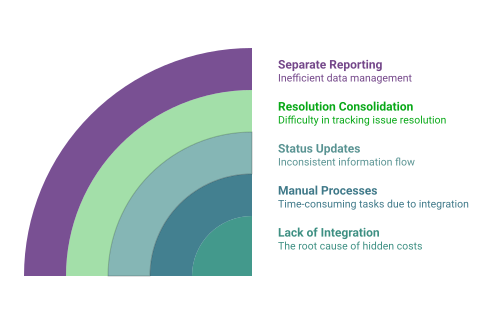
• Manual creation of corresponding Jira issue with copied information
• Ongoing manual status updates between both platforms
• Manual consolidation of resolution information
• Separate reporting and documentation in each system
Operational Inefficiencies
When Freshservice and Jira operate as separate entities, teams must manually coordinate between platforms. This creates bottlenecks in issue resolution, project delivery, and customer service responses. The time spent switching between applications, searching for related information, and manually updating multiple systems adds up to significant productivity losses.
IT service desk agents spend an average of 15-20 minutes per ticket when they need to coordinate with development teams using separate tools. This time multiplies across Юhundreds or thousands of tickets monthly, representing substantial hidden labor costs.
Data Fragmentation and Inconsistency
Operating Freshservice Jira environments independently creates data silos that prevent comprehensive visibility into your IT operations. Information becomes fragmented across platforms, making it difficult to track issues from initial report through resolution.
This fragmentation leads to inconsistent reporting, duplicate efforts, and missed connections between related incidents and development tasks. The cost of poor data quality and incomplete visibility extends beyond immediate operational impact to strategic planning and resource allocation decisions.
Manual Data Entry and Human Error Costs
Without proper Freshservice Jira integration, teams resort to manual data entry to keep information synchronized between platforms. This manual process introduces multiple cost factors that compound over time. The direct labor cost of manual data entry is just the beginning. Human error in transcription leads to mismatched priorities, incorrect status updates, and delayed responses to critical issues. These errors require additional time to identify and correct, further increasing operational costs.
“Data silos slow down processes by requiring manual data reconciliation and hindering collaboration.” - Credencys
Time Investment Per Ticket
Consider the typical workflow when a Freshservice incident requires development team intervention. Without integration, the process involves:
This process can add 30-45 minutes of additional work per ticket requiring cross-team coordination. For organizations processing thousands of tickets monthly, this represents significant hidden labor costs.
Error Correction and Rework
Manual processes inherently introduce errors that require correction. Studies show that manual data entry has an error rate of 1-5%, depending on complexity and operator experience. In integrated IT environments, even small errors can cascade into larger issues affecting multiple systems and teams.
The cost of error correction includes not only the time to identify and fix mistakes but also the potential impact on customer satisfaction and service delivery timelines. Critical issues may be delayed or misrouted due to transcription errors or missed updates between platforms.
Communication Breakdown and Delayed Resolution
One of the most significant hidden costs of running Freshservice Jira without integration stems from communication breakdowns between IT service management and development teams. These breakdowns create delays that impact both internal operations and customer satisfaction.
When teams work in isolated platforms, information sharing becomes dependent on email, messaging platforms, or verbal communication. This creates opportunities for miscommunication, lost context, and delayed responses to critical issues.
Extended Resolution Times
Freshservice Jira integration challenges directly impact mean time to resolution (MTTR) for incidents requiring development team involvement. Without automated synchronization, teams must manually coordinate status updates, priority changes, and resolution information.
Extended resolution times have cascading effects on customer satisfaction, SLA compliance, and team productivity. Each delayed resolution ties up resources longer and potentially impacts multiple subsequent tickets or projects.
Organizations typically see 25-40% longer resolution times for cross-functional issues when teams operate on disconnected platforms. This represents significant opportunity cost and potential SLA penalty exposure.
Priority Misalignment
Without integrated priority management, critical issues may not receive appropriate attention across teams. A high-priority incident in Freshservice may not translate to corresponding urgency in Jira development tasks, leading to delayed responses and customer impact.
Priority misalignment also affects resource allocation decisions. Development teams may work on lower-priority enhancements while critical bug fixes wait in service desk queues, creating inefficient use of technical resources.
Reporting and Analytics Limitations
The hidden costs of inadequate reporting and analytics capabilities represent some of the most significant long-term impacts of running Freshservice Jira without proper integration. Organizations lose visibility into end-to-end processes and struggle to make data-driven improvements.
Fragmented data across platforms makes comprehensive reporting extremely challenging. Teams must manually compile information from multiple sources, often resulting in incomplete or inconsistent insights that can lead to poor strategic decisions.
Incomplete Performance Metrics
Effective IT operations management requires comprehensive metrics that span service delivery and development activities. When Freshservice and Jira operate independently, organizations lose visibility into key performance indicators that cross platform boundaries.
Metrics such as end-to-end incident resolution time, development team responsiveness to service requests, and the relationship between service desk volume and development activity become difficult or impossible to track accurately.
• Cross-team collaboration effectiveness
• Resource utilization across service and development functions
• Customer impact correlation with development activities
• SLA compliance for complex, multi-team issues
.svg)
Strategic Planning Challenges
Limited visibility into integrated operations makes strategic planning and capacity management significantly more challenging. Without comprehensive data, IT leaders must make decisions based on incomplete information, potentially leading to resource misallocation or missed optimization opportunities.
The cost of suboptimal strategic decisions can far exceed the obvious operational inefficiencies. Poor capacity planning, misaligned team priorities, and missed improvement opportunities represent substantial hidden costs over time.
“Data fragmentation… creates manual consolidation, misaligned reports, and disconnect between performance and insight.” - LoadSpring
Customer Satisfaction Impact
The ultimate hidden cost of running Freshservice Jira without integration manifests in customer satisfaction and business reputation impact. While these costs may not be immediately quantifiable, they represent significant long-term business risk and opportunity cost.
Customers experiencing extended resolution times or poor communication due to platform disconnects may reduce their engagement, seek alternative solutions, or provide negative feedback that affects broader business relationships.
SLA Compliance Challenges
Meeting service level agreements becomes significantly more challenging when coordination between service management and development teams requires manual intervention. The additional time and complexity of cross-platform coordination directly impact SLA compliance rates.
SLA violations can result in direct financial penalties, contract renegotiations, or loss of customer trust. Even when formal penalties don't apply, repeated SLA misses damage customer relationships and may impact future business opportunities.
Organizations without proper Freshservice Jira integration typically experience 15-30% higher SLA violation rates for incidents requiring development team involvement compared to those with automated coordination capabilities.
Customer Experience Degradation
Poor coordination between IT service management and development teams creates inconsistent customer experiences. Customers may receive conflicting information, experience unexplained delays, or need to repeat information to different team members.
These experience issues compound over time, affecting customer loyalty and satisfaction. The cost of acquiring new customers typically far exceeds the cost of retaining existing ones, making customer satisfaction maintenance a critical business priority.
Security and Compliance Risks
Operating Freshservice Jira environments without proper integration introduces security and compliance risks that represent significant hidden costs. These risks may not manifest as immediate expenses but can result in substantial financial and operational impact when issues occur.
Disconnected platforms make it difficult to maintain consistent security policies, access controls, and audit trails across integrated business processes. This creates potential vulnerabilities and compliance gaps that may not be discovered until security incidents or compliance audits occur.
Audit Trail Complications
Compliance requirements often mandate comprehensive audit trails for IT operations and change management processes. When Freshservice and Jira operate independently, maintaining complete audit trails becomes challenging and error-prone.
Incomplete or fragmented audit trails can result in compliance violations, failed audits, and regulatory penalties. The cost of compliance failures extends beyond immediate fines to include remediation efforts, additional oversight requirements, and potential business restrictions.
• Incomplete incident response tracking
• Inconsistent access control records
• Difficult compliance reporting
• Elevated audit preparation costs
Access Control Challenges
Managing user access and permissions across disconnected platforms increases security risks and administrative overhead. Users may require access to multiple platforms to complete their responsibilities, creating additional attack surfaces and compliance complexity.
Inconsistent access controls between platforms can lead to privilege escalation risks, unauthorized data access, or compliance violations. The administrative cost of managing multiple access control systems also represents ongoing operational overhead.
The Benefits of Freshservice Jira Integration
Understanding the hidden costs of disconnected operations highlights the value proposition of proper Freshservice Jira integration. Organizations that integrate Freshservice to Jira effectively can eliminate most of these hidden costs while gaining additional operational benefits.
Successful integration creates seamless workflows that automatically synchronize data, maintain consistent priorities, and provide comprehensive visibility across IT service management and development activities.
Automated Workflow Synchronization
Proper Freshservice Jira integration eliminates manual coordination between platforms through automated workflow synchronization. When incidents in Freshservice require development attention, corresponding Jira issues can be created automatically with all relevant context and priority information.
Automated synchronization ensures that status updates, priority changes, and resolution information stay consistent across both platforms without manual intervention. This eliminates the labor costs and error risks associated with manual data entry and coordination.
Teams can focus on actual problem-solving activities rather than administrative coordination tasks, improving both productivity and job satisfaction.
Enhanced Visibility and Reporting
Integrated platforms provide comprehensive visibility into end-to-end IT operations processes. Organizations can track incidents from initial report through development resolution and deployment, gaining insights that would be impossible with disconnected systems.
This enhanced visibility supports better decision-making, improved resource allocation, and more effective strategic planning. The ability to analyze integrated data helps identify optimization opportunities and process improvements that can deliver ongoing value.
Modern integration platforms provide real-time synchronization capabilities that maintain data consistency while preserving the unique strengths of each platform.
Implementation Considerations for Freshservice Jira Integration
Successfully implementing Freshservice Jira integration requires careful planning and consideration of organizational needs, technical requirements, and change management factors. The approach you choose can significantly impact both implementation success and ongoing operational benefits.
Organizations must evaluate their current processes, identify key integration points, and design workflows that leverage the strengths of both platforms while eliminating operational inefficiencies.
Integration Architecture Options
Several architectural approaches exist for connecting Freshservice and Jira platforms. The choice depends on organizational requirements, technical constraints, and long-term strategic goals.
Native integrations provided by platform vendors offer basic connectivity but may lack the flexibility needed for complex organizational workflows. Third-party integration platforms provide more sophisticated capabilities but require additional evaluation and management.
• API-based custom integration development
• Integration platform as a service (iPaaS) solutions
• No-code integration platforms
• Enterprise service bus architectures
No-code integration platforms have emerged as particularly effective solutions for organizations seeking robust integration capabilities without extensive development overhead.
Data Mapping and Workflow Design
Successful integration requires careful mapping of data fields, workflow states, and business processes between platforms. Organizations must identify which information should synchronize automatically and which elements require manual oversight or approval. Workflow design should account for existing organizational processes while leveraging integration capabilities to eliminate inefficiencies. This may require some process re-engineering to fully realize integration benefits.
Key considerations include priority mapping, status synchronization, user assignment coordination, and escalation procedures. The goal is to create seamless workflows that feel natural to users while maintaining appropriate controls and visibility.
Change Management and User Adoption
Technical implementation represents only part of successful Freshservice Jira integration. Organizations must also manage the human factors associated with process changes and new workflow capabilities. User training, documentation updates, and ongoing support are essential for realizing integration benefits. Teams need to understand how integrated workflows differ from previous manual processes and how to leverage new capabilities effectively.
Change management planning should address potential resistance, communication strategies, and success metrics for measuring adoption and benefits realization.
Calculating Your Integration ROI
To justify investment in Freshservice Jira integration, organizations need to quantify both the hidden costs of current operations and the expected benefits of integration. This ROI calculation should include both direct cost savings and indirect benefits such as improved customer satisfaction and strategic capabilities.
The business case for integration becomes compelling when organizations accurately account for all hidden costs and project realistic benefit realization timelines.
Cost Assessment Framework
Begin by documenting current operational costs related to manual coordination between platforms. This includes labor time for data entry, error correction, extended resolution times, and additional communication overhead. Track metrics such as average time per ticket requiring cross-platform coordination, error rates in manual data transfer, and SLA compliance rates for integrated processes. These baseline measurements provide concrete data for ROI calculations.
• Error correction and rework expenses
• Extended resolution time impact
• SLA violation penalties or customer impact
• Reporting and analytics preparation overhead
• Compliance and audit preparation costs
Benefit Quantification
Integration benefits include direct cost savings from eliminated manual processes and indirect benefits from improved efficiency and capabilities. Organizations typically see benefits in multiple areas simultaneously, creating compound value from integration investment. Productivity improvements from automated workflows can be substantial. Teams spend less time on administrative coordination and more time on value-adding activities such as problem resolution and service improvement.
Enhanced visibility and reporting capabilities support better decision-making and strategic planning. While these benefits may be harder to quantify directly, they often represent significant long-term value creation opportunities.
ZigiOps: Streamlining Your Freshservice Jira Integration
ZigiOps provides a no-code solution for organizations seeking to integrate Freshservice to Jira without extensive development overhead or ongoing maintenance complexity. The platform addresses the hidden costs identified throughout this analysis by automating workflows and maintaining real-time synchronization between platforms.
With ZigiOps, organizations can implement sophisticated integration capabilities that eliminate manual coordination while preserving the unique strengths of both Freshservice and Jira platforms. The no-code approach enables rapid deployment and easy customization without requiring specialized integration expertise.
ZigiOps Key Integration Capabilities
ZigiOps delivers a comprehensive set of integration capabilities purpose-built for connecting Freshservice and Jira - covering every scenario IT and development teams actually encounter in production environments.
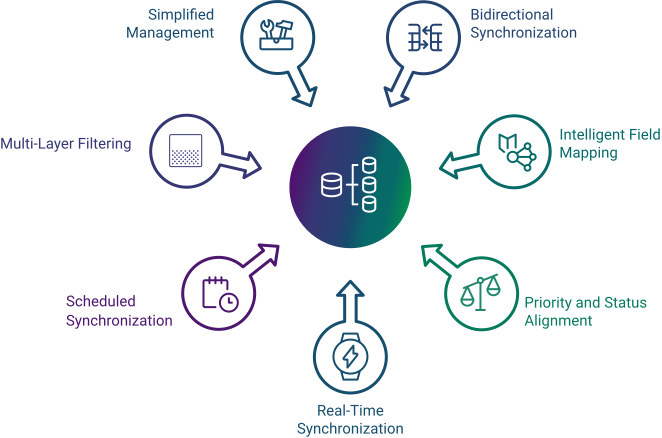
Bidirectional Ticket and Issue Synchronization
At its core, the integration keeps Freshservice incidents and Jira issues in sync across both directions, without manual intervention. When a service ticket is created in Freshservice, ZigiOps can automatically create a corresponding issue in Jira - and vice versa. Updates, comments, attachments, and status changes travel between platforms in real time, so neither team is ever working from stale data.
This bidirectional flow also includes a Respond Field Map mechanism: once an action completes in the target system, ZigiOps writes confirmation data back to the source. For example, after a Jira issue is created from a Freshservice ticket, the original ticket can be automatically updated with the Jira issue URL and ID - giving service agents instant visibility into development progress without leaving their own tool.
Intelligent Field Mapping - Including Conditional Logic
Field mapping in ZigiOps goes well beyond simple one-to-one field matching. The platform supports:
- Direct value mapping - straightforward field-to-field transfers (e.g., ticket summary to issue summary, description to description).
- Expression-based mapping - combine multiple fields, apply transformations, or inject hardcoded values where needed (e.g.,
summary = {ticket_number}: {short_description}). - Conditional mapping - apply different mapping logic depending on field values or workflow states. This is essential for aligning lifecycle stages across platforms, such as mapping Freshservice ticket statuses to the correct Jira issue states without triggering invalid transitions.
All of this is configured through ZigiOps' guided UI - no scripting, no custom code, and no reliance on your development team to maintain it.
Priority and Status Alignment
Freshservice and Jira use different taxonomies for priority levels and workflow statuses. ZigiOps handles the translation layer between them using conditional field mapping rules. You define how each status or priority value in one system corresponds to the appropriate value in the other - accounting for edge cases, project-specific rules, and organizational workflows.
This prevents the classic integration failure where a "High" priority incident in Freshservice maps incorrectly to a low-urgency Jira issue, or a status transition stalls because a required field wasn't populated on the target side.
Real-Time and Scheduled Synchronization
ZigiOps supports two trigger mechanisms that cover all integration patterns:
- Web Listener triggers - for systems that support webhooks, ZigiOps receives data the moment an event occurs, enabling near-instantaneous synchronization. Ideal for critical incidents where response time matters.
- Poller triggers -for scenarios where push notifications aren't available or aren't preferable, ZigiOps polls the source system on a configurable schedule (default: every 1 minute for tickets and events). This ensures no data is missed, regardless of the technical constraints of either platform.
Both mechanisms are backed by ZigiOps' built-in filtering engine, which lets you define precisely which records should be synchronized - by status, project, priority, assignee, or any other field - so your integration only processes what's actually relevant.
Multi-Layer Filtering Without Custom Queries
One of ZigiOps' standout technical capabilities is its filtering engine. Unlike platforms that pass your filter criteria directly to the external API -- and therefore inherit that API's limitations - ZigiOps applies its own filtering layer on top. This means you can use operators like contains, startsWith, or is one of even when the underlying system's API doesn't natively support them.
Filters also work at the related-entity level. In a single configured action, you can collect updated Freshservice incidents while simultaneously pulling in any new comments, attachments, or linked changes associated with those incidents. That's the kind of precision that eliminates redundant workflows and keeps data pipelines lean.
Pre-Built Templates as a Starting Point
ZigiOps ships with pre-built integration templates for Freshservice-Jira workflows. These templates include pre-configured collection logic and baseline field mappings for common scenarios, giving your team a working integration out of the box. From there, every element - triggers, filters, field maps, conditional logic, and response maps -- can be customized through the UI to match your exact processes.
No external consultants. No development sprints. Just a guided configuration experience that most teams complete in a single session.
Enterprise-Grade Security Throughout
Because ZigiOps is a standalone application (not a plugin running inside either platform), it operates as an independent, secure middleware layer. It does not store any of the data it transfers - records pass through in real time and are never written to ZigiOps' own storage. Combined with ISO 27001 certification and support for proxy configurations during system setup, ZigiOps meets the security and compliance requirements of regulated industries and enterprise procurement processes.
Implementation and Ongoing Management
The no-code approach significantly reduces implementation time and complexity compared to traditional integration development. Organizations can configure and deploy integrations in days or weeks rather than months, accelerating time to value realization. Ongoing management is simplified through visual configuration interfaces and automated monitoring capabilities. IT teams can maintain and modify integrations without specialized development skills, reducing long-term operational overhead.
Comprehensive implementation guides and best practices support organizations throughout their integration journey, from initial planning through optimization and ongoing management.
Best Practices for Sustainable Integration
Successful Freshservice Jira integration extends beyond initial implementation to ongoing optimization and management. Organizations that realize maximum value from integration invest in sustainable practices that evolve with changing business needs and platform capabilities. Long-term success requires attention to governance, monitoring, and continuous improvement processes that ensure integration continues delivering value over time.
1. Integration Governance
Establish clear governance processes for managing integration configurations, approving workflow changes, and monitoring integration performance. This includes defining roles and responsibilities for integration management and establishing change control procedures. Regular reviews of integration performance and business value help identify optimization opportunities and ensure alignment with evolving organizational needs. Integration governance should be integrated with broader IT governance processes and strategic planning activities.
Documentation of integration configurations, workflows, and business logic supports ongoing management and knowledge transfer. This documentation should be maintained as integrations evolve and business requirements change.
2. Performance Monitoring and Optimization
Implement monitoring capabilities that track integration performance, data quality, and business impact metrics. This enables proactive identification of issues and opportunities for optimization.Performance reviews should assess both technical metrics such as synchronization speed and error rates, and business metrics such as resolution time improvements and user satisfaction.
Continuous optimization based on performance data and user feedback ensures that integration continues delivering maximum value as organizational needs evolve and platforms update their capabilities.
3. Future-Proofing Your Integration Investment
Technology platforms continue evolving, and integration strategies must adapt to changing capabilities and business requirements. Organizations should consider long-term strategic factors when implementing Freshservice Jira integration to ensure sustainable value realization. Scalable integration platforms that can accommodate growth and changing requirements provide better long-term value than point solutions that may become obsolete or inadequate over time.
4. Platform Evolution Considerations
Both Freshservice and Jira continue adding new features and capabilities that may impact integration requirements. Organizations should choose integration approaches that can adapt to platform evolution without requiring complete reimplementation. API stability and backward compatibility are important considerations for long-term integration sustainability. Platforms with well-documented API roadmaps and migration support provide more predictable integration evolution paths.
Modern integration platforms that abstract underlying API complexity can help insulate organizations from platform changes while enabling access to new capabilities as they become available.
5. Expanding Integration Scope
Successful Freshservice Jira integration often creates opportunities for additional platform connections and workflow automation. Organizations should consider how initial integration investments can support broader digital transformation initiatives. Integration platforms that support multiple platforms and use cases provide better scalability for organizations planning to expand their integration capabilities over time. This approach can reduce overall integration complexity and management overhead.
Strategic integration planning should consider future platform additions, workflow automation opportunities, and evolving business requirements that may benefit from expanded integration capabilities.
Conclusion
Running Freshservice and Jira without proper integration carries costs that go well beyond obvious inefficiencies — manual coordination, data fragmentation, communication breakdowns, and missed strategic opportunities all compound over time, eroding productivity, customer satisfaction, and decision-making effectiveness. Proper integration eliminates these hidden costs while delivering enhanced visibility, stronger reporting, and better strategic planning. For most organizations, the ROI justifies the investment within the first year.
When evaluating IT operations efficiency, the business case becomes compelling once both obvious and hidden costs are honestly measured against integration requirements. No-code platforms like ZigiOps make this easier by removing development overhead and reducing maintenance complexity — accelerating time to value without sacrificing flexibility. The real question for IT leaders isn't whether integration pays off. It's how quickly they can act on it.