Connecting Microsoft Intune to IT Operations with ZigiOps
No-code Microsoft Intune integration for IT operations
Endpoint management has quietly become one of the most influential data sources in modern IT operations.
Every device enrollment, compliance failure, application deployment, or policy change carries operational meaning. Yet in many organizations, this information lives exclusively inside Microsoft Intune, disconnected from the systems where incidents are handled, assets are tracked, and operational decisions are made.
Microsoft Intune defines itself as a cloud-based endpoint management solution that simplifies device and application management across platforms. What it does not attempt to do is orchestrate how this data should be consumed by IT service management, asset systems, or operational workflows.
Industry Perspective: Microsoft Intune as an Authoritative Endpoint Data Source
Microsoft positions Microsoft Intune as a centralized cloud platform for managing devices, applications, and access across the organization. This framing reflects how endpoint platforms have evolved: from configuration tools into authoritative sources of operational data.
As endpoints become more distributed and dynamic, Intune increasingly serves as the system of record for device state, compliance posture, and application readiness. The operational value of that data, however, depends on its ability to move beyond the endpoint platform itself and inform service, asset, and operational workflows. - Microsoft Learn – What is Microsoft Intune
This is precisely the gap ZigiOps addresses.
Why Intune Data Becomes Operationally Valuable Only When Integrated
On its own, Intune provides excellent visibility. IT teams can see which devices are enrolled, which applications are installed, and which policies are enforced. The problem begins when this visibility needs to turn into action.
An endpoint that fails a compliance check is not just a security signal. It is an operational event. A failed application deployment is not just a configuration issue. It is a service-impacting condition. A newly enrolled device is not just inventory. It is an asset lifecycle change.
Without integration, these signals require manual interpretation and manual follow-up. Engineers export reports, switch tools, and reconstruct context across systems. This slows response and introduces inconsistency.
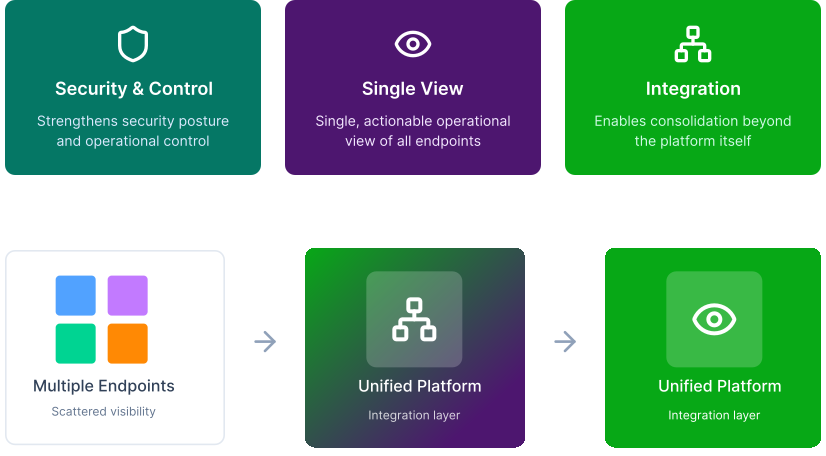
Industry guidance reflects this reality. Fortinet notes that unified endpoint management strengthens security and control precisely because it consolidates endpoint visibility into a single, actionable operational view. Integration is what enables that consolidation beyond the endpoint platform itself.
How ZigiOps Approaches Microsoft Intune Integration Differently?
Most Intune integrations in the market are built around one of two assumptions:
either everything must live inside a single platform, or every integration requires custom API work.
ZigiOps deliberately rejects both.
Instead of embedding Intune data into a specific ecosystem or forcing teams to manage Microsoft Graph complexity, ZigiOps acts as a neutral integration layer. It retrieves Intune data directly from Microsoft Graph, interprets it in an operational context, and delivers it to downstream systems without persisting or owning the data.
The defining characteristic here is not the API connection itself. It is the absence of code.
Integration behavior in ZigiOps is defined through configuration: what data is retrieved, how it is filtered, and how it is represented in target systems. This allows IT teams to adjust integrations as operational requirements evolve, without rewriting logic or redeploying scripts.
From Microsoft Graph to Operational Systems Without Exposing Complexity
Technically, all Intune data accessed by ZigiOps comes through Microsoft Graph. Authentication follows Microsoft’s recommended OAuth 2.0 client credentials model, using Azure AD application identities rather than user accounts.
What matters operationally is what happens next.
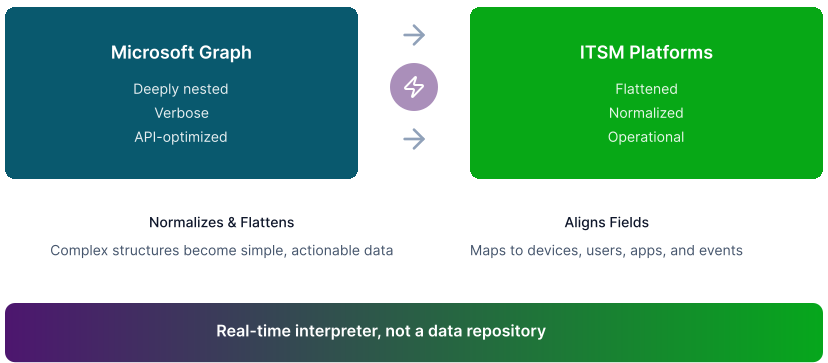
Microsoft Graph responses are deeply nested, verbose, and optimized for API consumers, not for ITSM or asset platforms. ZigiOps normalizes this data as it is processed, flattening complex structures and aligning fields with operational entities such as devices, users, applications, and events.
This transformation happens in transit. No device records, user data, or compliance states are stored inside ZigiOps. The platform functions as a real-time interpreter rather than a data repository.
Using Intune Devices as Living Configuration Items
Devices are the most common starting point for Intune integrations, and also the most misunderstood.
In many environments, asset databases represent devices as static records. In reality, endpoint state is fluid. Operating system versions change, ownership models shift, compliance status fluctuates, and users rotate.
ZigiOps treats Intune-managed devices as dynamic configuration items. Device attributes such as enrollment time, last sync, compliance evaluation results, and security posture are continuously synchronized, ensuring that asset records reflect the current operational reality rather than historical snapshots.
This has a direct impact on incident handling. When a ticket references a device, engineers see its actual compliance state and health indicators at the time of the issue, not outdated inventory data.
.svg)
Industry Perspective: Continuous Asset Visibility as an Operational Requirement
Guidance from NIST reinforces a broader operational principle: accurate, continuously updated system and asset information is essential for both security and day-to-day IT decision-making.
Static inventories and manually maintained records are no longer sufficient in environments where endpoint state changes constantly. Device configuration, compliance status, and ownership must be treated as living data, updated automatically and consumed by operational systems in real time.
This perspective aligns closely with the shift toward dynamic configuration items and real-time enrichment of incidents and workflows using endpoint data. - NIST Special Publication 800-53, Revision 5
Application and Policy Context as First-Class Operational Data
Applications in Intune are more than packages. They represent dependencies.
A failed application installation can affect productivity just as much as a network outage. A misapplied policy can cascade across hundreds of endpoints.
Through ZigiOps, application deployments and assignments are treated as operational data, not configuration noise. Application versions, deployment states, and user-device associations can be reflected in service and asset systems, allowing teams to correlate incidents with real deployment conditions.
This is where integration stops being informational and becomes diagnostic.
Turning Endpoint Events into Actionable Operational Signals
Perhaps the most significant shift occurs when Intune events are no longer reviewed manually.
Compliance failures, enrollment events, policy changes, and installation errors are not just logs. They are triggers.
With ZigiOps, these signals can be translated directly into operational workflows. An endpoint failing a security baseline can immediately surface as an issue enriched with device ownership, operating system details, and last known health state. No manual investigation is required to establish context.
ConnectWise highlights that tool sprawl and disconnected management workflows reduce operational maturity. The practical antidote is not fewer tools, but better orchestration between them.
Why No-Code Matters in Long-Term Integration Sustainability?
The technical challenge of integrating Intune is not writing the first integration. It is maintaining it.
APIs evolve. Operational requirements change. Security policies tighten. Script-based integrations age poorly under these conditions.
A no-code approach changes the ownership model. Instead of integrations being artifacts that must be rewritten, they become configurations that can be adapted. This is particularly important for endpoint data, which is continuously evolving as devices, platforms, and policies change.
ZigiOps’ role is not to abstract Microsoft Graph forever, but to allow IT teams to work at the operational level where they already think.
Closing the Gap Between Endpoint Management and IT Operations
Microsoft Intune excels at managing endpoints. ITSM, ITOM, and asset platforms excel at managing operations. The friction appears at the boundary between them.
ZigiOps exists at that boundary.
By connecting Intune to operational systems without code, without data storage, and without platform lock-in, it allows endpoint data to participate fully in IT operations rather than remaining isolated.
That is the difference between seeing endpoint data and actually using it.