Context Mapping in API Integrations: Connection Meets Accuracy
Master API integration context mapping
Successfully connecting two systems through APIs is just the beginning. The real challenge lies in ensuring that data flows accurately between systems with different contexts, structures, and business logic. This is where API integration context mapping becomes the critical missing layer that separates basic connectivity from true operational excellence.
Most IT teams focus heavily on establishing API connections but overlook the nuanced context mapping required to maintain data integrity across diverse enterprise systems. The result? Integration projects that appear successful on the surface but fail to deliver accurate, actionable data when it matters most.
Context mapping goes beyond simple field-to-field translations. It encompasses understanding how data behaves within each system's unique environment, business rules, and operational context. Without proper API integration context mapping, organizations face a cascade of data inconsistencies that can undermine entire digital transformation initiatives.
The Context Challenge in API Integration Failures
Enterprise systems don't exist in isolation. Each platform—whether it's ServiceNow, Jira, Salesforce, or a custom application—operates within its own contextual framework. These frameworks include specific data validation rules, workflow states, user permissions, and business logic that govern how information is processed and interpreted.
The disconnect occurs when organizations treat API integrations as simple data pipes. Raw data transfer without context preservation leads to what industry experts call "semantic drift"—where information loses its meaning as it moves between systems. Consider a ticket status that reads "In Progress" in one system but requires "Work in Progress" in another. Without proper API integration context mapping, automated processes break down, reporting becomes unreliable, and user adoption suffers.
"Organizations that fail to implement proper context mapping in their integration strategy experience 40% higher rates of data quality issues compared to those with comprehensive mapping frameworks."
— Gartner Integration Platform Research
The complexity multiplies in enterprise environments where multiple systems need to maintain synchronized states. A change in one system must propagate accurately to all connected platforms while preserving the contextual meaning within each system's operational framework. This requires sophisticated understanding of how each platform interprets and validates data.
Traditional integration approaches often underestimate this complexity, leading to implementations that work during testing but fail under real-world conditions. The missing element is comprehensive context mapping that accounts for the semantic, structural, and operational differences between integrated systems.
.svg)
The Hidden Costs of Inadequate Context Mapping
When API integration context mapping is insufficient, the consequences extend far beyond technical glitches. Organizations experience cascading failures that impact operational efficiency, decision-making accuracy, and user confidence in integrated systems.
Data corruption represents the most immediate impact. Without proper context preservation, information loses fidelity as it moves between systems. Priority levels, status indicators, and categorical data become misaligned, creating inconsistencies that compound over time. These inconsistencies force manual intervention, defeating the automation benefits that drove the integration initiative.
Process breakdowns follow closely behind data corruption. Automated workflows depend on predictable data structures and values. When context mapping fails to account for system-specific requirements, workflows stall, approvals route incorrectly, and escalation procedures trigger inappropriately. The result is operational chaos that requires constant manual correction.
Perhaps most damaging is the erosion of user trust. When integrated systems produce unreliable results, users begin bypassing automated processes in favor of manual workarounds. This behavior undermines the strategic value of integration investments and creates shadow IT practices that increase security and compliance risks.
Components of Effective API Integration Context Mapping
Successful API integration context mapping requires a systematic approach that addresses multiple dimensions of data interpretation and transformation. The foundation lies in understanding that context encompasses more than just data format differences—it includes business logic, validation rules, and operational workflows that give data meaning within each system.
The first component involves semantic mapping, which ensures that data elements maintain their intended meaning across systems. This goes beyond simple field mapping in API integrations to include understanding how each system interprets specific values. For example, mapping priority levels requires understanding not just the technical field names but how each system's users and processes interpret "High," "Critical," or "Urgent" priorities.
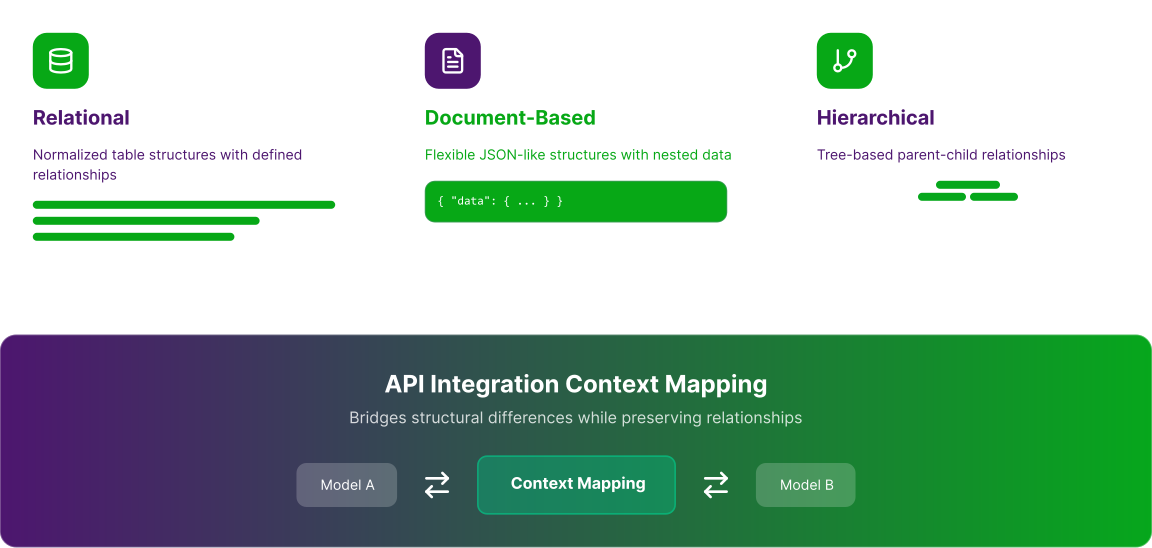
Structural mapping addresses differences in data organization and relationships between systems. Some platforms use hierarchical structures while others employ flat taxonomies. Effective context mapping translates these structural differences while preserving the logical relationships that give data its operational meaning.
Temporal mapping handles time-sensitive data and ensures that timestamps, due dates, and sequential information maintain accuracy across different time zones, calendar systems, and workflow timelines. This component is particularly critical in global enterprises where systems operate across multiple geographic regions.
Semantic Context Preservation
Semantic context preservation represents the most sophisticated aspect of API integration context mapping. It requires deep understanding of how each integrated system defines, validates, and processes specific data elements. This understanding must extend beyond technical documentation to include operational practices and user expectations.
Consider user role mappings between systems. A "Manager" role in one system might encompass permissions and responsibilities that map to multiple roles in another system. Effective semantic context preservation ensures that user access rights, approval authorities, and notification preferences translate accurately without creating security vulnerabilities or operational gaps.
Status and state mappings present similar challenges. Different systems may use various status models—some linear, others with complex branching possibilities. Conditional mapping approaches become essential for handling these complexities while maintaining data integrity.
Category and classification mappings require understanding not just the terminology differences between systems but the business logic that determines how items are classified. This includes understanding validation rules, inheritance properties, and impact on downstream processes.
Structural Context Alignment
Structural context alignment addresses the fundamental differences in how systems organize and relate data elements. Enterprise systems often employ different data models—some favor normalized relational structures while others use document-based or hierarchical approaches. Effective API integration context mapping bridges these structural differences without losing relational integrity.
Parent-child relationships require particular attention during structural mapping. A ticket hierarchy in one system might need to map to project-task relationships in another. The context mapping must preserve not just the relationships themselves but the business rules that govern how these relationships function within each system.
Data normalization differences present ongoing challenges. Some systems store concatenated values while others maintain separate fields. Address information, user names, and product codes often require structural transformation that maintains searchability and reporting capabilities across integrated systems.
Custom field mappings add another layer of complexity. Enterprise systems typically include extensive customization to meet specific business requirements. Effective context mapping must account for these customizations while ensuring that custom data elements maintain their functionality and meaning across integrated platforms.
Techniques for Handling Enterprise API Integration Failures
Enterprise environments present unique challenges that require sophisticated approaches to API integration context mapping. The scale, complexity, and criticality of enterprise systems demand techniques that go beyond basic mapping to ensure reliability, scalability, and maintainability of integrated solutions.
Dynamic context mapping represents one of the most powerful approaches for handling complex enterprise scenarios. Instead of static field mappings, dynamic approaches use rules engines and logic frameworks that adapt to changing data conditions. This technique proves particularly valuable when dealing with systems that have evolved different business rules or when integration requirements change over time.
Multi-stage validation ensures that context mapping accuracy is maintained throughout the integration process. This approach implements validation checkpoints at multiple levels—before transformation, during mapping, and after delivery. Each stage verifies different aspects of context preservation, creating multiple opportunities to catch and correct mapping errors before they impact operational systems.
Bidirectional context mapping addresses the reality that most enterprise integrations require data to flow in both directions. This technique ensures that context is preserved regardless of the data flow direction and that changes in either system propagate accurately to connected platforms without losing semantic meaning.
"The most successful enterprise integration projects implement context mapping strategies that account for bidirectional data flow and evolving business requirements. Static mapping approaches fail 60% more often in complex enterprise environments."
— Forrester Application Integration Report
Context Mapping for High-Volume Environments
High-volume enterprise environments require API integration context mapping approaches that maintain accuracy while supporting significant data throughput. Traditional mapping techniques often become bottlenecks when dealing with thousands of transactions per minute, requiring optimization strategies that balance context preservation with performance requirements.
Caching strategies for context mapping can significantly improve performance by storing frequently used mapping rules and transformation logic in high-speed memory. However, cache invalidation becomes critical to ensure that mapping changes propagate quickly throughout the integration infrastructure.
Parallel processing techniques allow context mapping operations to occur simultaneously across multiple data streams. This approach requires careful coordination to maintain data consistency while achieving the performance levels required for enterprise-scale operations.
Asynchronous mapping workflows help manage peak loads by queuing context mapping operations and processing them during lower-utilization periods. This technique requires sophisticated error handling and retry mechanisms to ensure that all data eventually receives proper context mapping treatment.
Error Recovery and Context Mapping Resilience
Enterprise API integration context mapping must include robust error recovery mechanisms that handle failures gracefully while preserving data integrity. The complexity of context mapping operations creates multiple failure points that require sophisticated recovery strategies.
Rollback mechanisms ensure that partial mapping failures don't leave systems in inconsistent states. When context mapping errors occur, rollback procedures must understand the dependencies between mapped elements and restore all affected systems to their previous consistent state.
Fallback mapping strategies provide alternative context mapping approaches when primary methods fail. These strategies might use simplified mapping rules or route data to manual review queues, ensuring that critical business processes continue even when sophisticated mapping logic encounters unexpected conditions.
Audit trails for context mapping operations provide visibility into mapping decisions and enable forensic analysis when integration issues arise. Comprehensive logging must capture not just the mapping results but the contextual factors that influenced mapping decisions, enabling administrators to understand and correct integration problems.
Field Mapping in API Integrations: Implementation Strategies
Technical implementation of field mapping in API integrations requires careful consideration of data types, validation rules, and transformation logic. The implementation must balance flexibility with performance while maintaining the context preservation that ensures data accuracy across integrated systems.
Schema evolution handling represents a critical technical challenge in field mapping implementations. Enterprise systems frequently undergo updates that change data structures, add new fields, or modify validation rules. Effective field mapping in API integrations must accommodate these changes without requiring complete reimplementation of integration logic.
Transformation rule engines provide the technical foundation for sophisticated field mapping implementations. These engines must support complex logic that can handle conditional transformations, data validation, and error handling while maintaining performance standards required for enterprise-scale operations.
Data type conversion strategies ensure that field mappings handle differences in how systems represent similar information. Date formats, numeric precision, text encoding, and boolean representations often vary between systems, requiring robust conversion logic that preserves accuracy while preventing data loss.
Advanced field mapping techniques include pattern matching, regular expression transformations, and lookup table integrations that enable sophisticated data manipulation while maintaining mapping transparency and maintainability.
Configuration Management for Context Mapping
Configuration management becomes crucial when implementing API integration context mapping at enterprise scale. The complexity of mapping rules, transformation logic, and validation criteria requires systematic approaches to configuration storage, versioning, and deployment.
Version control for mapping configurations ensures that changes are tracked, tested, and deployed consistently across multiple environments. Integration teams need the ability to roll back mapping changes, compare configuration versions, and manage parallel development of mapping enhancements.
Environment-specific mapping configurations accommodate differences between development, testing, and production environments. Field names, validation rules, and available data elements often vary between environments, requiring flexible configuration approaches that maintain consistency while supporting environment-specific requirements.
Configuration validation mechanisms prevent invalid mapping rules from being deployed to production systems. Automated validation should verify that mapping configurations are syntactically correct, reference valid system fields, and maintain logical consistency across all mapped relationships.
Monitoring and Optimization of Context Mapping Performance
Continuous monitoring of API integration context mapping performance provides insights into optimization opportunities and helps identify potential issues before they impact business operations. Monitoring strategies must address both technical performance metrics and business accuracy indicators.
Performance metrics should include mapping throughput, transformation latency, and resource utilization patterns. These metrics help identify bottlenecks in the context mapping process and guide optimization efforts toward the most impactful improvements.
Accuracy monitoring focuses on the business impact of context mapping decisions. This includes tracking mapping error rates, data quality scores, and user-reported discrepancies that indicate context mapping problems. Regular accuracy assessments help ensure that technical performance optimizations don't compromise mapping quality.
Proactive alerting systems notify administrators when context mapping performance degrades or error rates increase. These systems must balance sensitivity with specificity, providing early warning of problems without generating excessive false alarms that reduce administrator responsiveness.
"Organizations that implement comprehensive monitoring for their API integration context mapping report 45% fewer production issues and 30% faster problem resolution times compared to those with basic monitoring approaches."
— TechTarget API Integration Research
Building Resilient Context Mapping Strategies
Resilient API integration context mapping strategies anticipate and prepare for the inevitable changes, failures, and evolving requirements that characterize enterprise IT environments. Building resilience requires combining technical robustness with operational flexibility and strategic alignment with business objectives.
Change management integration ensures that context mapping strategies adapt to business evolution without compromising data integrity or operational continuity. This includes establishing processes for evaluating mapping changes, testing modifications in safe environments, and rolling out updates with minimal business disruption.
Disaster recovery planning for context mapping includes backup strategies for mapping configurations, procedures for rebuilding mapping logic after system failures, and contingency plans for maintaining business operations when primary mapping systems are unavailable.
Scalability planning addresses the reality that successful integration initiatives often expand beyond their original scope. Context mapping strategies must accommodate additional systems, increased data volumes, and more complex business requirements without requiring fundamental architectural changes.
The most resilient strategies also include regular assessment and optimization cycles that ensure context mapping continues to meet business needs as systems and requirements evolve. This includes performance tuning, accuracy validation, and strategic alignment reviews that keep integration investments aligned with business value.
Future-Proofing API Integration Context Mapping
Future-proofing API integration context mapping requires anticipating technology trends and business evolution while building solutions that remain valuable over extended periods. This strategic approach helps organizations maximize their integration investments while maintaining operational flexibility.
Cloud migration considerations ensure that context mapping strategies work effectively across hybrid and multi-cloud environments. This includes understanding how context mapping performance and functionality change when systems move between on-premises and cloud platforms, and ensuring that mapping configurations remain portable across different hosting environments.
API evolution management addresses the reality that APIs themselves change over time. Effective context mapping must accommodate API versioning, deprecation schedules, and feature additions without requiring complete reimplementation of integration logic.
Machine learning integration represents an emerging opportunity for enhancing context mapping accuracy and reducing maintenance overhead. ML approaches can identify mapping patterns, suggest optimization opportunities, and automatically adapt to minor system changes while flagging significant modifications that require human review.
"The next generation of API integration platforms will leverage machine learning to automate up to 70% of context mapping decisions while maintaining higher accuracy rates than manual configuration approaches."
— Gartner API Strategy Research
Measuring Success in Enterprise API Integration Failures Prevention
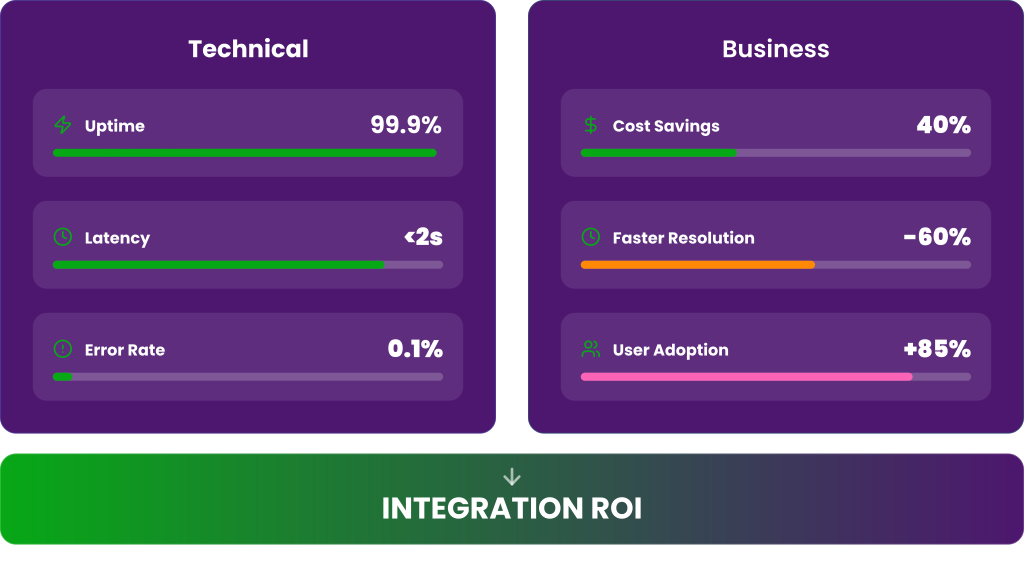
Measuring the success of API integration context mapping initiatives requires comprehensive metrics that address both technical performance and business value. Effective measurement strategies help organizations understand the return on their integration investments while identifying opportunities for continued improvement.
Technical success metrics include data accuracy rates, integration reliability scores, and performance benchmarks that demonstrate the technical effectiveness of context mapping implementations. These metrics should be tracked over time to identify trends and validate optimization efforts.
Business impact measurements focus on how improved context mapping translates into operational benefits. This includes reduced manual intervention requirements, faster process completion times, and improved decision-making accuracy resulting from higher-quality integrated data.
User satisfaction indicators provide insights into how well context mapping supports end-user productivity and system adoption. Regular surveys, usage analytics, and support ticket analysis help identify areas where context mapping improvements would deliver significant user experience benefits.
Cost-benefit analysis quantifies the financial impact of context mapping investments by comparing implementation and maintenance costs against operational savings and productivity improvements. This analysis helps justify continued investment in context mapping capabilities and guides resource allocation decisions.
Continuous Improvement Framework for Context Mapping
Implementing a continuous improvement framework ensures that API integration context mapping capabilities evolve with changing business needs and technological advances. This framework should include regular assessment cycles, optimization planning, and strategic alignment reviews.
Regular assessment cycles evaluate current context mapping performance against established benchmarks and identify areas for improvement. These assessments should include both automated analysis of technical metrics and qualitative evaluation of business impact and user satisfaction.
Optimization planning translates assessment findings into actionable improvement initiatives. This planning process should prioritize improvements based on business value, implementation complexity, and resource availability while maintaining focus on strategic objectives.
Strategic alignment reviews ensure that context mapping investments continue supporting broader business objectives as organizational priorities evolve. These reviews should assess whether current mapping strategies remain aligned with digital transformation goals and identify opportunities for expanding integration value.
Knowledge management and documentation practices ensure that context mapping expertise is preserved and shared across the organization. This includes maintaining comprehensive documentation of mapping decisions, capturing lessons learned from implementation experiences, and developing training materials that support broader team capability development.
Conclusion
API integration context mapping represents the sophisticated layer of intelligence that transforms basic system connectivity into reliable, accurate data integration. Organizations that invest in comprehensive context mapping strategies position themselves to realize the full value of their integration initiatives while avoiding the pitfalls that lead to enterprise API integration failures.
The technical complexity of context mapping should not be underestimated, but neither should its strategic importance. As enterprises continue expanding their integration footprints and depending more heavily on automated processes, the accuracy and reliability enabled by effective context mapping become competitive advantages that directly impact operational efficiency and decision-making quality.
Success in API integration context mapping requires combining technical sophistication with strategic planning, operational discipline, and continuous improvement commitment. Organizations that approach context mapping as a strategic capability rather than a technical afterthought will find themselves better positioned to leverage their integration investments for sustainable business value.
The investment in comprehensive context mapping pays dividends through reduced operational overhead, improved data quality, and enhanced user confidence in integrated systems. As integration requirements continue evolving and expanding, organizations with robust context mapping capabilities will adapt more quickly and maintain competitive advantages in their digital transformation journeys.
Modern integration platforms that prioritize context mapping capabilities provide the foundation for building these strategic advantages while reducing the complexity and risk associated with enterprise-scale API integration initiatives.