The Real Cost of a ServiceNow Integration in 2026: IntegrationHub vs iPaaS vs ZigiOps

When IT leaders evaluate ServiceNow integration cost, the initial license or subscription price is rarely the number that matters most. Hidden implementation fees, ongoing maintenance overhead, developer salaries, and per-flow execution charges quietly inflate what seemed like a straightforward budget line into a multi-year financial commitment. In 2026, with enterprise IT stacks growing more complex and integration demands accelerating, getting the TCO calculation right before you commit is not optional — it is mission-critical.
This article breaks down the ServiceNow integration TCO across three leading approaches — ServiceNow IntegrationHub, third-party iPaaS platforms, and ZigiOps — using realistic cost assumptions, published vendor data, and analyst benchmarks. Whether you are a CTO signing off on a platform decision or a system administrator defending a budget recommendation, this guide gives you the numbers and the context to make a defensible choice.
A note on the figures below: all cost breakdowns in this article are ZigiWave's own estimates, modeled for a mid-sized enterprise running 5–10 ITSM integrations over three years. They are intended as a directional planning benchmark, not a quote. Pricing for ServiceNow IntegrationHub and third-party iPaaS platforms varies by vendor, contract, license tier, and negotiated terms, so ZigiWave cannot guarantee these as specific or fixed figures. The ZigiOps estimate reflects our own pricing structure and is the only figure we can speak to with direct authority; even so, your actual quote will depend on your specific scope.
Why ServiceNow Integration Cost Is Harder to Calculate Than It Looks
Most vendor pricing pages show you the entry point, not the destination. ServiceNow integration cost is a compounding equation: you pay for access, then you pay for usage, then you pay for the humans who build and maintain the connections, and finally you pay — often dearly — every time something breaks or needs to scale. According to Gartner's integration platform research, organizations routinely underestimate the total cost of integration projects by 30–50% because they focus exclusively on licensing rather than full lifecycle costs.
The three cost dimensions that matter most are:
- Direct costs: Licensing, subscription tiers, per-flow or per-execution fees, connector marketplace purchases
- Indirect costs: Developer and admin time, training, professional services engagements, and vendor support contracts
- Opportunity costs: Delayed go-live timelines, integration failures causing downtime, and the cost of rebuilding when platforms change pricing models
Understanding all three dimensions is what separates a superficial quote comparison from a genuine ServiceNow integration TCO analysis.
A standard rule of thumb used by analysts like McKinsey and Boston Consulting Group (BCG) is the "Implementation-to-License Ratio."
- The Reality: For every $1 spent on software licensing fees, enterprises typically spend $2 to $3 on integration, data migration, and customization.
- In highly complex environments, this hidden ratio can easily escalate to 5x the baseline license cost.
Option 1: ServiceNow IntegrationHub — Costs, Capabilities, and Limitations
What IntegrationHub Is and How It's Priced
IntegrationHub is ServiceNow's native integration layer, embedded directly into the Now Platform. It uses a spoke-based architecture where each spoke connects ServiceNow to a specific third-party application. Access to IntegrationHub requires either a Professional or Enterprise ServiceNow license tier, and advanced spoke bundles — including premium spokes for platforms like Azure DevOps, Jira, or Zendesk — are sold as add-ons or require higher-tier entitlements.
The pricing model is built around execution capacity: organizations are allocated a fixed number of IntegrationHub operations per day based on their license. Exceeding those limits triggers overage charges. As of 2025–2026, ServiceNow's standard allocation is approximately 50,000 operations per day for mid-tier customers, with enterprise add-on packs available in increments that can cost $15,000–$40,000 per year depending on volume.
Year-by-Year IntegrationHub Cost Breakdown
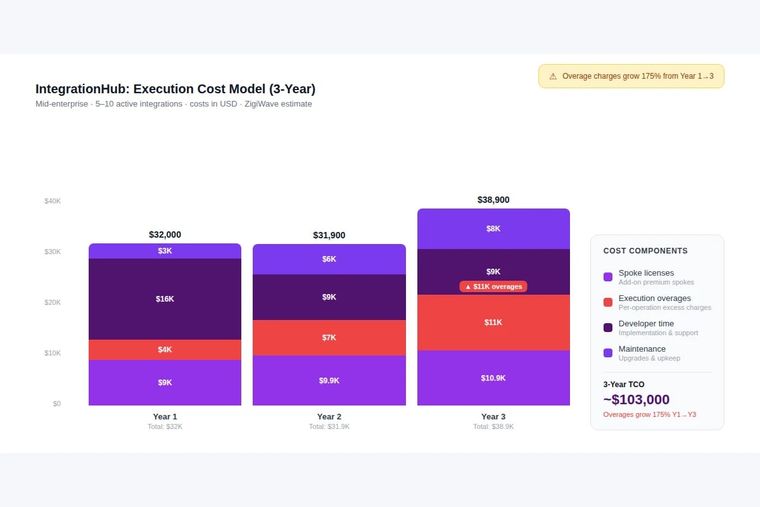
For a mid-sized enterprise running 5–10 active integrations (incident management, change management, CMDB sync, and DevOps pipelines), here is a realistic IntegrationHub cost model:
| Cost Category | Year 1 | Year 2 | Year 3 |
|---|---|---|---|
| Premium spoke licenses / add-ons | $9,000 | $9,900 | $10,900 |
| Execution capacity overages | $4,000 | $7,000 | $11,000 |
| Developer/admin implementation time | $16,000 | $9,000 | $9,000 |
| Ongoing maintenance and upgrades | $3,000 | $6,000 | $8,000 |
| Annual Total | $32,000 | $31,900 | $38,900 |
| 3-Year TCO | ~$103,000 (above $100,000) |
Note: The figures above are ZigiWave's own estimates, modeled on typical mid-enterprise licensing and staffing patterns. ServiceNow's actual IntegrationHub pricing depends on your contract, license tier, and negotiated terms, so treat this as a planning benchmark rather than a quoted price. ZigiWave cannot guarantee specific or fixed pricing for platforms other than ZigiOps; for a confirmed figure, check directly with ServiceNow or your account representative.
Key Limitations of IntegrationHub
- Vendor lock-in: All logic lives inside ServiceNow. If you renegotiate your ServiceNow contract or migrate workloads, integrations must be rebuilt from scratch.
- Scaling costs are non-linear: As operation volumes grow, execution capacity overage charges escalate faster than most budget models anticipate.
- Spoke gaps: Not every tool your organization uses has a pre-built spoke. Custom spokes require scripted REST steps, adding significant developer time.
- Upgrade fragility: ServiceNow's twice-yearly release cycle can break existing flow logic, creating unplanned maintenance cycles.
For organizations managing complex integrations such as a ServiceNow to Azure DevOps integration or two-way ticket synchronization, IntegrationHub's operational limits and spoke dependency model create recurring cost pressure that compounds year over year.
Option 2: IntegrationHub vs iPaaS — What Changes When You Go Third-Party
How iPaaS Platforms Price ServiceNow Integrations
The IntegrationHub vs iPaaS comparison is not simply a build-vs-buy question — it is a question of where complexity lives and who pays for it. Leading iPaaS platforms such as MuleSoft, Boomi, Workato, and Microsoft Azure Integration Services offer ServiceNow connectors, but their pricing models vary significantly. Most charge based on a combination of connector count, monthly active users, data volume, or task/recipe execution counts.
MuleSoft Anypoint Platform, for example, typically starts at $50,000–$150,000 per year for enterprise tiers before implementation costs are applied. Workato's enterprise pricing for ITSM-focused deployments commonly reaches $30,000–$80,000 annually depending on recipe count. Both require certified specialists to design, deploy, and maintain integration flows — and those specialists command salaries of $90,000–$140,000 per year in the current market.
The Hidden Costs in the IntegrationHub vs iPaaS Debate
When IT managers frame the IntegrationHub vs iPaaS decision purely around platform licensing, they miss the staffing dimension entirely. According to Forrester's Enterprise iPaaS Wave Report, the average enterprise spends 60–70% of its total integration budget on human resources — not software licenses. This fundamentally changes the TCO calculus.
According to SAP, you need to choose an enterprise iPaaS if you want to reduce integration complexity and operational costs.
SAP, Enterprise iPaaS vs traditional integration: Which is right for you?
For the IntegrationHub vs iPaaS comparison at the same mid-enterprise scale (5–10 integrations), here is what iPaaS typically costs:
| Cost Category | Year 1 | Year 2 | Year 3 |
|---|---|---|---|
| iPaaS platform license (mid-tier) | $10,600 | $11,700 | $12,850 |
| Certified integration specialist (partial FTE) | $12,550 | $13,150 | $13,700 |
| Professional services / implementation | $7,700 | $2,300 | $2,300 |
| Training and certification | $1,550 | $800 | $800 |
| Annual Total | $32,400 | $27,950 | $29,650 |
| 3-Year TCO | ~$90,000 (average) |
Note: These iPaaS figures are ZigiWave's own estimates, averaged across typical mid-tier deployments, and vary widely by vendor, contract terms, and integration volume. ZigiWave cannot guarantee specific or fixed pricing for iPaaS platforms; confirm current pricing directly with the vendor you are evaluating.
Where iPaaS Wins — and Where It Doesn't
iPaaS platforms genuinely excel at breadth of connectivity and governance at scale. For organizations managing 50+ integrations across a heterogeneous stack, enterprise iPaaS provides centralized monitoring, error handling, and compliance logging that point-to-point solutions cannot match. However, the IntegrationHub vs iPaaS trade-off becomes unfavorable for IT operations teams when the required integrations are ITSM-centric — incident routing, change advisory board automation, CMDB synchronization — because these platforms were not purpose-built for ITSM workflows and require significant customization to behave correctly in those contexts.
Common use cases like a ServiceNow to Zendesk integration or a Jira to ServiceNow integration require two-way field mapping, conditional routing logic, and attachment synchronization — features that generic iPaaS recipes handle inconsistently without deep customization.
Option 3: ZigiOps — ServiceNow Integration Cost Built for ITSM Teams
What ZigiOps Is and How It Differs
ZigiOps is a no-code data integration platform purpose-built for IT Operations. Unlike generic iPaaS platforms or ServiceNow's native integration layer, ZigiOps was designed specifically to connect ITSM, monitoring, DevOps, and customer support tools — including ServiceNow — without requiring scripting, middleware configuration, or certified integration specialists. Every pre-built integration template is engineered for the exact data models and workflow patterns that ITSM teams actually use.
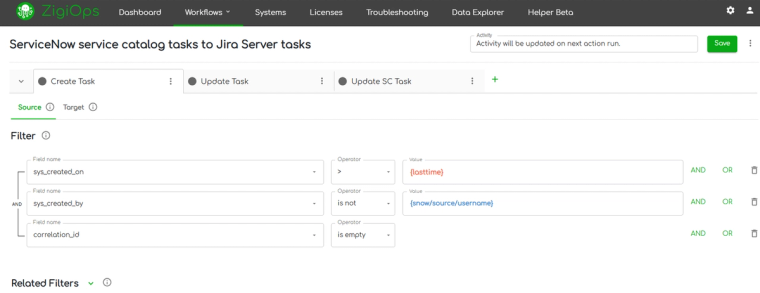
The ServiceNow integration cost with ZigiOps is structured around predictable annual licensing rather than per-execution or per-flow consumption models. This means your costs do not spike when incident volumes surge, when a monitoring tool floods ServiceNow with alerts, or when you add users to your ITSM instance. You can explore the full range of available ServiceNow integrations offered by ZigiOps to understand the breadth of pre-built connectivity available out of the box.
ZigiOps 3-Year TCO Breakdown
| Cost Category | Year 1 | Year 2 | Year 3 |
|---|---|---|---|
| ZigiOps platform license | $10,700 | $10,700 | $10,700 |
| Implementation (no-code, IT admin led) | $3,550 | $900 | $900 |
| Ongoing maintenance (minimal — no code to maintain) | $900 | $900 | $900 |
| Execution overages | $0 | $0 | $0 |
| Annual Total | $15,150 | $12,500 | $12,500 |
| 3-Year TCO | ~$40,000 |
Note: This is ZigiOps's own pricing estimate, based on typical licensing for a mid-sized deployment; your actual quote will depend on the number of systems and workflows you connect. Unlike the estimates for competing platforms, this figure reflects ZigiWave's own pricing structure directly.
Why the ZigiOps Cost Model Is Structurally Different
The cost efficiency of ZigiOps is not just about a lower license price — it stems from three structural differences in how the platform is designed and delivered:
- No-code configuration: Integrations are configured by IT administrators using a visual interface, eliminating the need for dedicated developers or certified integration consultants. This removes the largest cost category in every competing model.
- Pre-built ITSM templates: ZigiOps ships with ready-to-deploy integration templates for the most common ITSM, DevOps, and monitoring tool combinations. A ServiceNow and Azure DevOps integration, for example, can be operational in hours rather than weeks.
- No consumption-based pricing: Whether your ServiceNow instance processes 1,000 or 1,000,000 events per month, your platform cost remains constant. This is a critical differentiator as ITSM event volumes scale with organizational growth.
Head-to-Head: ServiceNow Integration TCO Comparison at 3 Years
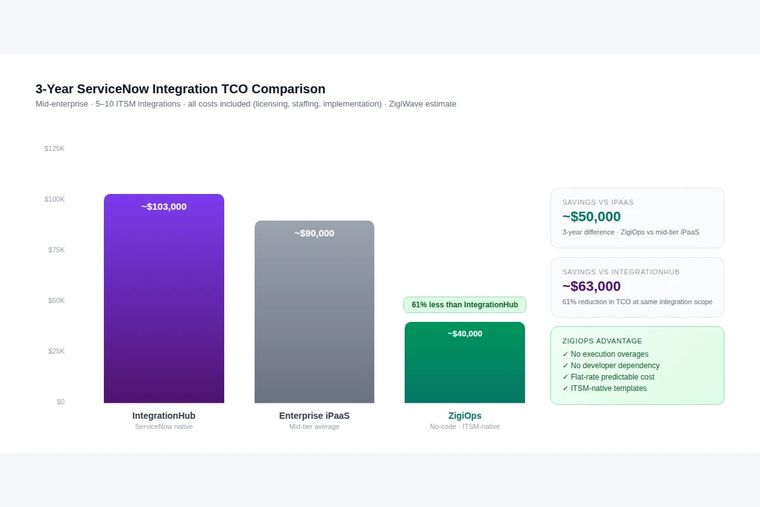
Bringing all three models together into a single ServiceNow integration TCO comparison reveals the true magnitude of the cost differences — particularly when viewed over the full three-year lifecycle:
| Platform | 3-Year TCO | Dev Skills Required | Execution-Based Pricing | ITSM-Native | Vendor Lock-in Risk |
|---|---|---|---|---|---|
| IntegrationHub | above ~$100,000 | Medium-High | Yes | Partial | High |
| iPaaS (mid-tier) | ~$90,000 (average) | High | Yes | No | Medium |
| ZigiOps | ~$40,000 | None | No | Yes | Low |
Note: All figures in this table are ZigiWave estimates intended for directional budget planning. IntegrationHub and iPaaS pricing depends heavily on your specific contract, license tier, and vendor negotiation, so ZigiWave cannot guarantee these as fixed or specific numbers for those platforms. The ZigiOps figure reflects our own typical pricing more directly.
The ServiceNow integration TCO gap between ZigiOps and the alternatives is not marginal. At roughly $50,000 in estimated savings over three years versus a comparable mid-tier iPaaS deployment, the difference funds headcount, infrastructure, or strategic initiatives. Compared to IntegrationHub — ServiceNow's own native integration layer — ZigiOps represents an estimated 61% reduction in total cost of ownership at the same integration scope. Interestingly, in this cost model the native IntegrationHub option, once developer time and execution overages are counted, comes out more expensive than a mid-tier iPaaS deployment, underscoring how much staffing and overage costs (not just license price) drive the total.
Factors That Will Affect Your Specific ServiceNow Integration Cost in 2026
1. Number and Complexity of Integrations
A single two-way integration between ServiceNow and one other tool costs a fraction of what a multi-tool ecosystem synchronization demands. If your ITSM environment connects ServiceNow to monitoring platforms (Datadog, Dynatrace), DevOps tools (Jira, Azure DevOps), customer service platforms (Zendesk, Salesforce Service Cloud), and IT asset management systems simultaneously, your complexity multiplier increases proportionally. The full ZigiOps integration catalog covers this breadth without incrementally increasing cost per connector.
2. Data Volume and Event Frequency
High-volume environments — particularly those where monitoring tools generate thousands of alerts that must be evaluated, deduplicated, and selectively promoted to ServiceNow incidents — expose the fundamental weakness of consumption-based pricing. Every IntegrationHub operation and most iPaaS task executions count against your allocation regardless of whether the event ultimately creates a ticket. ZigiOps's flat-rate model means monitoring-heavy environments are not financially penalized for the noise inherent in modern observability stacks.
3. Internal Skill Availability
The single largest variable in ServiceNow integration cost planning is whether your team has in-house integration expertise. ServiceNow training documentation confirms that reaching proficiency for advanced tools requires significant experience, contributing to high talent turnover costs.
4. Rate of Change in Your IT Stack
If your organization regularly adopts new tools, consolidates vendors, or migrates workloads between clouds, your integration layer will need to evolve continuously. Every time a connected system changes its API, updates its data model, or deprecates an endpoint, coded integrations require developer intervention. ZigiOps updates its pre-built connectors centrally, so customers are not responsible for chasing API changes in tools like Jira integrated with ServiceNow when Atlassian releases updates.
5. Compliance and Audit Requirements
Regulated industries — financial services, healthcare, government — face additional ServiceNow integration cost pressure from compliance requirements. Integration logs, data residency constraints, and audit trails add overhead to every platform. Platforms that provide built-in logging and monitoring without additional licensing (as ZigiOps does) avoid the additional cost of compliance tooling that enterprise iPaaS platforms typically charge separately.
Independent research from organizations like the Ponemon Institute shows that non-compliance costs are often over 2.7 times higher than maintaining proper logging and data lineage infrastructure, as noted in ISACA and IIA guidelines.
Common Mistakes That Inflate ServiceNow Integration Cost
Even well-resourced IT teams make predictable errors in integration cost modeling. Awareness of these patterns helps you build a more accurate budget from the start:
- Ignoring the cost of the first failed implementation: Many organizations underestimate initial complexity, launch an under-resourced implementation, fail, and then restart. The sunk cost of the first attempt is real and rarely appears in competitor case studies.
- Treating developer time as free: Internal development time has a real cost — salary, benefits, opportunity cost from other projects deferred. When integration logic requires ongoing developer attention, that cost accrues whether or not it appears in your IT budget.
- Assuming execution volume stays flat: Integration event volumes grow with the business. A volume model that fits Year 1 may be dangerously underfunded by Year 3. Build growth assumptions into your ServiceNow integration TCO from day one.
- Underpricing professional services: Integration vendors often provide low estimates for professional services during the sales cycle. Independent benchmarks suggest most enterprise ServiceNow integrations require 40–80% more professional services hours than initially scoped.
- Forgetting the cost of downtime: Integration failures cause service disruptions. When a broken integration prevents incidents from routing correctly in ServiceNow, SLA breaches have direct financial consequences — penalties, churned customers, regulatory findings.
How to Choose the Right ServiceNow Integration Approach for Your Organization
Choose IntegrationHub If:
- You are a ServiceNow-only shop with no plans to integrate more than 3–5 tools
- You have in-house ServiceNow certified developers who are already funded and available
- Your integration volumes are stable and predictably within the operation limits of your license tier
- All connected systems have available premium spokes in the ServiceNow Store
Choose Enterprise iPaaS If:
- You have 50+ integrations across a heterogeneous enterprise technology landscape extending well beyond ITSM
- You have a dedicated integration platform team with certified architects
- Centralized governance, API management, and enterprise service bus capabilities are strategic requirements
- You need broad, cross-department connectivity beyond ITSM and are comparing platforms in the tens of thousands of dollars per year, with the additional capability justifying the cost
Choose ZigiOps If:
- Your primary use cases are ITSM, DevOps, monitoring, and customer support tool integration with ServiceNow as the hub
- Your team does not have dedicated integration developers and needs IT administrators to own integration management
- Your ServiceNow integration cost budget is under pressure and you need maximum capability per dollar
- You need to go live quickly — in days or weeks rather than months — with reliable, pre-tested integration logic
- You want predictable costs that do not scale with event volume or number of users
For organizations that fit the ZigiOps profile, the ServiceNow integration solutions available through ZigiOps cover the most common ITSM connectivity requirements with a deployment model that matches how IT operations teams actually work.
ServiceNow Integration Cost: Final Verdict and 3-Year TCO Summary
The headline numbers tell a compelling story. Over a realistic three-year horizon for a mid-enterprise organization running 5–10 ITSM integrations:
- IntegrationHub total cost: above ~$100,000 — defensible if you are already deeply invested in ServiceNow development resources and your integration scope is narrow, though developer time and execution overages tend to push the real number higher than the license price suggests
- iPaaS total cost: ~$90,000 on average — justifiable at enterprise scale with broad connectivity requirements, though pricing varies significantly by vendor, contract, and integration volume
- ZigiOps total cost: ~$40,000 — the lowest ServiceNow integration TCO of the three approaches, with no trade-off in capability for ITSM-focused integration scenarios
Note: These figures are ZigiWave's own estimates for a mid-sized enterprise running 5–10 ITSM integrations over three years. IntegrationHub and iPaaS pricing depends on your specific vendor, contract terms, and license tier, and ZigiWave cannot guarantee specific or fixed pricing for those platforms. The ZigiOps estimate reflects our own typical pricing more directly, though your final quote will still depend on your exact scope.
The right choice depends on your specific stack, team capabilities, and integration complexity. But for the majority of IT operations teams evaluating ServiceNow integration cost in 2026, the combination of predictable licensing, no-code configuration, and purpose-built ITSM templates makes ZigiOps the most financially defensible option across a three-year planning horizon.
If you are ready to see exactly what your ServiceNow integration cost would look like with ZigiOps — including pre-built connectors for the tools your team already uses — explore the full ServiceNow integration capabilities on the ZigiWave platform and request a personalized demo with the ZigiOps team.
For the category-level tradeoffs behind these TCO numbers, see our iPaaS overview.